Question: could you help me? describes gender differences in access to services and activities in prison. Please name and define at least two of them. could
describes gender differences in access to services and activities in prison. Please name and define at least two of them. could this help?
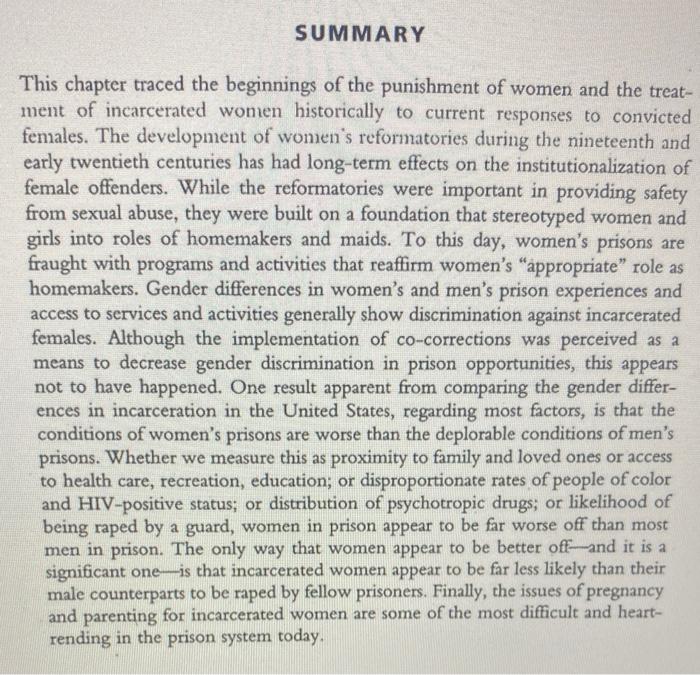
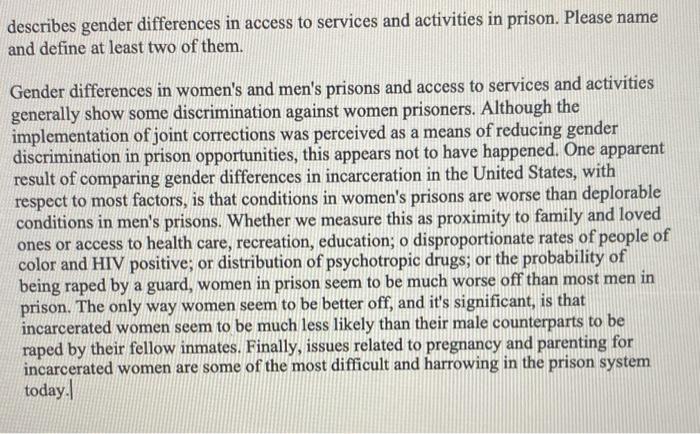
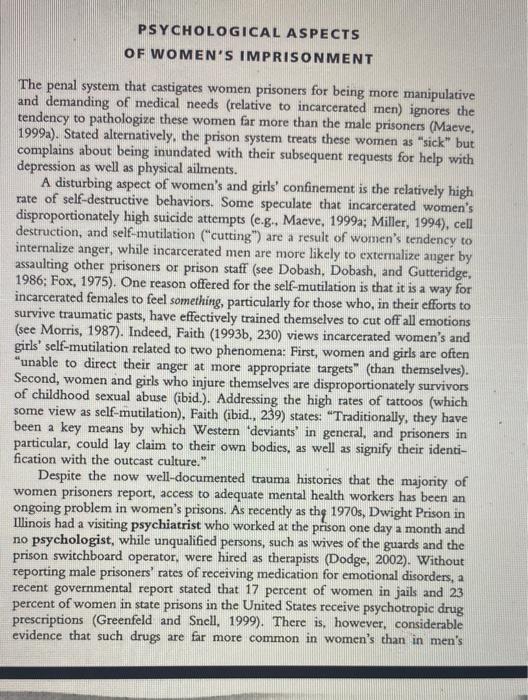
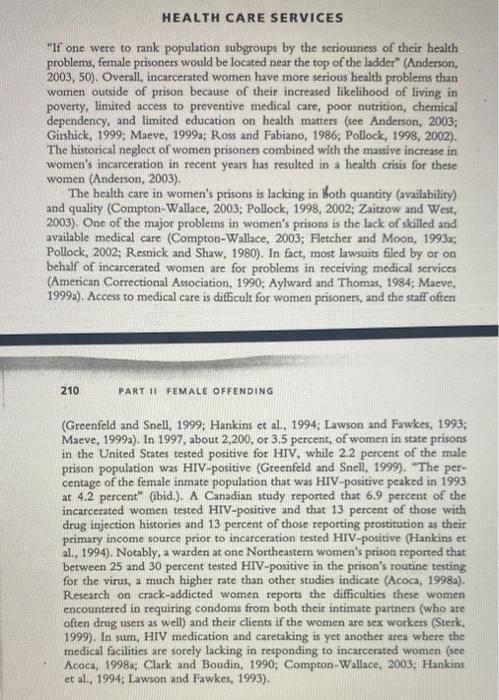
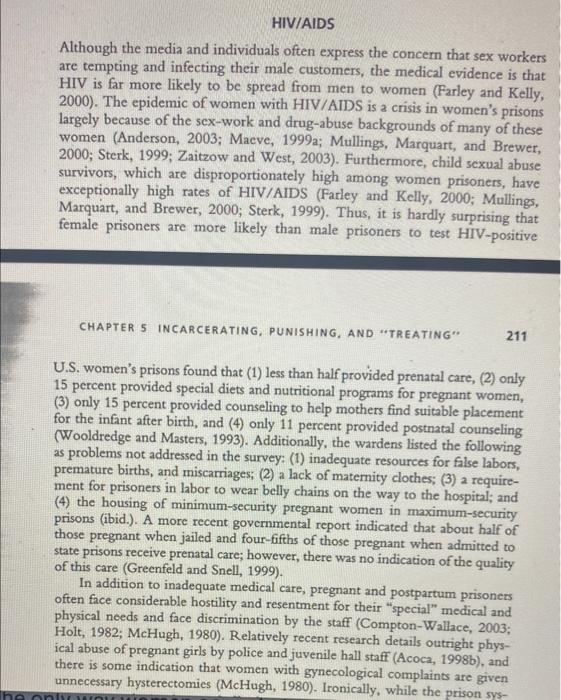
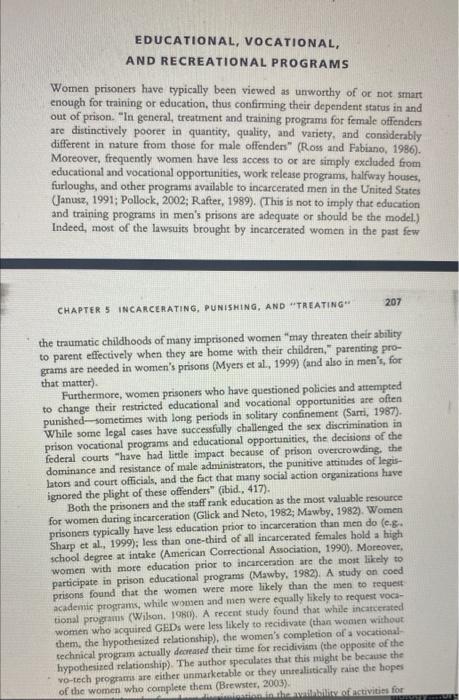
describes gender differences in access to services and activities in prison. Please name and define at least two of them. Gender differences in women's and men's prisons and access to services and activities generally show some discrimination against women prisoners. Although the implementation of joint corrections was perceived as a means of reducing gender discrimination in prison opportunities, this appears not to have happened. One apparent result of comparing gender differences in incarceration in the United States, with respect to most factors, is that conditions in women's prisons are worse than deplorable conditions in men's prisons. Whether we measure this as proximity to family and loved ones or access to health care, recreation, education; o disproportionate rates of people of color and HIV positive; or distribution of psychotropic drugs; or the probability of being raped by a guard, women in prison seem to be much worse off than most men in prison. The only way women seem to be better off, and it's significant, is that incarcerated women seem to be much less likely than their male counterparts to be raped by their fellow inmates. Finally, issues related to pregnancy and parenting for incarcerated women are some of the most difficult and harrowing in the prison system today.| This chapter traced the beginnings of the punishment of women and the treatment of incarcerated women historically to current responses to convicted females. The development of women's reformatories during the nineteenth and early twentieth centuries has had long-term effects on the institutionalization of female offenders. While the reformatories were important in providing safety from sexual abuse, they were built on a foundation that stereotyped women and girls into roles of homemakers and maids. To this day, women's prisons are fraught with programs and activities that reaffirm women's "appropriate" role as homemakers. Gender differences in women's and men's prison experiences and access to services and activities generally show discrimination against incarcerated females. Although the implementation of co-corrections was perceived as a means to decrease gender discrimination in prison opportunities, this appears not to have happened. One result apparent from comparing the gender differences in incarceration in the United States, regarding most factors, is that the conditions of women's prisons are worse than the deplorable conditions of men's prisons. Whether we measure this as proximity to family and loved ones or access to health care, recreation, education; or disproportionate rates of people of color and HIV-positive status; or distribution of psychotropic drugs; or likelihood of being raped by a guard, women in prison appear to be far worse off than most men in prison. The only way that women appear to be better off-and it is a significant one-is that incarcerated women appear to be far less likely than their male counterparts to be raped by fellow prisoners. Finally, the issues of pregnancy and parenting for incarcerated women are some of the most difficult and heartrending in the prison system today. The penal system that castigates women prisoners for being more manipulative and demanding of medical needs (relative to incarcerated men) ignores the tendency to pathologize these women far more than the male prisoners (Maeve, 1999a). Stated alternatively, the prison system treats these women as "sick" but complains about being inundated with their subsequent requests for help with depression as well as physical ailments. A disturbing aspect of women's and girls' confinement is the relatively high rate of self-destructive behaviors. Some speculate that incarcerated women's disproportionately high suicide attempts (e.g., Maeve, 1999a; Miller, 1994), cell destruction, and self-mutilation ("cutting") are a result of women's tendency to internalize anger, while incarcerated men are more likely to extermalize anger by assaulting other prisoners or prison staff (see Dobash, Dobash, and Gutteridge, 1986; Fox, 1975). One reason offered for the self-mutilation is that it is a way for incarcerated females to feel something, particularly for those who, in their efforts to survive traumatic pasts, have effectively trained themselves to cut off all emotions (see Morris, 1987). Indeed, Faith (1993b,230) views incarcerated women's and girls' self-mutilation related to two phenomena: First, women and girls are often "unable to direct their anger at more appropriate targets" (than themselves). Second, women and girls who injure themselves are disproportionately survivors of childhood sexual abuse (ibid.). Addressing the high rates of tattoos (which some view as self-mutilation), Faith (ibid., 239) states: "Traditionally, they have been a key means by which Western 'deviants' in general, and prisoners in particular, could lay claim to their own bodies, as well as signify their identification with the outcast culture." Despite the now well-documented trauma histories that the majority of women prisoners report, access to adequate mental health workers has been an ongoing problem in women's prisons. As recently as the 1970s, Dwight Prison in Illinois had a visiting psychiatrist who worked at the prison one day a month and no psychologist, while unqualified persons, such as wives of the guards and the prison switchboard operator, were hired as therapists (Dodge, 2002). Without reporting male prisoners' rates of receiving medication for emotional disorders, a recent governmental report stated that 17 percent of women in jails and 23 percent of women in state prisons in the United States receive psychotropic drug prescriptions (Greenfeld and Snell, 1999). There is, however, considerable evidence that such drugs are far more common in women's than in men's HEALTH CARE SERVICES "If one were to rank population subgroups by the seriousness of their health problems, female prisoners would be located near the top of the ladder" (Anderson, 2003,50 ). Overall, incarcerated women have more serious health problems than women outside of prison because of their increased likelihood of living in poverty, limited access to preventive medical care, poor nutrition, chemical dependency, and limited education on health matters (see Anderson, 2003; Girshick, 1999; Maeve, 1999a; Ross and Fabiano, 1986; Pollock, 1998, 2002). The historical neglect of women prisoners combined with the massive increase in women's incarceration in recent years has resulted in a health crisis for these women (Anderson, 2003). The health care in women's prisons is lacking in Both quantity (availability) and quality (Compton-Wallace, 2003; Pollock, 1998, 2002; Zaitzow and West, 2003). One of the major problems in women's prisons is the lack of skilled and available medical care (Compton-Wallace, 2003; Fletcher and Moon, 1993a; Pollock, 2002; Resnick and Shaw, 1980). In fact, most lawsuits filed by or on behalf of incarcerated women are for problems in receiving medical services (American Correctional Association, 1990; Aylward and Thomas, 1984: Maeve, 1999a). Access to medical care is difficult for women prisoners, and the staff often 210 PART 11 FEMALE OFFENDING (Greenfeld and Snell, 1999; Hankins et al., 1994; Lawson and Fawkes, 1993; Maeve, 1999a). In 1997, about 2,200, or 3.5 percent, of women in state prisons in the United States tested positive for HIV, while 2.2 percent of the male prison population was HIV-positive (Greenfeld and Snell, 1999). "The percentage of the female inmate population that was HIV-positive peaked in 1993 at 4.2 percent" (ibid.). A Canadian study reported that 6.9 percent of the incarcerated women tested HIV-positive and that 13 percent of those with drag injection histories and 13 percent of those reporting prostitution as their primary income source prior to incarceration tested HIV-positive (Hankins et al., 1994). Notably, a warden at one Northeastern women's prison reported that between 25 and 30 percent tested HIV-positive in the prison's routine testing for the virus, a much higher rate than other studies indicate (Acoca, 1998a). Research on crack-addicted women reports the difficulties these women encountered in requiring condoms from both their intimate partners (who are often drug users as well) and their clients if the women are sex workers (Sterk, 1999). In sum, HIV medication and caretaking is yet another area where the medical facilities are sorely lacking in responding to incarcerated women (see Acoca, 1998a; Clatk and Boudin, 1990; Compton-Wallace, 2003; Hankins et al., 1994: Lawson and Fawkes, 1993). HIV/AIDS Although the media and individuals often express the concern that sex workers are tempting and infecting their male customers, the medical evidence is that HIV is far more likely to be spread from men to women (Farley and Kelly, 2000). The epidemic of women with HIV/AIDS is a crisis in women's prisons largely because of the sex-work and drug-abuse backgrounds of many of these women (Anderson, 2003; Macve, 1999a; Mullings, Marquart, and Brewer, 2000; Sterk, 1999; Zaitzow and West, 2003). Furthermore, child sexual abuse survivors, which are disproportionately high among women prisoners, have exceptionally high rates of HIV/AIDS (Farley and Kelly, 2000; Mullings, Marquart, and Brewer, 2000; Sterk, 1999). Thus, it is hardly surprising that female prisoners are more likely than male prisoners to test HIV-positive CHAPTER 5 INCARCERATING, PUNISHING, AND "TREATING" 211 U.S. women's prisons found that (1) less than half provided prenatal care, (2) only 15 percent provided special diets and nutritional programs for pregnant women, (3) only 15 percent provided counseling to help mothers find suitable placement for the infant after birth, and (4) only 11 percent provided postnatal counseling (Wooldredge and Masters, 1993). Additionally, the wardens listed the following as problems not addressed in the survey: (1) inadequate resources for fllse labors, premature births, and miscarriages; (2) a lack of maternity clothes; (3) 2 requirement for prisoners in labor to wear belly chains on the way to the hospital; and (4) the housing of minimum-security pregnant women in maximum-security prisons (ibid.). A more recent governmental report indicated that about half of those pregnant when jailed and four-fifths of those pregnant when admitted to state prisons receive prenatal care; however, there was no indication of the quality of this care (Greenfeld and Snell, 1999). In addition to inadequate medical care, pregnant and postpartum prisoners often face considerable hostility and resentment for their "special" medical and physical needs and face discrimination by the staff (Compton-Wallace, 2003; Holt, 1982; McHugh, 1980). Relatively recent research details outright physical abuse of pregnant girls by police and juvenile hall staff (Acoca, 1998b), and there is some indication that women with gynecological complaints are given unnecessary hysterectomies (McHugh,1980). Ironically, while the prison suen AND RECREATIONAL PROGRAMS Women prisoners have typically been viewed as unworthy of or not smart enough for training or education, thus confirming their dependent status in and out of prison. "In general, treatment and training programs for female offenden are distinctively poorer in quantity, quality, and variety, and considerably different in nature from those for male offenden" (Ross and Fabiano, 1986). Moreover, frequently women have less access to or are simply excluded from educational and vocational opportunities, work release programs, halfway houses, furloughs, and other prognams available to incarcenated men in the United States (Janusz, 1991; Pollock, 2002; Rafter, 1989). (This is not to imply that education and training programs in men's prisons are adequate or should be the model.) Indeed, most of the lawsuits brought by incarcerated women in the past few CHAPTER 5 INCAMCERATING, PUNISHING, AND "TREATING" 207 the traumatic childhoods of many imprisoned women "may threaten their ability to parent effectively when they are home with their children," parenting programs are needed in women's prisons (Myers et al, 1999) (and also in men's, for that matter). Furthermore, women prisoners who have questioned policies and attempted to change their restricted educational and vocational opportunities are ofien punished-sometimes with long periods in solitary confinement (Sarri, 1987). While some legal cases have successfally challenged the sex discrimination in prison vocational programs and educational opportunities, the decisions of the federal courts "have had little impact because of prison overcrowding, the dominance and resistance of male administrators, the punitive attitudes of legisignored the plight of these offenders" (ibid., 417). Both the prisoners and the staff rank education as the most valuable resource for women during incarceration (Glick and Neto, 1982; Mawby, 1982). Women prisoners typically have less education prior to incarceration than men do (e.g. Sharp ct al,, 1999); less than one-third of all incarcerated females hold a high school degree at intake (American Correctional Association, 1990). Moreover, participate in prison educational programs (Mawby. 1982). A study on coed prisons found that the women were more likely than the men to requed academic programs, while women and men were equally likely to request vocational programs (Wiloon, 1080), A recent study found thas while incareenated women who acquired GEDs were less likely to recidivate (than women without, them, the hypothenized relationship), the women's completion of a vocationaltechnical program actually dereased their time for recidivism (the opposite of the hypothesized relationship). The author speculates that this might be became the ro-tech programs are either unmarketable or they unrealistically raine the hopes of the women who complete them (Brewster, 2003)









 Study Help