







Question: Coulomb's law states the electrostatic force (electric force) between two point-charges is given by F = K|Q||Q| r There are a few subtleties when
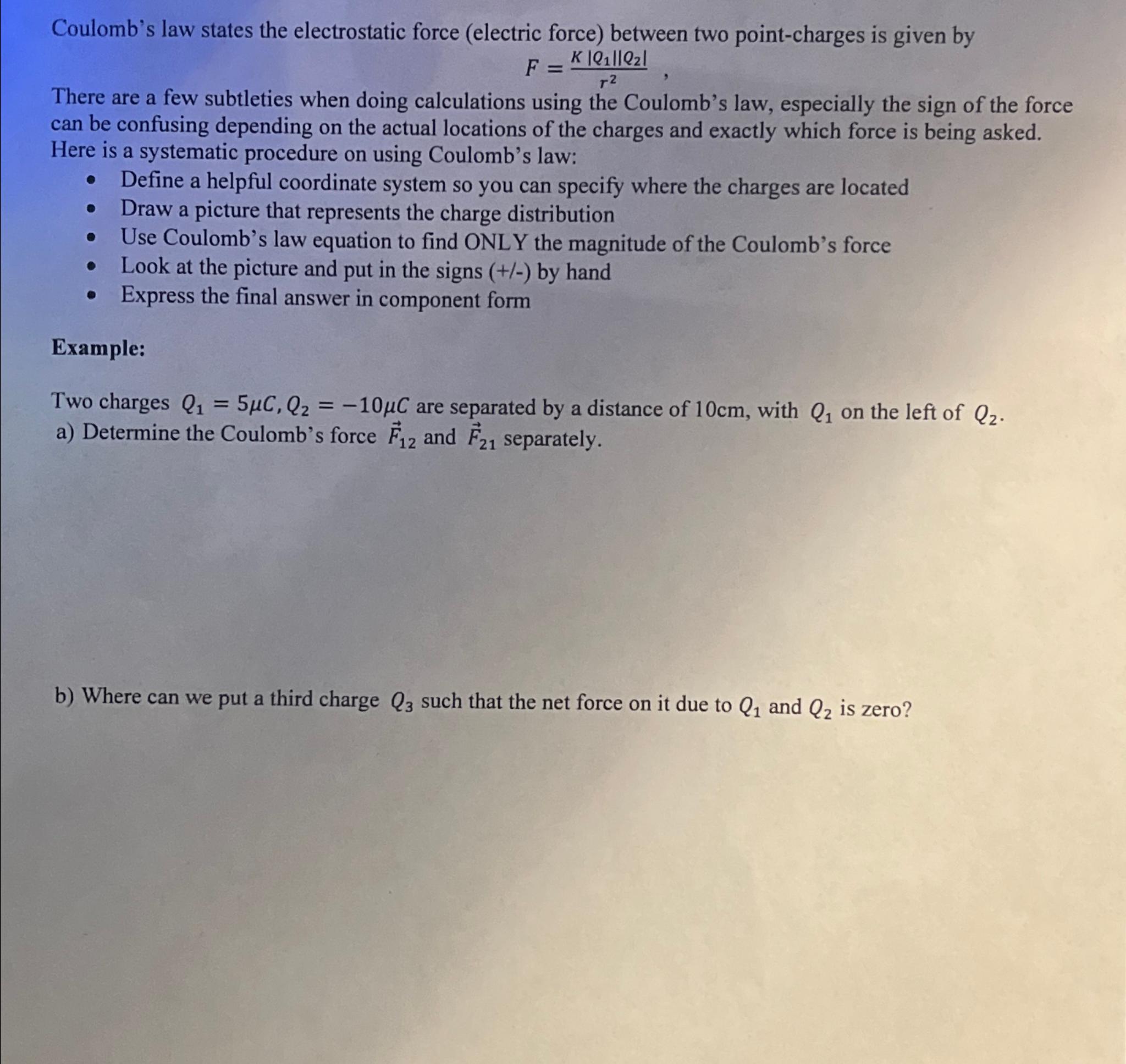
Coulomb's law states the electrostatic force (electric force) between two point-charges is given by F = K|Q||Q| r There are a few subtleties when doing calculations using the Coulomb's law, especially the sign of the force can be confusing depending on the actual locations of the charges and exactly which force is being asked. Here is a systematic procedure on using Coulomb's law: Define a helpful coordinate system so you can specify where the charges are located Draw a picture that represents the charge distribution Use Coulomb's law equation to find ONLY the magnitude of the Coulomb's force Look at the picture and put in the signs (+/-) by hand Express the final answer in component form Example: Two charges Q = 5C, Q = -10C are separated by a distance of 10cm, with Q on the left of Q. a) Determine the Coulomb's force F12 and F21 separately. b) Where can we put a third charge Q3 such that the net force on it due to Q and Q2 is zero?
Step by Step Solution
There are 3 Steps involved in it

Get step-by-step solutions from verified subject matter experts
 Study Help