







Question: CQuestion Weight: 0 . 2 > Use the Graphical User Interface ( GUI ) CIV 2 2 6 3 _ A 6 Q 5 ,
CQuestion Weight: Use the Graphical User Interface GUI
CIVAQGuTh.hml
to enter your results. Enoer only wambers in the GUI, no characters or symbols.
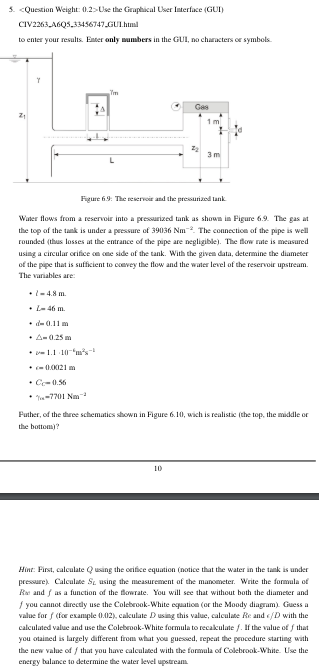
Waner flows from a reservoir into a pressurized tank as showe in Pigure The gas at
the top of the tark is under a peessure of The connection of the pipe is well
rounded thus losses at the entrance of the pipe are negligible The flow rate is measured
using a circular crifice ce cee side of the tank. With the given data, determine the diameter
of the pupe that is sufficient to coevey the flow and the water level of the reservoir upstream.
The viriables are:
:
Futher, of the dree schematics shown in Figure wich is realistic the top, the middle or
the bottomy?
Hint: First, calculate using the orifice equation notice that the water in the tank is under
presoure Calculate using the measurement of the manometer. Write the formula of
Res and as a function of the flowrate. You will see that without both the diameter and
you cannot directly use the ColebrookWhite equation or the Moody diagram Guess a
value for for example calkulate using this value, calculate e and with the
calculated value and use the Colebrook. White formula to recalculate If the value of that
you otained is largely different from what you guessed, repeat the procedure starting with
the new value of that you have calculated with the formula of ColebroakWhite. Use the
energy balance to determine the water level upstream.
Step by Step Solution
There are 3 Steps involved in it
1 Expert Approved Answer
Step: 1 Unlock

Question Has Been Solved by an Expert!
Get step-by-step solutions from verified subject matter experts
Step: 2 Unlock
Step: 3 Unlock
 Study Help