







Question: create a balanced chemical equation and theoretical yield crystallization This experiment assumes a famillarity with the general macroscale crystallization procedure (see Technique 11. Section 11.3).
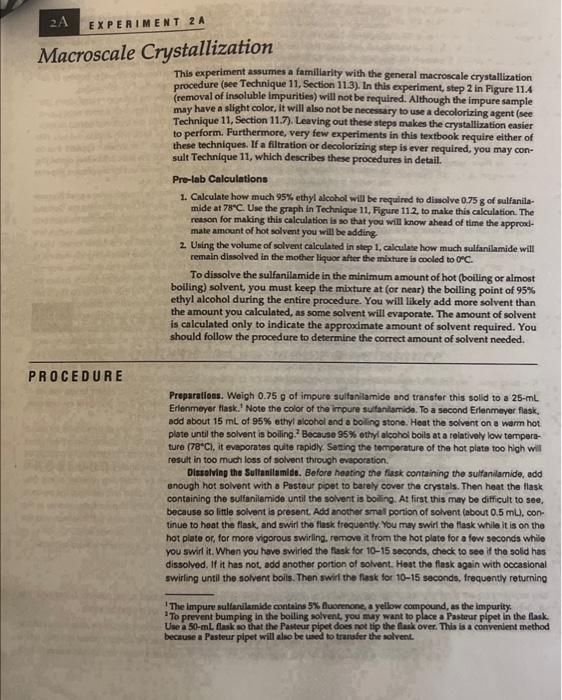
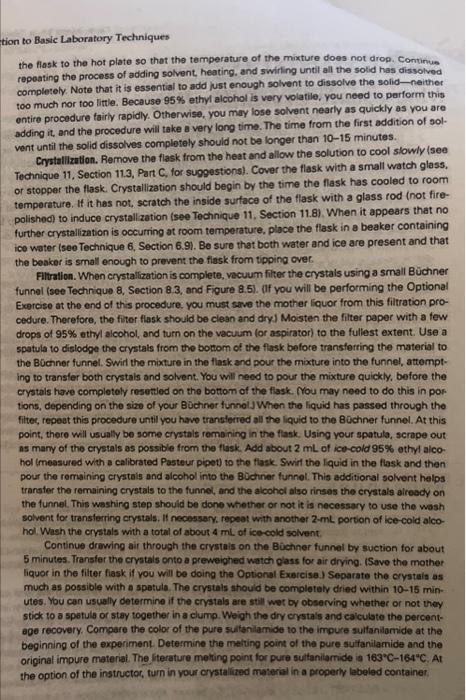
crystallization This experiment assumes a famillarity with the general macroscale crystallization procedure (see Technique 11. Section 11.3). In this experiment, step 2 in Figure 11.4 (removal of insoluble impurities) will not be required. Although the impure sample may have a slight color, it will also not be necessary to use a decolorixing agent (see Technique 11, Section 11.7). Leaving out these steps makes the crystallization easier to perform. Furthermore, very few experiments in this textbook require elther of these techniques. If a filtration or decolorizing step is ever required, you may consult Technique 11, which describes these procedures in detail. Pre-lab Calculations 1. Calculate how much 95% ethyl alcohol will be required to disolve 0.75g of sulfanilamide at 78C. Use the graph in Technique 11, Frgure 112, to make this caleulation. The reason for making this calculation is so that you will know ahead of time the approxlmate amount of hot solvent you will be adding. 2. Using the volume of solvent caiculated in step 1, calculate how much sulfanilamide will remain dissolved in the mother liquor after the mixture is cooled to 0C. To dissolve the sulfanilamide in the minimum amount of hot (boiling or almost boiling) solvent, you must keep the mixture at (or near) the boiling point of 95% ethyl alcohol during the entire procedure. You will likely add more solvent than the amount you calculated, as some solvent will evaporate. The amount of solvent is calculated only to indicate the approximate amount of solvent required. You should follow the procedure to determine the correct amount of solvent needed. Preparations. Weigh 0.75g of impure suifanilamide and transter this solid to a 25mL Erienmeyer flask.' Note the color of the impure sultanilamide. To a second Erlenmeyer flask. add about 15mL of 95% ethyl alcohol and a boling stone. Heat the solvent on a warm hot plate until the solvent is bolling 2 Because 95% ethyl alcohol boils at a telatively low temperature (78Cl, it eveporates quite repidly Sening the temperature of the hot plate too high wil result in too much loss of solvent through evaporation. Discolving the Sultanllamlds. Before heating the flask containing the sulfanilamide, add onough hot solvent with a Pasteur pipet to bately cover the crystals. Then heat the llask containing the sulfanilemide until the solvent is boiling. At first this may be difficult to see, because so little solvent is present. Add another small portion of solvent (about 0.5mL, continue to hoat the flask, and swirl the flask frequently. You may swirl the flask while it is on the hot plate or, for more vigorous swirling. remove it from the hot plate for a few seconds while you swirl it. When you have swirled the fask for 1015 seconds, check to see it the solid has dissolved. If it has not, add another portion of solvent: Heat the flask again with occasional swirling until the solvent bolis. Then swid the fask for 1015 seconds, frequently returning TThe impure sulfanilamide contains 5% fluorenone, a yellow compound, as the impuriby. 2 To prevent bumping in the boiling solvent, you mayy want to place a Pasteur pipet in the flask. Use a 50-ml. flask so that the Pasteur pipet does not tip the flask over. This is a convenient method because a Pasteur pipet will also be used to tranafer the solvent. ion to Basic Laboratory Techniques the flask to the hot plate so that the temperature of the mixture does not drop. Continus repeating the process of adding solvent. heating. and swirling until all the solid has dissolved completely. Note that it is essential to add just enough solvent to dissolve the solid-neither too much nor too little. Because 95% ethyl alcohol is very volatile, you need to parform this entire procedure fairly rapidly. Otherwise, you may lose solvent nearly as quickly as you are adding it, and the procedure will take avery long time. The time from the first addition of solvent until the solid dissolves completely should not be longer than 1015 minutes. Crystalilzalion. Remove the flask from the heat and allow the solution to cool slowiy isee Technique 11. Section 11.3, Part C, for suggestions). Cover the flask with a small watch glass. or stopper the flask. Crystallization should begin by the time the flask has cooled to room temperature. If it has not, scratch the inside surface of the flask with a glass rod (not firepolishod) to induce crystallzation (see Technique 11. Section 11.8). When it appears that no further crystallization is occurring at room temperature, place the flask in a beaker containing ice water (see Technique 6, Section 6.9). Be sure that both water and ice are present and that the beaker is small enough to prevent the flask from tipping over. Filtallon. When crystalization is complete, vecuum filter the crystals using a small Bchner funnel (see Technique 8, Section 8 3, and Figure 8.5). (If you will be performing the Optional Exercise at the end of this procedure. you must save the mother liquor from this filtration procedure. Therefore, the fiter flask should be clean and dryi Mosten the filter paper with a few drops of 95% ethyl alcohol, and turn on the vacuum (or aspirator) to the fullest extent. Use a spatula to dislodge the crystais from the bottom of the flask before transterting the material to the Buchner funnel. Swirl the mixture in the flask and pour the mixture into the funnel, attempting to transfer both crystals and solvent. You will need to pour the mixture quickly, before the crystals have completely resetjed on the bottom of the fiask. You may need to do this in por: tions, depending on the size of your Bucchner funnoljWhen the liquid has passed through the filtec, repeat this procedure until you have trannterred all the liquid to the Buchner funnel. At this point, there will usually be some crystals rembining in the fask. Using your spatula, scrape out: as many of the crystals as possible from the flask. Add about 2mL of ice-cold 95% ethy alcohol (mneasured with a calibrated Pasteur pipet) to the flask. Swirf the liquid in the flask and then pour the remaining crystais and alcohol into the Bochner fynnol. This additional solvont halps. transter the remaining crystals to the funnel, and the alcohol also rinses the crystals already on the funnel. This washing step should be done whether or not it is necessary to use the wash solvent for translerring orystals. If necessary, repeat with another 2-mL portion of ice-cold alcohol. Wash the crystals with a total of about 4ml of ice-cold solvent. Continue drawing air through the crystais on the Buchner funnel by suction for about 5 minutes. Transfer the crystals onte a preweighed watch glass for air drying. (Save the mother liquor in the filter fiask if you will be doing the Optional Exercisa.) Separate the crystais as much as possible with a spetula. The crystals should be completely dried within 1015 minute5. You can usually determine if the crystals are still wer by observing whather or not they stick to a spetule or stay together in a clump. Weigh the dry crystals and caiculste the percentage recovery. Compare the colos of the pure suitanilamide to the impure sulfanilamide at the beginning of the experiment. Determine the melting point of the pure sutanilamide and the original impure material. The literature metting point for pure suttanitamide is 163C1644C. At the option of the instructor, tum in your crystalitied meterial in a properly labeled container
Step by Step Solution
There are 3 Steps involved in it

Get step-by-step solutions from verified subject matter experts
 Study Help