







Question: Create both a Risk Probability Impact Matrix and a Risk Response Plan for each of your identified risks (consider this what would a plan B
Create both a Risk Probability Impact Matrix and a Risk Response Plan for each of your identified risks (consider this what would a plan "B" look like). The format is optional. Include 7-8 risks from the case. Follow the Case picture below.
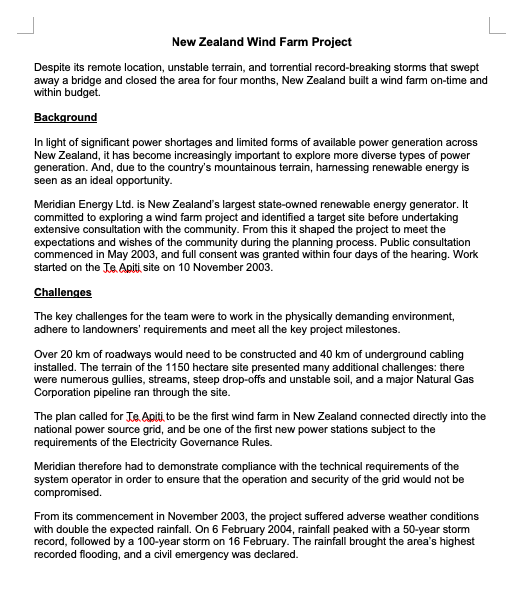
New Zealand Wind Farm Project Despite its remote location, unstable terrain, and torrential record-breaking storms that swept away a bridge and closed the area for four months, New Zealand built a wind farm on-time and within budget. Background In light of significant power shortages and limited forms of available power generation across New Zealand, it has become increasingly important to explore more diverse types of power generation. And, due to the country's mountainous terrain, hamessing renewable energy is seen as an ideal opportunity. Meridian Energy Ltd. is New Zealand's largest state-owned renewable energy generator. It committed to exploring a wind farm project and identified a target site before undertaking extensive consultation with the community. From this it shaped the project to meet the expectations and wishes of the community during the planning process. Public consultation commenced in May 2003, and full consent was granted within four days of the hearing. Work started on the Te Apiti site on 10 November 2003. Challenges The key challenges for the team were to work in the physically demanding environment, adhere to landowners' requirements and meet all the key project milestones. Over 20 km of roadways would need to be constructed and 40 km of underground cabling installed. The terrain of the 1150 hectare site presented many additional challenges: there were numerous gullies, streams, steep drop-offs and unstable soil, and a major Natural Gas Corporation pipeline ran through the site. The plan called for Te Apiti to be the first wind farm in New Zealand connected directly into the national power source grid, and be one of the first new power stations subject to the requirements of the Electricity Governance Rules. Meridian therefore had to demonstrate compliance with the technical requirements of the system operator in order to ensure that the operation and security of the grid would not be compromised. From its commencement in November 2003, the project suffered adverse weather conditions with double the expected rainfall. On 6 February 2004, rainfall peaked with a 50-year storm record, followed by a 100-year storm on 16 February. The rainfall brought the area's highest recorded flooding, and a civil emergency was declared
Step by Step Solution
There are 3 Steps involved in it

Get step-by-step solutions from verified subject matter experts
 Study Help