







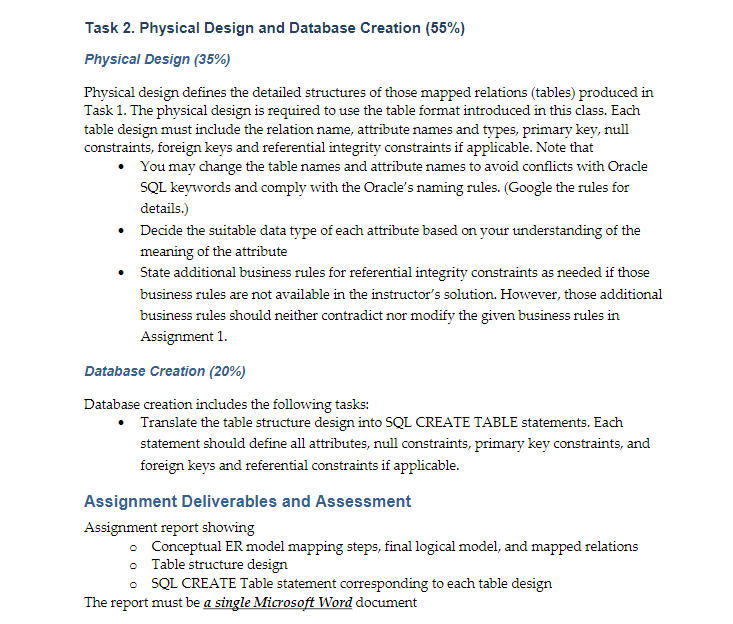
Question: Create -Conceptual ER model mapping steps, final logical model,and mapped relations. -Table structure design -SQL CREATE Table statement corresponding to each table design. The report
Create
-Conceptual ER model mapping steps, final logical model,and mapped relations.
-Table structure design
-SQL CREATE Table statement corresponding to each table design.
The report must be a single Microsoft Word document
Please look at the images below to see the instructions.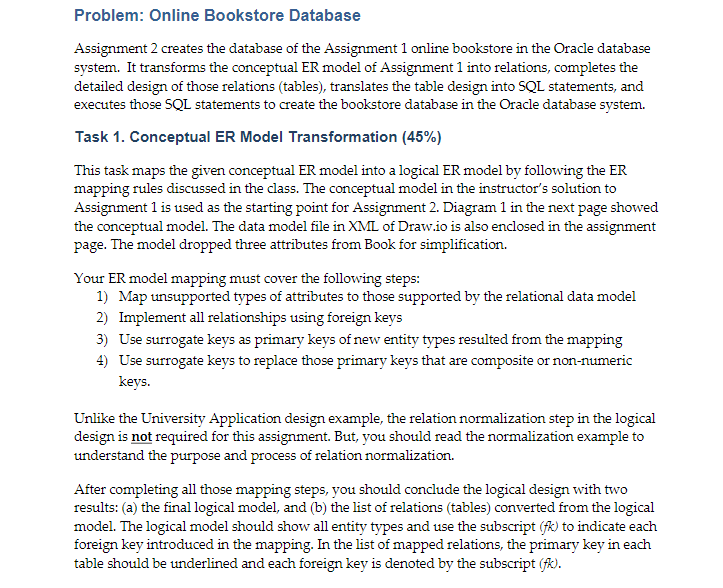
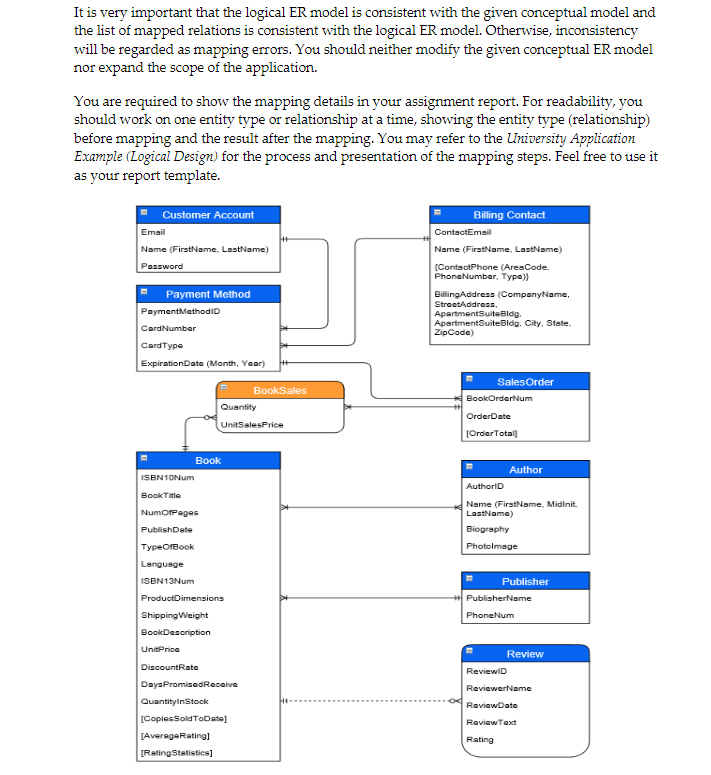
Problem: Online Bookstore Database Assignment 2 creates the database of the Assignment 1 online bookstore in the Oracle database system. Ittransforms the conceptual ER model of Assignment 1 into relations, completes the detailed design of those relations (tables), translates the table design into SQL statements, and executes those SQL statements to create the bookstore database in the Oracle database system. Task 1. Conceptual ER Model Transformation (45%) This task maps the given conceptual ER model into a logical ER model by following the ER mapping rules discussed in the class. The Assignment 1 is used as the starting point for Assignment 2. Diagram 1 in the next page showed the conceptual model. The data model file in XML of Draw.io is also enclosed in the assignment page. The model dropped three attributes from Book for simplification. conceptual model in the instructor's solution to Your E model mapping must cover the following steps: 1) 2) 3) 4) Map unsupported types of attributes to those supported by the relational data model Implement all relationships using foreign keys Use surrogate keys as primary keys ot new entity types resulted from the mapping Use surrogate keys to replace those primary keys that are composite or non-numeric keys. Unlike the University Application design example, the relation normalization step in the logical design is not required for this assignment. But, you should read the normalization example to understand the purpose and process of relation normalization. After completing all those mapping steps, you should conclude the logical design with two results: (a) the final logical model, and (b) the list of relations (tables) converted from the logical model. The logical model should show all entity types and use the subscript (fx) to indicate each foreign key introduced in the mapping. In the list of mapped relations, the primary key in each table should be underlined and each foreign key is denoted by the subscript (ftc) Problem: Online Bookstore Database Assignment 2 creates the database of the Assignment 1 online bookstore in the Oracle database system. Ittransforms the conceptual ER model of Assignment 1 into relations, completes the detailed design of those relations (tables), translates the table design into SQL statements, and executes those SQL statements to create the bookstore database in the Oracle database system. Task 1. Conceptual ER Model Transformation (45%) This task maps the given conceptual ER model into a logical ER model by following the ER mapping rules discussed in the class. The Assignment 1 is used as the starting point for Assignment 2. Diagram 1 in the next page showed the conceptual model. The data model file in XML of Draw.io is also enclosed in the assignment page. The model dropped three attributes from Book for simplification. conceptual model in the instructor's solution to Your E model mapping must cover the following steps: 1) 2) 3) 4) Map unsupported types of attributes to those supported by the relational data model Implement all relationships using foreign keys Use surrogate keys as primary keys ot new entity types resulted from the mapping Use surrogate keys to replace those primary keys that are composite or non-numeric keys. Unlike the University Application design example, the relation normalization step in the logical design is not required for this assignment. But, you should read the normalization example to understand the purpose and process of relation normalization. After completing all those mapping steps, you should conclude the logical design with two results: (a) the final logical model, and (b) the list of relations (tables) converted from the logical model. The logical model should show all entity types and use the subscript (fx) to indicate each foreign key introduced in the mapping. In the list of mapped relations, the primary key in each table should be underlined and each foreign key is denoted by the subscript (ftc)
Step by Step Solution
There are 3 Steps involved in it

Get step-by-step solutions from verified subject matter experts
 Study Help