



Question: Critical Thinking Problem 20.1 Understanding Stockholders' Equity Just after its formation on September 1, 2019, the ledger accounts of the Ducks, Inc., contained the following
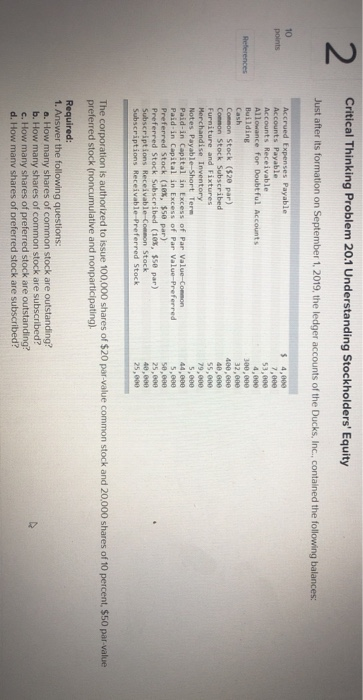
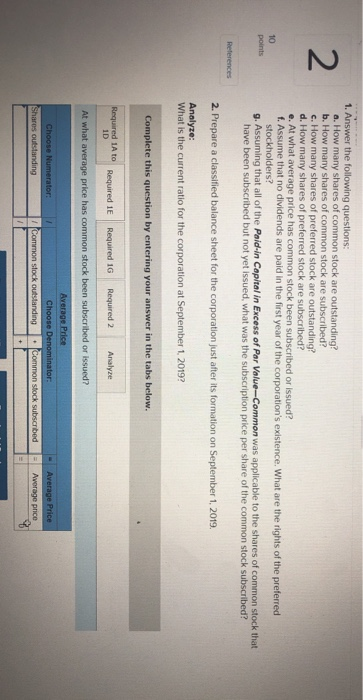
Critical Thinking Problem 20.1 Understanding Stockholders' Equity Just after its formation on September 1, 2019, the ledger accounts of the Ducks, Inc., contained the following balances: 10 $ 4,000 points 53,000 4,000 300,000 32,000 References Accrued Expenses Payable Accounts Payable Accounts Receivable Allowance for Doubtful Accounts Building Cash Common Stock (520 par) Common Stock Subscribed Furniture and Fixtures Merchandise Inventory Notes Payable-Short Term Paid-in Capital in Excess of Par Value-Common Paid in Capital in Excess of Par Value-Preferred Preferred Stock (10%, $50 par) Preferred Stock Subscribed (105, $50 par) Subscriptions Receivable-Common Stock Subscriptions Receivable Preferred Stock 40.000 55,000 79,000 5,000 44,000 5.30 25,000 25.000 The corporation is authorized to issue 100,000 shares of $20 par-value common stock and 20,000 shares of 10 percent. $50 par-value preferred stock (noncumulative and nonparticipating) Required: 1. Answer the following questions: a. How many shares of common stock are outstanding? b. How many shares of common stock are subscribed? c. How many shares of preferred stock are outstanding? d. How many shares of preferred stock are subscribed? 1. Answer the following questions: a. How many shares of common stock are outstanding? b. How many shares of common stock are subscribed? c. How many shares of preferred stock are outstanding? d. How many shares of preferred stock are subscribed? e. At what average price has common stock been subscribed or issued? f. Assume that no dividends are paid in the first year of the corporation's existence. What are the rights of the preferred stockholders? g. Assuming that all of the Paid-in Capital in Excess of Par Value-Common was applicable to the shares of common stock that have been subscribed but not yet issued, what was the subscription price per share of the common stock subscribed? points References 2. Prepare a classified balance sheet for the corporation just after its formation on September 1, 2019 Analyze: What is the current ratio for the corporation at September 1, 2019? Complete this question by entering your answer in the tabs below. Required 1A to Required 10 Required 16 Required 2 Analyze At what average price has common stock been subscribed or issued? Choose Numerator Average Price Choose Denominator: 1 Common stock outstanding Common stock subscribed Average Price Shares outstanding Average price
Step by Step Solution
There are 3 Steps involved in it

Get step-by-step solutions from verified subject matter experts