







Question: Cross - correlation ( 2 8 points ) We are building our own Acoustic Positioning System. NOTE: The signatures vec ( s ) _ (
Crosscorrelation points
We are building our own Acoustic Positioning System.
NOTE: The signatures vecsvecs in each subpart are different; each prompt is independent from the others.
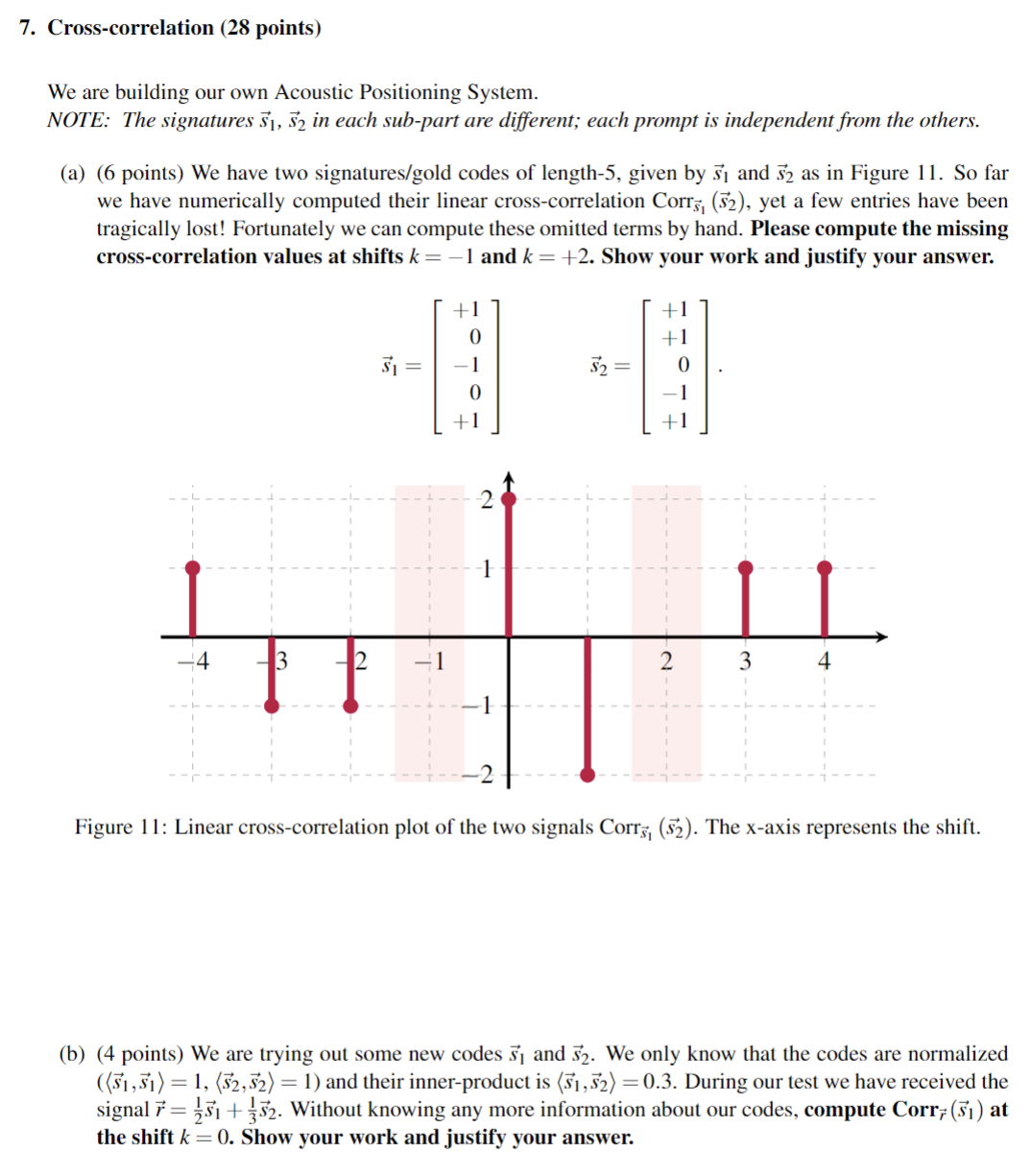
a points We have two signaturesgold codes of length given by vecs and vecs as in Figure So far
we have numerically computed their linear crosscorrelation Corrvecsvecs yet a few entries have been
tragically lost! Fortunately we can compute these omitted terms by hand. Please compute the missing
crosscorrelation values at shifts k and k Show your work and justify your answer.
vecsvecs
Figure : Linear crosscorrelation plot of the two signals Corrvecsvecs The x axis represents the shift.
b points We are trying out some new codes vecs and vecs We only know that the codes are normalized
:vecsvecs::vecsvecs: and their innerproduct is :vecsvecs: During our test we have received the
signal vecrvecsvecs Without knowing any more information about our codes, compute Corrvecrvecs at
the shift k Show your work and justify your answer.
c points We again have two new signals vecs and vecs and are now given the plot of Corrvecsvecs as shown
in Figure Our receiver identified a signal vecr which we know to be related to the code vecs by some
scaling, shifting, andor reflection. However, we only know the linear crosscorrelation Corrvecsvecr as
shown in Figure Can you express vecr in terms of vecs Show your work and justify your answer.
Figure : Linear crosscorrelation plots for Corrvecsvecs
Figure : Linear crosscorrelation plots for CorrvecSvecr
d points With a little effort we managed to create two good gold codes of length vecs and vecs The linear crosscorrelation of vecs and vecs is small at all shifts while the autocorrelation of each signal is also small, except at shift k We receive our first signal vecr which we know to be a combination of both codes
vecrnvecsnkvecsnk
The linear crosscorrelation Corrvecrvecs has been computed and plotted in Figure and similarly Corrvecrvecs is plotted in Figure Determine the shifts for vecs and vecs in the received signal vecr ie solve for k and k in equation Explain your answer.
Note: Don't worry too much about identifying the exact value for k and k As long as your answer is reasonable, you will receive full credit.
Figure : Linear crosscorrelation piots ior corrvecrs
f points After optimizing two orthogonal codes vecs and vecs:vecsvecs: vecs and make it orthogonal to vecs and vecs We can start by writing vecs as
vecsvecavecb such that veca belongs to the span vecsvecs and vecb is orthogonal to span vecsvecs ie:vecbvecs:
and :vecbvecs: Use the idea of projections to write both veca and vecb in terms of vecsvecs and vecs and
innerproducts thereof. For full credit your final answer may not contain matrices nor matrix
vector products Show your work and justify your answer.
Step by Step Solution
There are 3 Steps involved in it
1 Expert Approved Answer
Step: 1 Unlock

Question Has Been Solved by an Expert!
Get step-by-step solutions from verified subject matter experts
Step: 2 Unlock
Step: 3 Unlock
 Study Help