







Question: (d) An undercomplete auto-encoder (AE) is trained on the MNIST dataset. The latent dimension is 2. The user plots the 10 clusters with 10
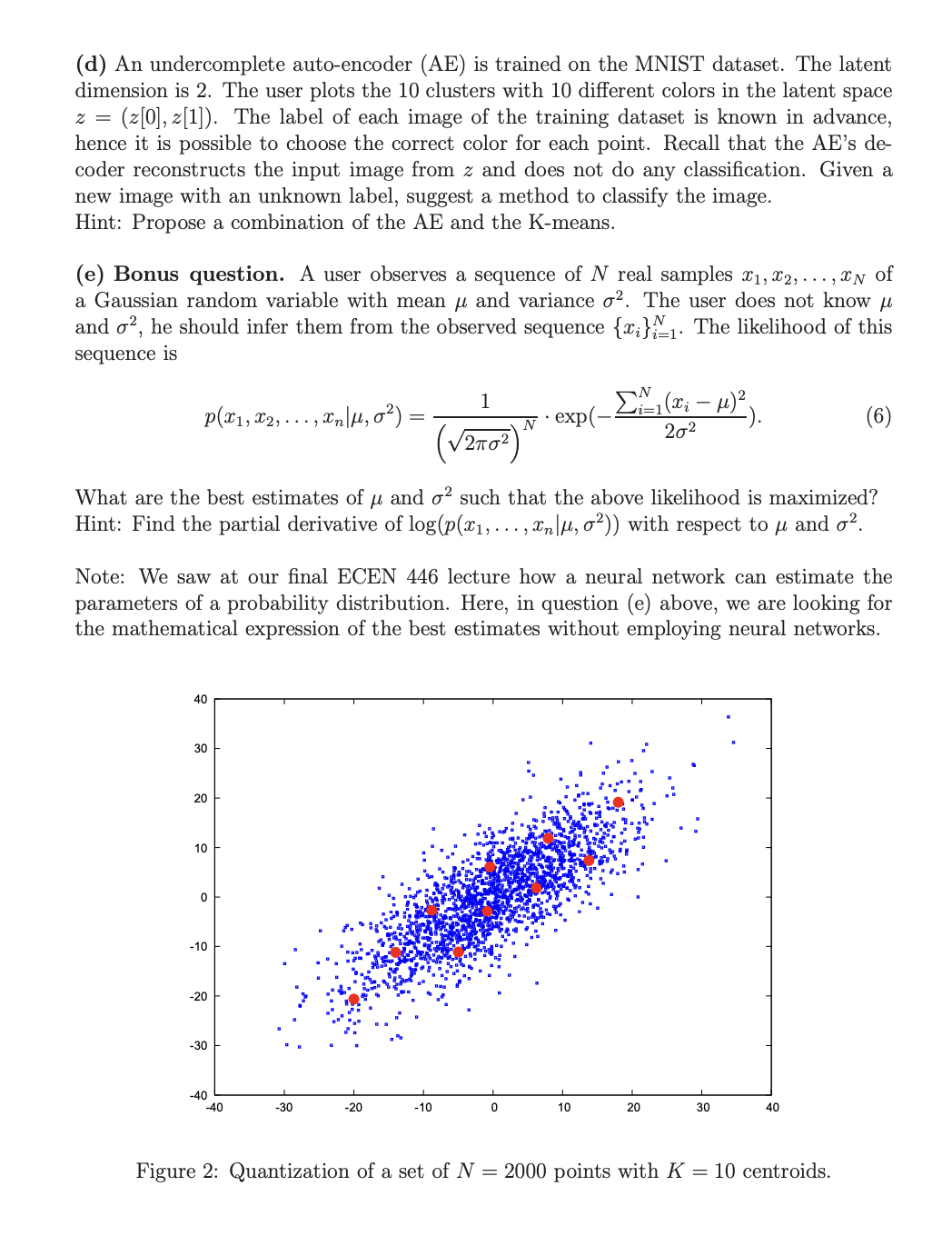
(d) An undercomplete auto-encoder (AE) is trained on the MNIST dataset. The latent dimension is 2. The user plots the 10 clusters with 10 different colors in the latent space 2 = (z[0], z[1]). The label of each image of the training dataset is known in advance, hence it is possible to choose the correct color for each point. Recall that the AE's de- coder reconstructs the input image from z and does not do any classification. Given a new image with an unknown label, suggest a method to classify the image. Hint: Propose a combination of the AE and the K-means. (e) Bonus question. A user observes a sequence of N real samples x, x2,..., N of a Gaussian random variable with mean and variance o. The user does not know and o2, he should infer them from the observed sequence {x}. The likelihood of this sequence is p(x, x2,...,xn, 0) = 40 What are the best estimates of u and o2 such that the above likelihood is maximized? Hint: Find the partial derivative of log (p(x,..., nu, o)) with respect to and o. 30 Note: We saw at our final ECEN 446 lecture how a neural network can estimate the parameters of a probability distribution. Here, in question (e) above, we are looking for the mathematical expression of the best estimates without employing neural networks. 20 10 0 -10 -20 -30 -40 -40 -30 1 (2O) -20 JA exp(-i-1 (2; -1)). (xi 20 -10 0 10 20 30 (6) 40 Figure 2: Quantization of a set of N = 2000 points with K = 10 centroids.
Step by Step Solution
3.41 Rating (151 Votes )
There are 3 Steps involved in it
d To classify a new image with an unknown label using the undercomplete autoencoder AE trained on the MNIST dataset we can use a combination of the AE ... View full answer

Get step-by-step solutions from verified subject matter experts
 Study Help