



Question: (d) Draw the constraint set C = {(x, y) = R: xe 3e, c y, x 0, y 0} for the case c =
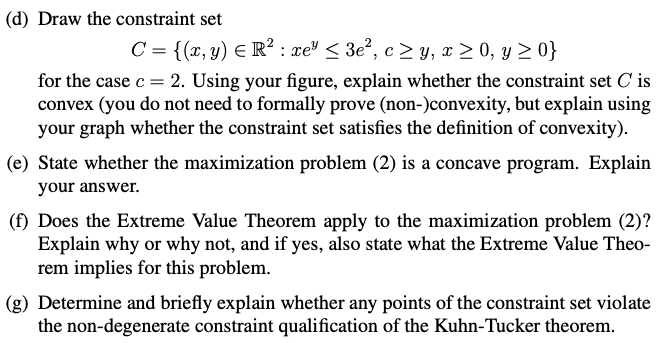
(d) Draw the constraint set C = {(x, y) = R: xe 3e, c y, x 0, y 0} for the case c = 2. Using your figure, explain whether the constraint set C is convex (you do not need to formally prove (non-)convexity, but explain using your graph whether the constraint set satisfies the definition of convexity). (e) State whether the maximization problem (2) is a concave program. Explain your answer. (f) Does the Extreme Value Theorem apply to the maximization problem (2)? Explain why or why not, and if yes, also state what the Extreme Value Theo- rem implies for this problem. (g) Determine and briefly explain whether any points of the constraint set violate the non-degenerate constraint qualification of the Kuhn-Tucker theorem.
Step by Step Solution
There are 3 Steps involved in it

Get step-by-step solutions from verified subject matter experts