



Question: .data getrange: .asciiz Enter range (in yards): tflight: .asciiz Time of flight: hmax: .asciiz Maximum height: theta: .asciiz Angle trajectory: newline:
.data
getrange: .asciiz "Enter range (in yards): "
tflight: .asciiz "Time of flight: "
hmax: .asciiz "Maximum height: "
theta: .asciiz "Angle trajectory: "
newline: .asciiz " "
space: .asciiz " "
pi: .float 3.14
g: .float 32.174
deg: .float 180.0
ftconv: .float 3.0
sec: .float 3600.0
temp: .float 1.0
error: .asciiz "Error! Enter the range in yards no more than 42240"
.text
main:
# print prompt and get user input for range
li $v0, 4 # print string syscall
la $a0, getrange
syscall
li $v0, 6 # read float syscall
syscall
move $t0, $v0
# validate input
li $t1, 42240 # 24 miles = 42240 yards
ble $t0, $t1, input_valid
li $v0, 4 # print string syscall
la $a0, error
syscall
j main
input_valid:
# convert yards to feet
li $t1, 3 # 3 feet per yard
mul $t0, $t0, $t1 # range in feet
# calculate time-of-flight
li $t1, 2500
lwc1 $f1, g # gravity
mul.s $f2, $f1, $f1 # g^2
mul.s $f3, $f2, $f2 # g^4
lwc1 $f4, temp # numerator
mul.s $f5, $f4, $f2 # numerator * g^2
li $t2, 2 # denominator
li $t6, 2 # initialize power of 2 to 2
li $t3, 3 # exponent
lwc1 $f6, temp # term
li $t4, 0 # sign
lwc1 $f7, temp # power of 2
lwc1 $f8, temp # factorial
lwc1 $f9, temp # angle in radians
li $t5, 1 # counter
lwc1 $f10, deg # conversion factor
lwc1 $f11, ftconv # feet in a yard
lwc1 $f12, sec # seconds in an hour
li $t5, 0 #initialize the counter to 0
#taylor series for sin to find tof
TaylorLoop:
# calculate term
div.s $f6, $f5, $f8
# add/subtract term
add.s $f4, $f4, $f6
sub.s $f4, $f4, $f6
# increment counter
addi $t5, $t5, 1
# calculate power of 2
mul.s $f7, $f7, $f2
move $t7, $t6 # move value of $t6 to $t7
li $t2, 0 # clear $t2
addi $t2, $t7, 0 # copy value of $t7 to $t2
addi $t6, $t6, 2 # update power of 2
# calculate factorial
mul.s $f8, $f8, $f9
add.s $f9, $f9, $f9
add.s $f9, $f9, $f9
# calculate numerator
mul.s $f4, $f4, $f3 #result of tof stored in $f4
# check for end of loop
bne $t5, 20, TaylorLoop
# calculate angle trajectory
li $t5, 2
lwc1 $f23, pi
mul.s $f9, $f4, $f1 #f4(results stored fot tof) * g($f1)
div.s $f10, $f9, $f12
mul.s $f11, $f10, $f11
mtc1 $t2, $f24 #convert the input value $t2 to float
cvt.s.w $f24, $f24
div.s $f12, $f11, $f24
div.s $f13, $f12, $f23
mul.s $f14, $f13, $f10
#calculate time of flight
div.s $f16, $f11, $f14
sqrt.s $f17, $f14
div.s $f18, $f16, $f17
mtc1 $t0, $f25 #convert the input value $t0 to float
cvt.s.w $f25, $f25
mul.s $f19, $f18, $f25
# print time of flight
li $v0, 4 # print string syscall
la $a0, tflight
syscall
li $v0, 2 # print float syscall
mov.s $f12, $f19
syscall
# print newline
li $v0, 4 # print string syscall
la $a0, newline
syscall
# calculate maximum height
mul.s $f20, $f16, $f17
div.s $f21, $f20, $f1
div.s $f22, $f21, $f24
# print maximum height
li $v0, 4 # print string syscall
la $a0, hmax
syscall
li $v0, 2 # print float syscall
mov.s $f12, $f22
syscall
# print newline
li $v0, 4 # print string syscall
la $a0, newline
syscall
# print angle trajectory
li $v0, 4 # print string syscall
la $a0, theta
syscall
li $v0, 2 # print float syscall
mov.s $f12, $f14
syscall
# print newline
li $v0, 4 # print string syscall
la $a0, newline
syscall
# exit program
li $v0, 10 # exit syscall
syscall
The MIPS code for the time of flight in seconds, maximum height in feet and angle trajectory in degrees does not work and give correct answers in MARS simulation. The output is given as NAN for all three things. Moreover, the range input check is not working as well when more than 42240 yards are being input, the error message does displays on the output. Please explain the purpose of each line and modify the code so that correct numbers for the time of flight, maximum height, and angle trajectory is calculated and displayed on the output. Make sure to use correct equations to calculate the time of flight, maximum height, and angle trajectory using Taylor series for trigonometric functions. I do not confirm that the above following code is correct or not correct. Thank you so much.
The following equations should be used:
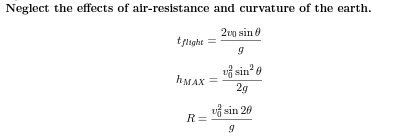
Neglect the effects of air-resistance and curvature of the earth. tflight=g2v0sinhMAX=2gv02sin2R=gv02sin2
Step by Step Solution
There are 3 Steps involved in it

Get step-by-step solutions from verified subject matter experts