







Question: Data Link: https://1drv.ms/x/s!AtTjRPADpkNUagvnVDzLirenXis This case study concerns a retailer's loyalty program. The retailer focuses on service delivery, but also sells products related to that service

Data Link: https://1drv.ms/x/s!AtTjRPADpkNUagvnVDzLirenXis
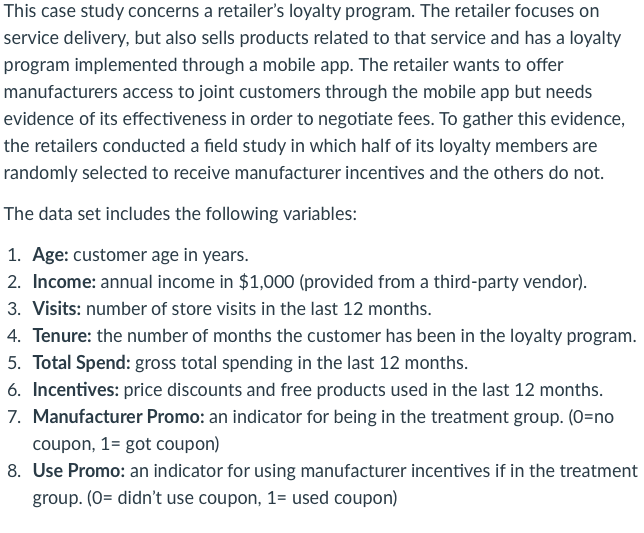
This case study concerns a retailer's loyalty program. The retailer focuses on service delivery, but also sells products related to that service and has a loyalty program implemented through a mobile app. The retailer wants to offer manufacturers access to joint customers through the mobile app but needs evidence of its effectiveness in order to negotiate fees. To gather this evidence, the retailers conducted a field study in which half of its loyalty members are randomly selected to receive manufacturer incentives and the others do not. The data set includes the following variables: 1. Age: customer age in years. 2. Income: annual income in $1,000 (provided from a third-party vendor). 3. Visits: number of store visits in the last 12 months. 4. Tenure: the number of months the customer has been in the loyalty program. 5. Total Spend: gross total spending in the last 12 months. 6. Incentives: price discounts and free products used in the last 12 months. 7. Manufacturer Promo: an indicator for being in the treatment group. (0-no coupon, 1-got coupon) 8. Use Promo: an indicator for using manufacturer incentives if in the treatment group. (0- didn't use coupon, 1-used coupon) This case study concerns a retailer's loyalty program. The retailer focuses on service delivery, but also sells products related to that service and has a loyalty program implemented through a mobile app. The retailer wants to offer manufacturers access to joint customers through the mobile app but needs evidence of its effectiveness in order to negotiate fees. To gather this evidence, the retailers conducted a field study in which half of its loyalty members are randomly selected to receive manufacturer incentives and the others do not. The data set includes the following variables: 1. Age: customer age in years. 2. Income: annual income in $1,000 (provided from a third-party vendor). 3. Visits: number of store visits in the last 12 months. 4. Tenure: the number of months the customer has been in the loyalty program. 5. Total Spend: gross total spending in the last 12 months. 6. Incentives: price discounts and free products used in the last 12 months. 7. Manufacturer Promo: an indicator for being in the treatment group. (0-no coupon, 1-got coupon) 8. Use Promo: an indicator for using manufacturer incentives if in the treatment group. (0- didn't use coupon, 1-used coupon)
Step by Step Solution
There are 3 Steps involved in it

Get step-by-step solutions from verified subject matter experts
 Study Help