







Question: Data: Part 1 (9 points). Finding the initial velocity of the ball using the pendulum. In this part of the lab, a ball is
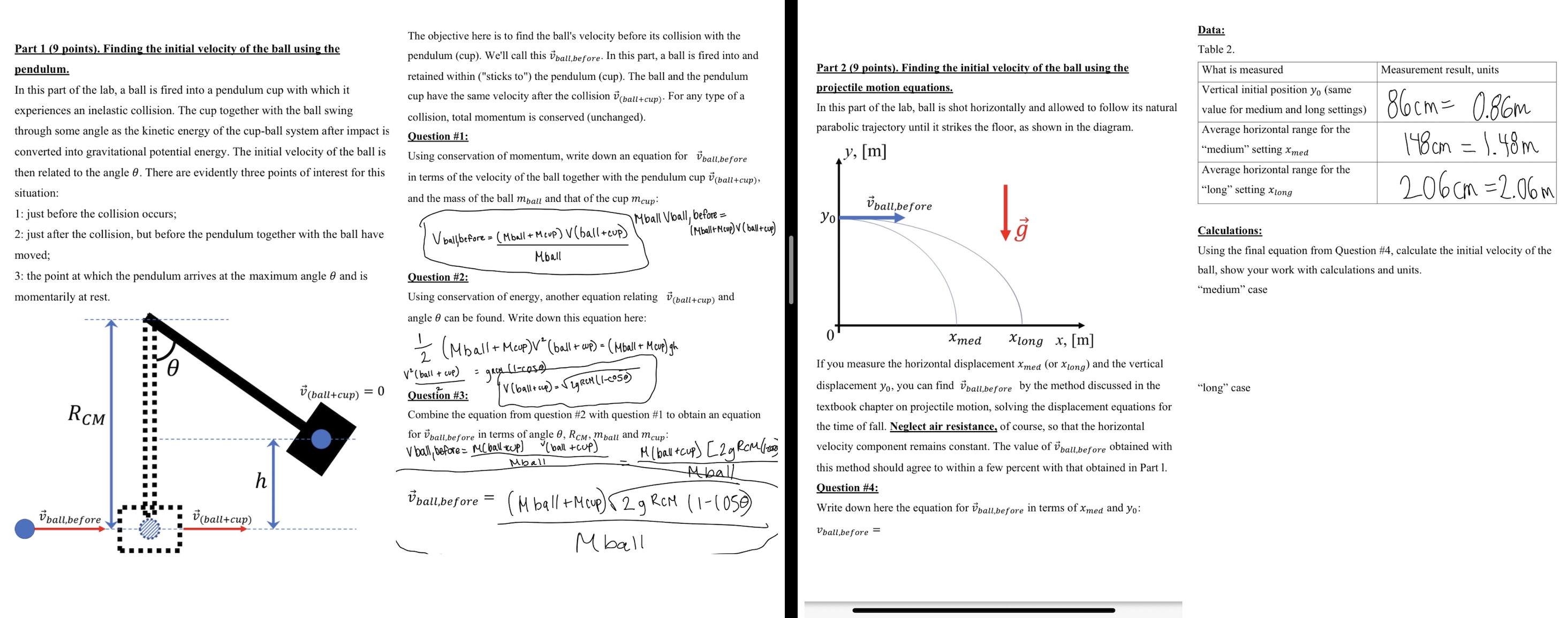
Data: Part 1 (9 points). Finding the initial velocity of the ball using the pendulum. In this part of the lab, a ball is fired into a pendulum cup with which it experiences an inelastic collision. The cup together with the ball swing through some angle as the kinetic energy of the cup-ball system after impact is converted into gravitational potential energy. The initial velocity of the ball is then related to the angle 0. There are evidently three points of interest for this situation: 1: just before the collision occurs; 2: just after the collision, but before the pendulum together with the ball have moved; 3: the point at which the pendulum arrives at the maximum angle 0 and is momentarily at rest. The objective here is to find the ball's velocity before its collision with the pendulum (cup). We'll call this ball, before. In this part, a ball is fired into and retained within ("sticks to") the pendulum (cup). The ball and the pendulum cup have the same velocity after the collision (ball+cup). For any type of a collision, total momentum is conserved (unchanged). Question #1: Using conservation of momentum, write down an equation for ball, before in terms of the velocity of the ball together with the pendulum cup (ball+cup), and the mass of the ball mall and that of the cup mcup: Part 2 (9 points). Finding the initial velocity of the ball using the projectile motion equations. In this part of the lab, ball is shot horizontally and allowed to follow its natural parabolic trajectory until it strikes the floor, as shown in the diagram. y, [m] V ball, before = (Mball + Meup) V (ball+cup) Mball Vball, before = (Mball+ Mcup) V (ball + cup) Vball, before yo Mball Question #2: Using conservation of energy, another equation relating (ball+cup) and angle can be found. Write down this equation here: 11/12 (Mball + Mcop) V (ball + up) = (Mball + Mcup)gh 0 Xlong x, [m] Table 2. What is measured Vertical initial position yo (same value for medium and long settings) Average horizontal range for the "medium" setting xmed Average horizontal range for the "long" setting Xtong Measurement result, units 86cm= 0.86m 148cm = 1.48m 206cm=2.06m Calculations: Using the final equation from Question #4, calculate the initial velocity of the ball, show your work with calculations and units. "medium" case RCM V (ball + cup) = gacy (1-cose) V(ball+cup) = 0 Question #3: | V (ball + cup)= 2gRCM (1-coso) Vball, before V(ball+cup) h Combine the equation from question #2 with question #1 to obtain an equation for ball, before in terms of angle 0, RCM, mball and mcup: V ball, before = MC ball cup) Vball,before "(ball + cup) Mball Mball+cup) [2 RCM/ Mball (M ball + Mcup) 2 g RCM (1-1056) Mball xmed If you measure the horizontal displacement xmed (or Xlong) and the vertical displacement yo, you can find ball, before by the method discussed in the textbook chapter on projectile motion, solving the displacement equations for the time of fall. Neglect air resistance, of course, so that the horizontal velocity component remains constant. The value of ball,before obtained with this method should agree to within a few percent with that obtained in Part 1. Question #4: Write down here the equation for ball, before in terms of xmed and yo: Vball, before = "long" case
Step by Step Solution
There are 3 Steps involved in it

Get step-by-step solutions from verified subject matter experts
 Study Help