







Question: .. Data Sheet I. Determining Electrode Potentials Using a Cu2+(aq) Cu(s) Reference E star A. The Cu(s) Cu2+(aq)|| Zn2+(aq)| Zn(s) Cell bole potential, observed, V
..
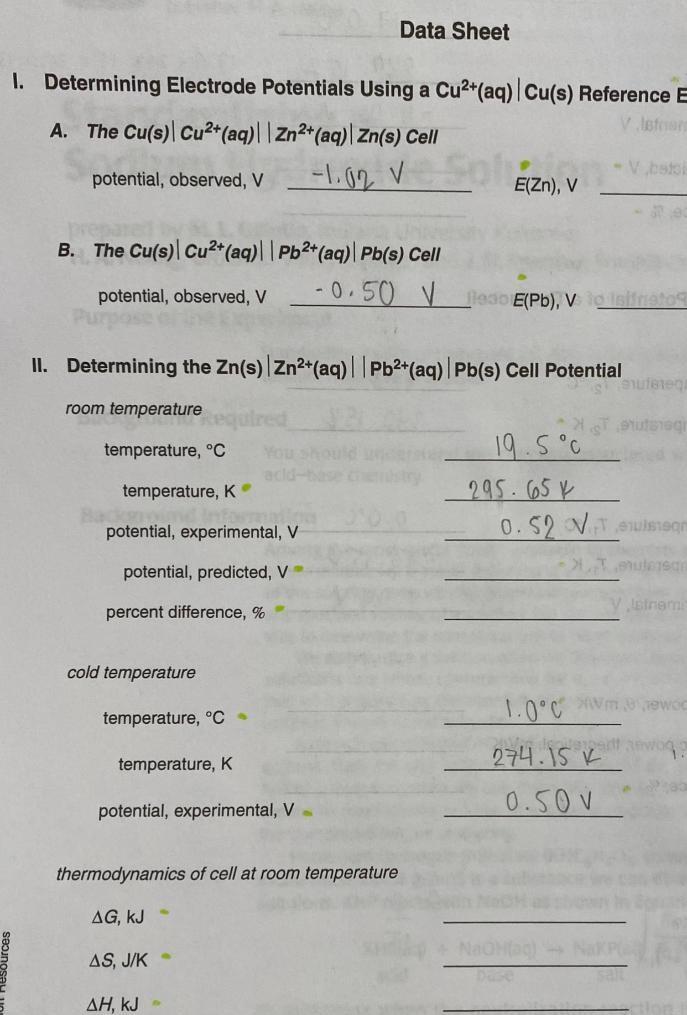
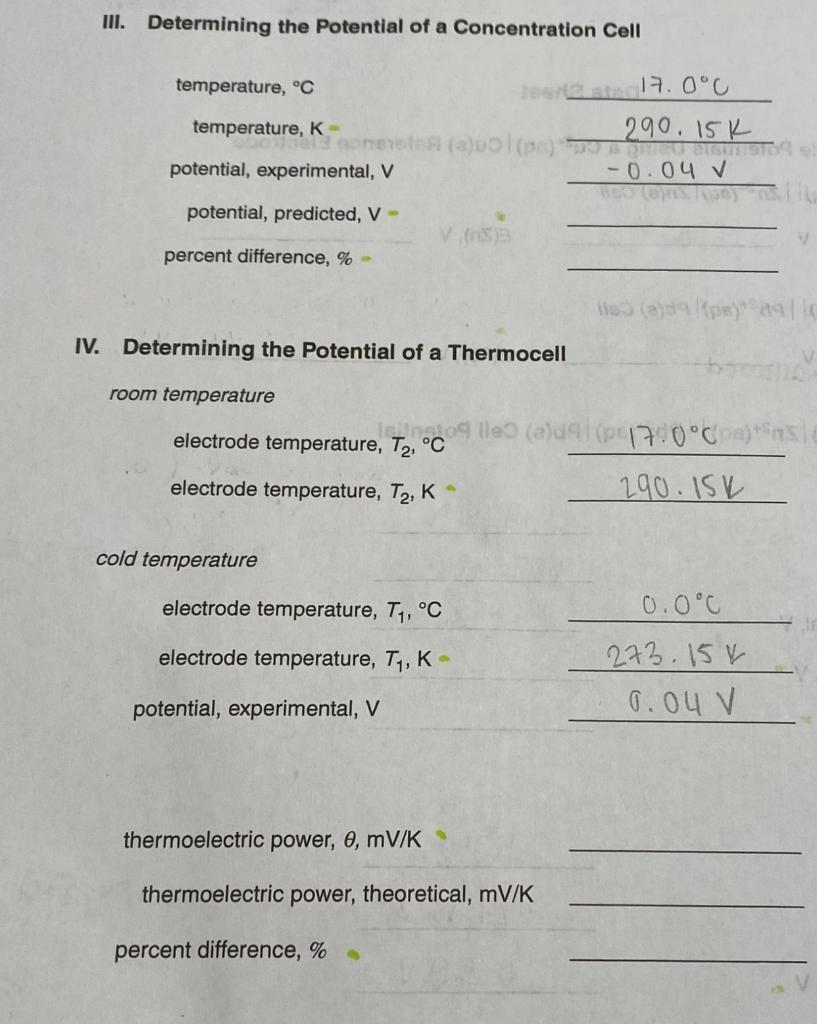
Data Sheet I. Determining Electrode Potentials Using a Cu2+(aq) Cu(s) Reference E star A. The Cu(s) Cu2+(aq)|| Zn2+(aq)| Zn(s) Cell bole potential, observed, V E(Zn), v -1.02 V B. The Cu(s) Cu2+(aq)|| Pb2+ (aq)| Pb(s) Cell potential, observed, v -0.50 V 195E(Pb), V. II. Determining the Zn(s)[Zn2+(aq) || Pb2+(aq) | Pb(s) Cell Potential isten room temperature temperature, C OU! 19.5c 295.65k 0.52 Visuistaan temperature, K potential, experimental, V potential, predicted, V se percent difference, % binem cold temperature temperature, C 1.0C mere 274.15k at 0.50V temperature, K potential, experimental, V thermodynamics of cell at room temperature AG, KJ AS, J/K - , kJ III. Determining the Potential of a Concentration Cell 17.0C temperature, C temperature, K- 290. 15k re. Noneta (col) STOL potential, experimental, V -0.04 V potential, predicted, V- V percent difference, % - lia ( ap) agli IV. Determining the Potential of a Thermocell room temperature rolle (@dal (17.0C)*5) electrode temperature, T2, C electrode temperature, T2, K 290. ISK cold temperature electrode temperature, T1, C electrode temperature, T, K- 0.0C 273.158 0.04 V potential, experimental, V thermoelectric power, 0, mV/K thermoelectric power, theoretical, mV/K percent difference, %
Step by Step Solution
There are 3 Steps involved in it

Get step-by-step solutions from verified subject matter experts
 Study Help