







Question: Data table (Click the icon here in order to copy the contents of the data table below into a spreadsheet.) Ratio comparisons Robert Arias recently
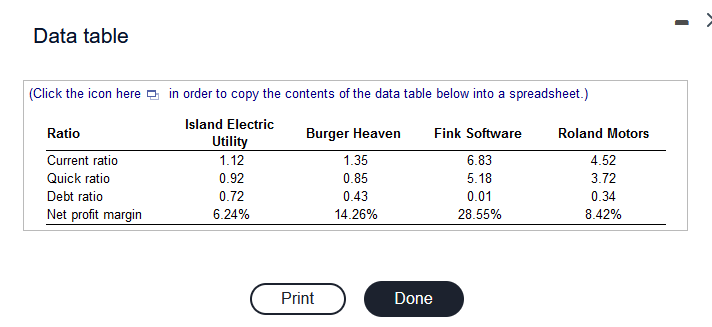
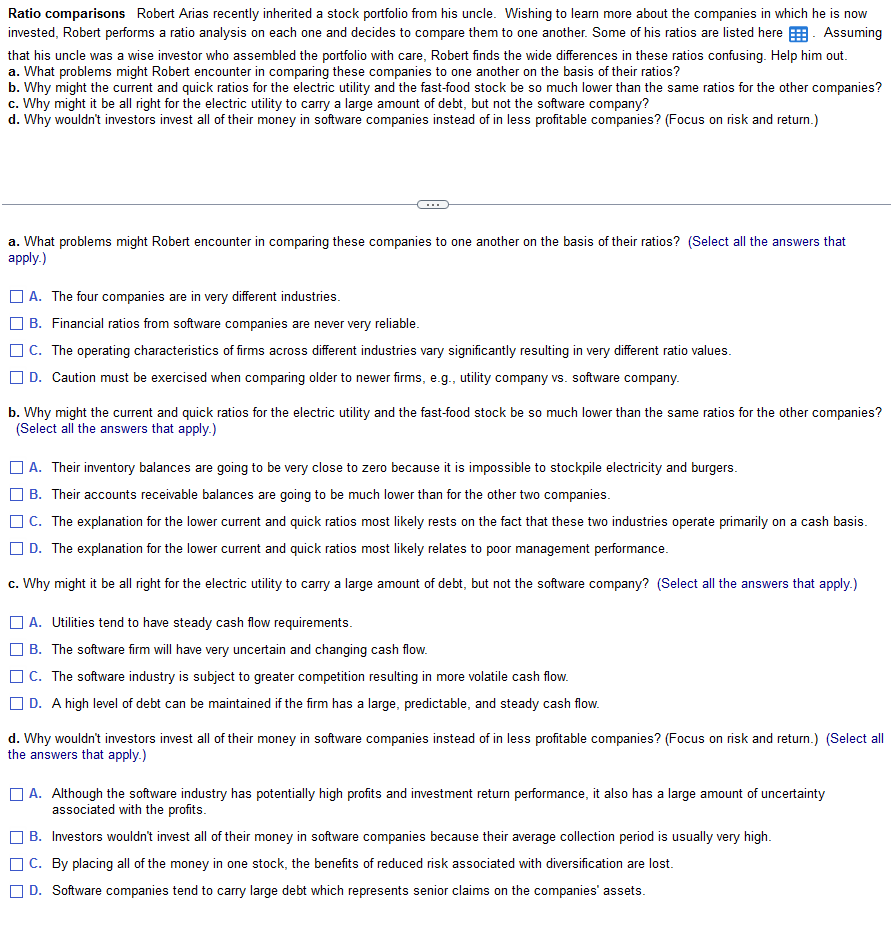
Data table (Click the icon here in order to copy the contents of the data table below into a spreadsheet.) Ratio comparisons Robert Arias recently inherited a stock portfolio from his uncle. Wishing to learn more about the companies in which he is now invested, Robert performs a ratio analysis on each one and decides to compare them to one another. Some of his ratios are listed here . Assuming that his uncle was a wise investor who assembled the portfolio with care, Robert finds the wide differences in these ratios confusing. Help him out. a. What problems might Robert encounter in comparing these companies to one another on the basis of their ratios? b. Why might the current and quick ratios for the electric utility and the fast-food stock be so much lower than the same ratios for the other companies? c. Why might it be all right for the electric utility to carry a large amount of debt, but not the software company? d. Why wouldn't investors invest all of their money in software companies instead of in less profitable companies? (Focus on risk and return.) a. What problems might Robert encounter in comparing these companies to one another on the basis of their ratios? (Select all the answers that apply.) A. The four companies are in very different industries. B. Financial ratios from software companies are never very reliable. C. The operating characteristics of firms across different industries vary significantly resulting in very different ratio values. D. Caution must be exercised when comparing older to newer firms, e.g., utility company vs. software company. b. Why might the current and quick ratios for the electric utility and the fast-food stock be so much lower than the same ratios for the other companies? (Select all the answers that apply.) A. Their inventory balances are going to be very close to zero because it is impossible to stockpile electricity and burgers. B. Their accounts receivable balances are going to be much lower than for the other two companies. C. The explanation for the lower current and quick ratios most likely rests on the fact that these two industries operate primarily on a cash basis. D. The explanation for the lower current and quick ratios most likely relates to poor management performance. c. Why might it be all right for the electric utility to carry a large amount of debt, but not the software company? (Select all the answers that apply.) A. Utilities tend to have steady cash flow requirements. B. The software firm will have very uncertain and changing cash flow. C. The software industry is subject to greater competition resulting in more volatile cash flow. D. A high level of debt can be maintained if the firm has a large, predictable, and steady cash flow. d. Why wouldn't investors invest all of their money in software companies instead of in less profitable companies? (Focus on risk and return.) (Select al the answers that apply.) A. Although the software industry has potentially high profits and investment return performance, it also has a large amount of uncertainty associated with the profits. B. Investors wouldn't invest all of their money in software companies because their average collection period is usually very high. C. By placing all of the money in one stock, the benefits of reduced risk associated with diversification are lost. D. Software companies tend to carry large debt which represents senior claims on the companies" assets
Step by Step Solution
There are 3 Steps involved in it

Get step-by-step solutions from verified subject matter experts
 Study Help