



Question: Dave is a high school graduate deciding whether or not to go to university. Suppose he lives for two periods after high school. In
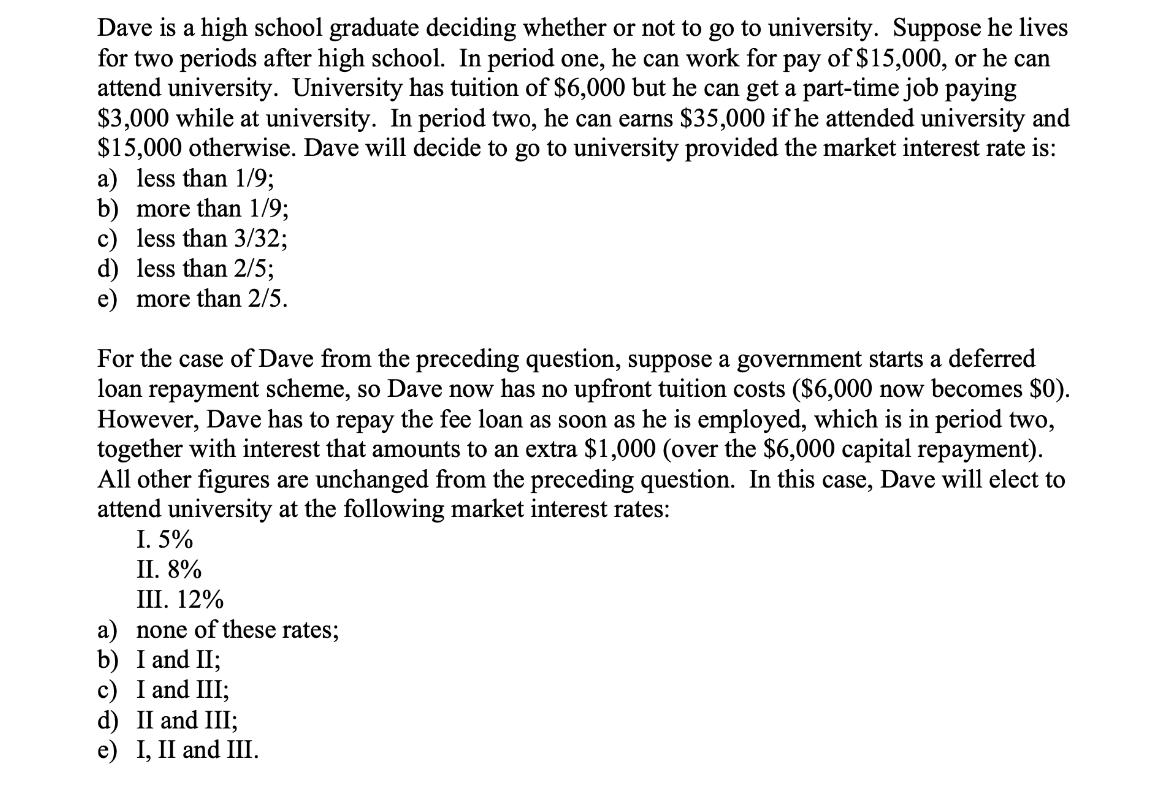
Dave is a high school graduate deciding whether or not to go to university. Suppose he lives for two periods after high school. In period one, he can work for pay of $15,000, or he can attend university. University has tuition of $6,000 but he can get a part-time job paying $3,000 while at university. In period two, he can earns $35,000 if he attended university and $15,000 otherwise. Dave will decide to go to university provided the market interest rate is: a) less than 1/9; b) more than 1/9; c) less than 3/32; d) less than 2/5; e) more than 2/5. For the case of Dave from the preceding question, suppose a government starts a deferred loan repayment scheme, so Dave now has no upfront tuition costs ($6,000 now becomes $0). However, Dave has to repay the fee loan as soon as he is employed, which is in period two, together with interest that amounts to an extra $1,000 (over the $6,000 capital repayment). All other figures are unchanged from the preceding question. In this case, Dave will elect to attend university at the following market interest rates: I. 5% II. 8% III. 12% a) none of these rates; b) I and II; c) I and III; d) II and III; e) I, II and III.
Step by Step Solution
3.43 Rating (159 Votes )
There are 3 Steps involved in it
Part ... View full answer

Get step-by-step solutions from verified subject matter experts