







Question: Decide if each Sample student response is correct or incorrect. Explain why. FRQ AND RESPONSEOPTION 1 John Benton was charged with burglary and larceny in
Decide if each Sample student response is correct or incorrect. Explain why.
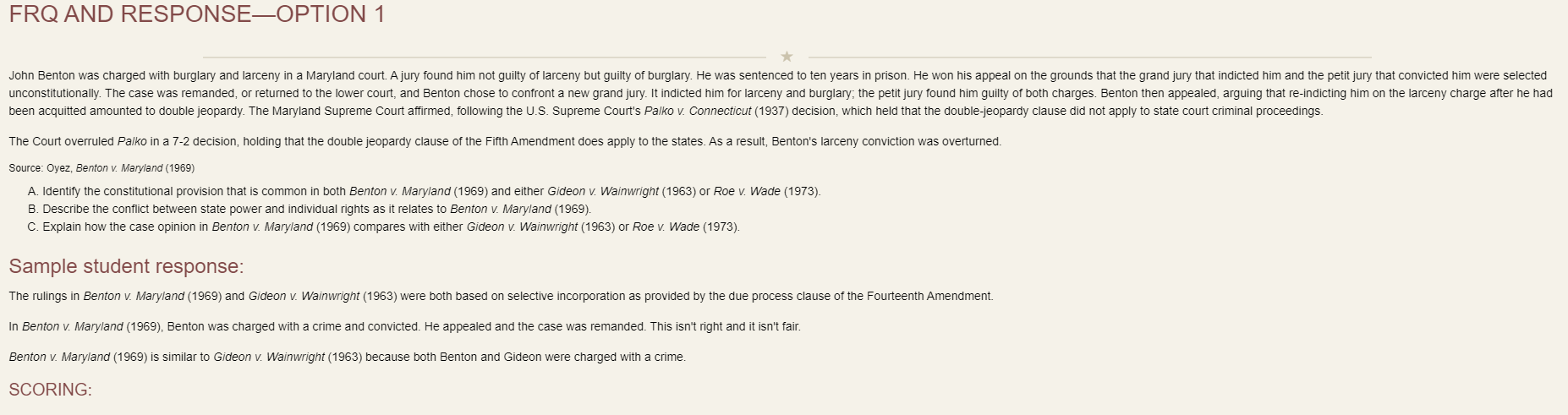
FRQ AND RESPONSEOPTION 1 John Benton was charged with burglary and larceny in a Maryland court. A jury found him not guilty of larceny but guilty of burglary. He was sentenced to ten years in prison. He won his appeal on the grounds that the grand jury that indicted him and the petit jury that convicted him were selected unconstitutionally. The case was remanded, or returned to the lower court, and Benton chose to confront a new grand jury. It indicted him for larceny and burglary, the petit jury found him guilty of both charges. Benton then appealed arguing that re-indicting him on the larceny charge after he had been acquitted amounted to double jeopardy. The Maryland Supreme Court affirmed, following the U.S. Supreme Court's Palko v. Connecticut (1937) decision, which held that the double-jeopardy clause did not apply to state court criminal proceedings. The Court overruled Palko in a 7-2 decision, holding that the double jeopardy clause of the Fifth Amendment does apply to the states. As a result, Benton's larceny conviction was overturned. Source: Oyez, Benton v. Maryland (1969) A. Identify the constitutional provision that is common in both Benton v. Maryland (1969) and either Gideon v. Wainwright (1963) or Roe v. Wade (1973). B. Describe the conflict between state power and individual rights as it relates to Benton v. Maryland (1969). C. Explain how the case opinion in Benton v. Maryland (1969) compares with either Gideon v. Wainwright (1963) or Roe v. Wade (1973). Sample student response: The rulings in Benton v. Maryland (1969) and Gideon v. Wainwright (1963) were both based on selective incorporation as provided by the due process clause of the Fourteenth Amendment. In Benton v. Maryland (1969), Benton was charged with a crime and convicted. He appealed and the case was remanded. This isn't right and it isn't fair. Benton v. Maryland (1969) is similar to Gideon v. Wainwright (1963) because both Benton and Gideon were charged with a crime. SCORINGStep by Step Solution
There are 3 Steps involved in it
1 Expert Approved Answer
Step: 1 Unlock

Question Has Been Solved by an Expert!
Get step-by-step solutions from verified subject matter experts
Step: 2 Unlock
Step: 3 Unlock
 Study Help