







Question: Define the cache memory size, block size, and associativity as constants (cache_size, block_size, and associativity). Also, define the replacement policy, which could be selected
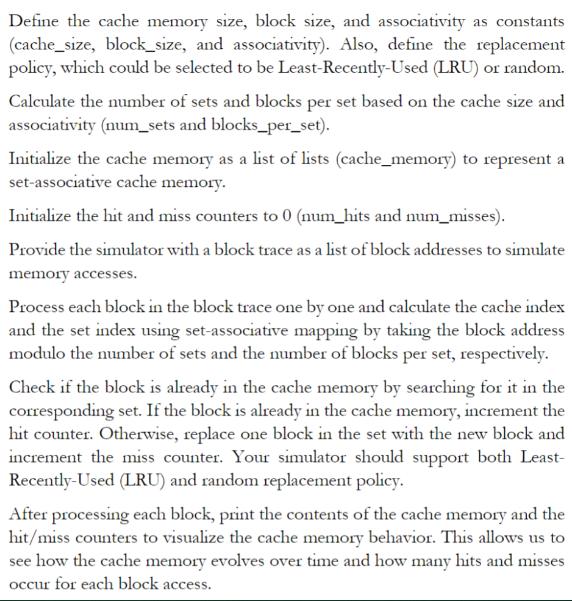
Define the cache memory size, block size, and associativity as constants (cache_size, block_size, and associativity). Also, define the replacement policy, which could be selected to be Least-Recently-Used (LRU) or random. Calculate the number of sets and blocks per set based on the cache size and associativity (num_sets and blocks_per_set). Initialize the cache memory as a list of lists (cache_memory) to represent a set-associative cache memory. Initialize the hit and miss counters to 0 (num_hits and num_misses). Provide the simulator with a block trace as a list of block addresses to simulate memory accesses. Process each block in the block trace one by one and calculate the cache index and the set index using set-associative mapping by taking the block address modulo the number of sets and the number of blocks per set, respectively. Check if the block is already in the cache memory by searching for it in the corresponding set. If the block is already in the cache memory, increment the hit counter. Otherwise, replace one block in the set with the new block and increment the miss counter. Your simulator should support both Least- Recently-Used (LRU) and random replacement policy. After processing each block, print the contents of the cache memory and the hit/miss counters to visualize the cache memory behavior. This allows us to see how the cache memory evolves over time and how many hits and misses occur for each block access.
Step by Step Solution
There are 3 Steps involved in it
Heres a Python code example that implements the described cache simulator with support for both LRU and random replacement policies import random Cons... View full answer

Get step-by-step solutions from verified subject matter experts
 Study Help