







Question: Derive Eq. 15.4 from Eq. 15.3, proving that it is the correct value for the critical radius of a spherical nucleus.This does not mean plugging
Derive Eq. 15.4 from Eq. 15.3, proving that it is the correct value for the critical radius of a spherical nucleus.This does not mean plugging Eq. 15.3 into 15.4 and solving. It requires basic calculus.
??
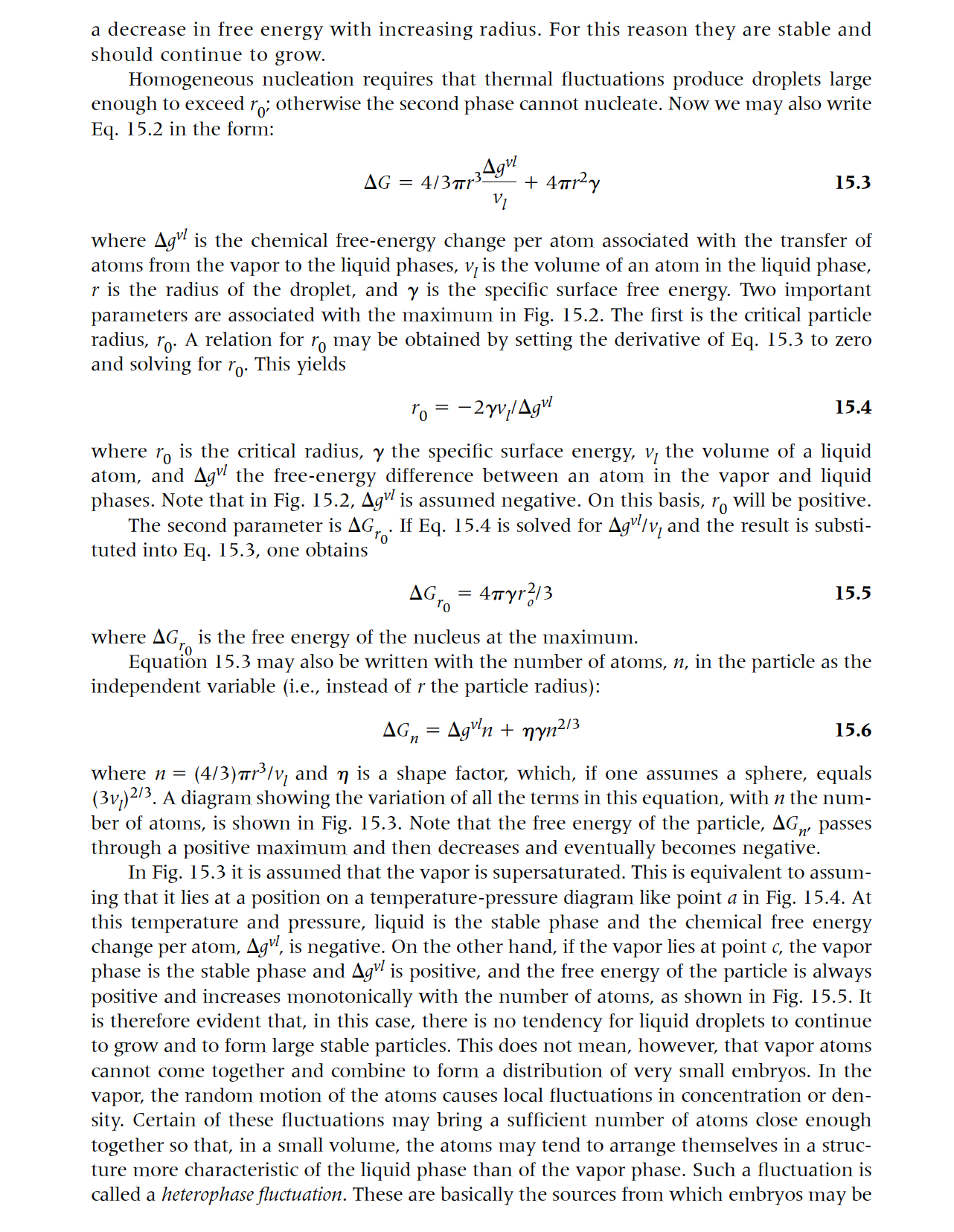
a decrease in free energy with increasing radius. For this reason they are stable and should continue to grow. Homogeneous nucleation requires that thermal uctuations produce droplets large enough to exceed r ; otherwise the second phase cannot nucleate. Now We may also Write Eq. 15.2 in the form: Ag\" V1 AG = 413m3 + 4m2y 15.3 where Ag\" is the chemical free-energy change per atom associated with the transfer of atoms from the vapor to the liquid phases, v! is the volume of an atom in the liquid phase, I" is the radius of the droplet, and 'y is the specic surface free energy. Two important parameters are associated with the maximum in Fig. 15.2. The rst is the critical particle radius, 1\"). A relation for r0 may be obtained by setting the derivative of Eq. 15.3 to zero and solving for To. This yields r0 = 2yv,/Agv1 15.4 Where r0 is the critical radius, 7 the specic surface energy, vi the volume of a liquid atom, and Ag\" the free-energy difference between an atom in the vapor and liquid phases. Note that in Fig. 15.2, Ag\" is assumed negative. On this basis, r0 will be positive. The second parameter is AGr . If Eq. 15.4 is solved for Agvzlv: and the result is substi- tuted into Eq. 15.3, one obtains 0 _ 2 AGTO 41T'YT'0/3 15.5 where AGrO is the free energy of the nucleus at the maximum. Equation 15.3 may also be written with the number of atoms, n, in the particle as the independent variable (i.e., instead of r the particle radius): AG\" = Agn + 7330125 15.6 Where n = (413)7173/1/1 and n is a shape factor, which, if one assumes a sphere, equals (3v[)2'3. A diagram showing the variation of all the terms in this equation, with n the num- ber of atoms, is shown in Fig. 15.3. Note that the free energy of the particle, AG\
Step by Step Solution
There are 3 Steps involved in it

Get step-by-step solutions from verified subject matter experts
 Study Help