







Question: Description of assignment: The data presented in this assignment is stored in the file named Veneer.csv located in the Assignment 3 folder in the Topic
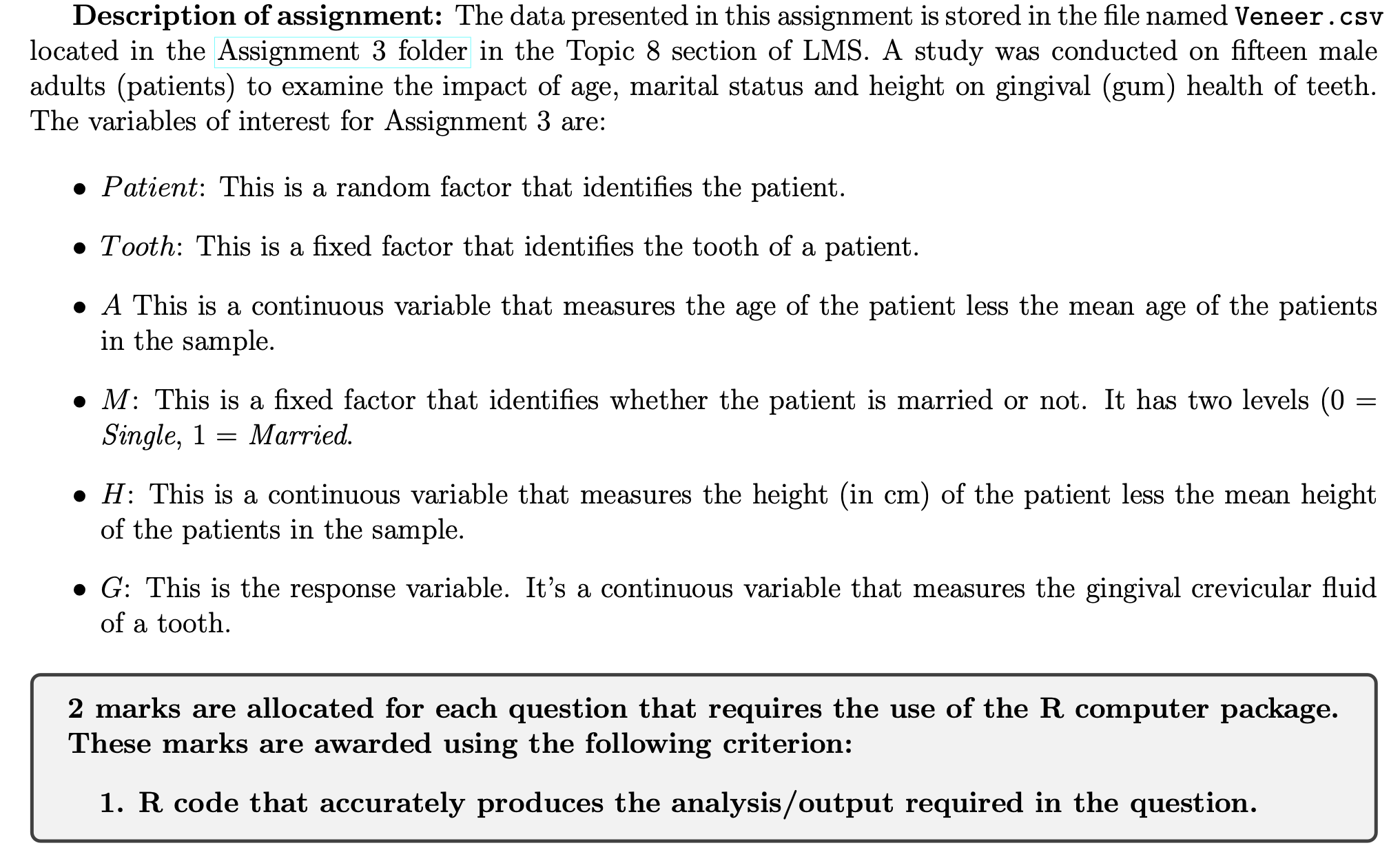
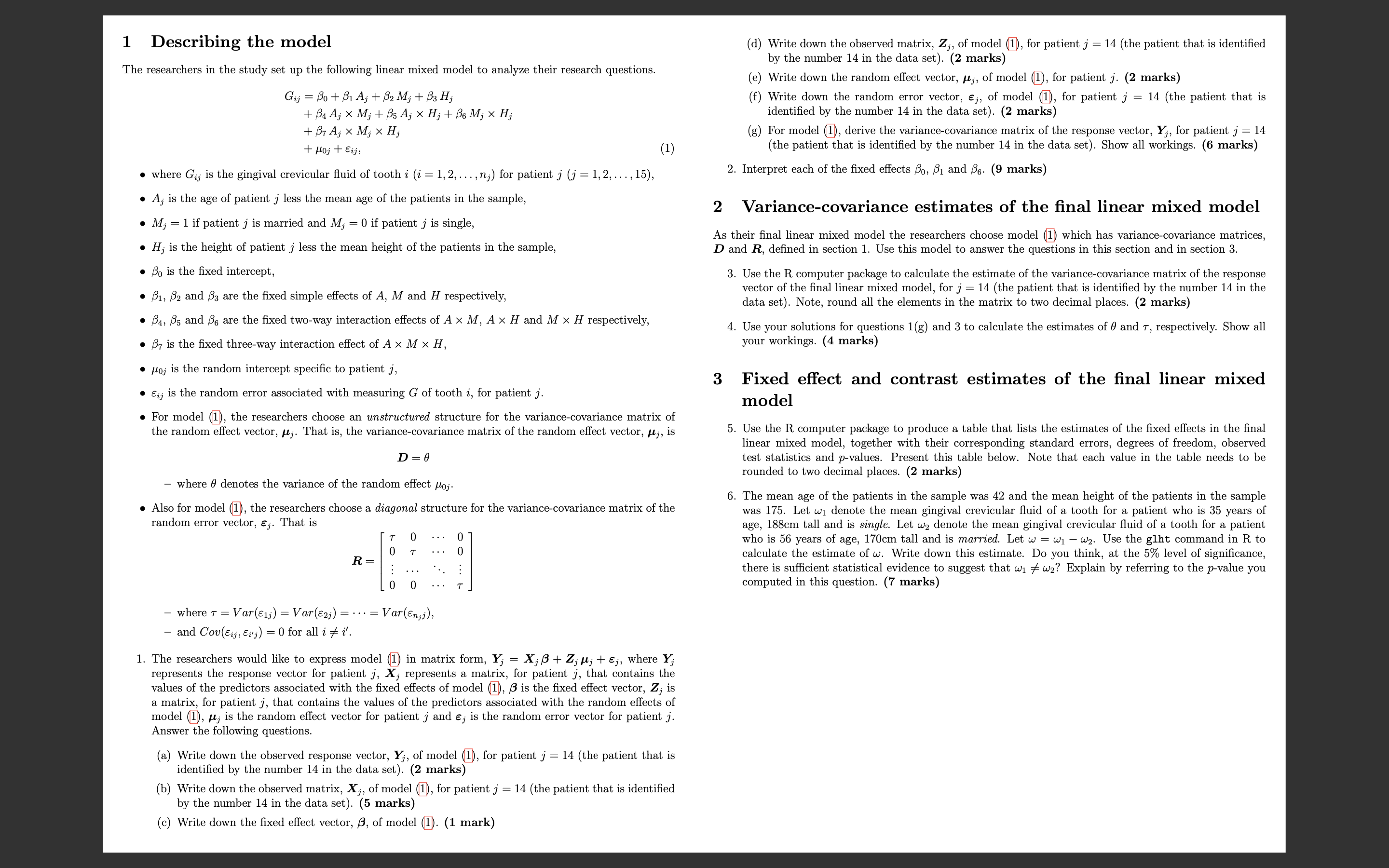
Description of assignment: The data presented in this assignment is stored in the file named Veneer.csv located in the Assignment 3 folder in the Topic 8 section of LMS. A study was conducted on fifteen male adults (patients) to examine the impact of age, marital status and height on gingival (gum) health of teeth. The variables of interest for Assignment 3 are: e Patient: This is a random factor that identifies the patient. Tooth: This is a fixed factor that identifies the tooth of a patient. e A This is a continuous variable that measures the age of the patient less the mean age of the patients in the sample. e M: This is a fixed factor that identifies whether the patient is married or not. It has two levels (0 = Single, 1 = Married. e H: This is a continuous variable that measures the height (in cm) of the patient less the mean height of the patients in the sample. e (G: This is the response variable. It's a continuous variable that measures the gingival crevicular fluid of a tooth. 2 marks are allocated for each question that requires the use of the R computer package. These marks are awarded using the following criterion: 1. R code that accurately produces the analysis/output required in the question. 1 Describing the model (d) Write down the observed matrix, Z;, of model (1), for patient j = 14 (the patient that is identified : oo . } ) by the number 14 in the data set). (2 marks) The researchers in the study set up the following linear mixed model to analyze their research questions. {6 i SO meHaL i) i (2isusriy Gij=Po+BiAj+ B M+ Bs H; + B1Aj x Mj + Bs A; x Hj + Bs M; x H; + Br Aj x M x Hj + Hoj + 3, 1) (f) Write down the random error vector, ;, of model (1), for patient j = 14 (the patient that is identified by the number 14 in the data set). (2 marks) (g) For model (L), derive the variance-covariance matrix of the response vector, Y;, for patient j = 14 (the patient that is identified by the number 14 in the data set). Show all workings. (6 marks) o where Gy; is the gingival crevicular fluid of tooth i (i = 1,2, ... ,n;) for patient j (j = 1,2,...,15), 2. Interpret each of the fixed effects fo, By and f;. (9 marks) o A; is the age of patient j less the mean age of the patients in the sample, 2 Variance-covariance estimates of the final linear mixed model e M; =1 if patient j is married and M; = 0 if patient j is single, As their final linear mixed model the researchers choose model (1) which has variance-covariance matrices, e Hj is the height of patient j less the mean height of the patients in the sample, D and R, defined in section 1. Use this model to answer the questions in this section and in section 3. o By is the fixed intercept, o B1, B> and By are the fixed simple effects of A, M and H respectively, o By, B5 and B are the fixed two-way interaction effects of A x M, A x H and M x H respectively, o B is the fixed three-way interaction effect of A x M x H, o yug; is the random intercept specific to patient j, is the random error associated with measuring G of tooth 4, for patient j. For model (1), the researchers choose an unstructured structure for the variance-covariance matrix of the random effect vector, p;. That is, the variance-covariance matrix of the random effect vector, p, is D=9 where denotes the variance of the random effect io;. Also for model (1), the researchers choose a diagonal structure for the variance-covariance matrix of the random error vector, ;. That is where 7 = Var(ey;) = Var(ey;) = - = Var(en,;), and Cov(ej, ;) = 0 for all i # 7. . The researchers would like to express model (1) in matrix form, ; = X;8 + Z; u; + ;, where Y} represents the response vector for patient j, X; represents a matrix, for patient j, that contains the values of the predictors associated with the fixed effects of model (1), B is the fixed effect vector, Z; is a matrix, for patient j, that contains the values of the predictors associated with the random effects of model (1), p; is the random effect vector for patient j and ; is the random error vector for patient j. Answer the following questions. (a) Write down the observed response vector, Y;, of model (1), for patient j = 14 (the patient that is identified by the number 14 in the data set). (2 marks) (b) Write down the observed matrix, X, of model (1), for patient j = 14 (the patient that is identified by the number 14 in the data set). (5 marks) (c) Write down the fixed effect vector, B, of model (1). (1 mark) 3. Use the R computer package to calculate the estimate of the variance-covariance matrix of the response vector of the final linear mixed model, for j = 14 (the patient that is identified by the number 14 in the data set). Note, round all the elements in the matrix to two decimal places. (2 marks) . Use your solutions for questions 1(g) and 3 to calculate the estimates of and 7, respectively. Show all your workings. (4 marks) Fixed effect and contrast estimates of the final linear mixed model . Use the R computer package to produce a table that lists the estimates of the fixed effects in the final linear mixed model, together with their corresponding standard errors, degrees of freedom, observed test statistics and p-values. Present this table below. Note that each value in the table needs to be rounded to two decimal places. (2 marks) . The mean age of the patients in the sample was 42 and the mean height of the patients in the sample was 175. Let w; denote the mean gingival crevicular fluid of a tooth for a patient who is 35 years of age, 188cm tall and is single. Let w, denote the mean gingival crevicular fluid of a tooth for a patient who is 56 years of age, 170cm tall and is married. Let w = w; w,. Use the glht command in R to calculate the estimate of w. Write down this estimate. Do you think, at the 5% level of significance, there is sufficient statistical evidence to suggest that w; # ws? Explain by referring to the p-value you computed in this question. (7 marks)
Step by Step Solution
There are 3 Steps involved in it

Get step-by-step solutions from verified subject matter experts
 Study Help