



Question: despite an increasingly globalized world, however, it turns out that high performing firms im certain industries are concentrated in specific countries. Although globalization lowers barriers
despite an increasingly globalized world, however, it turns out that high performing firms im certain industries are concentrated in specific countries. Although globalization lowers barriers to trade and investments and increases human capital mobility, one key question remains: why are certain industries more competitive in some countries than others? (Rothaermel, 2021, p. 376) 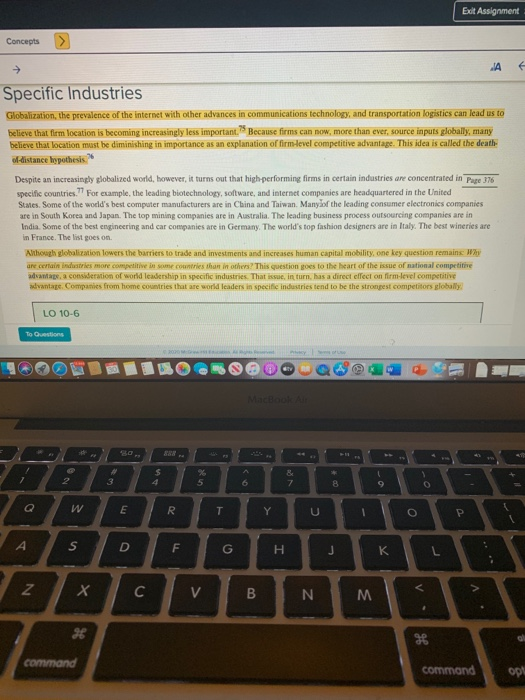
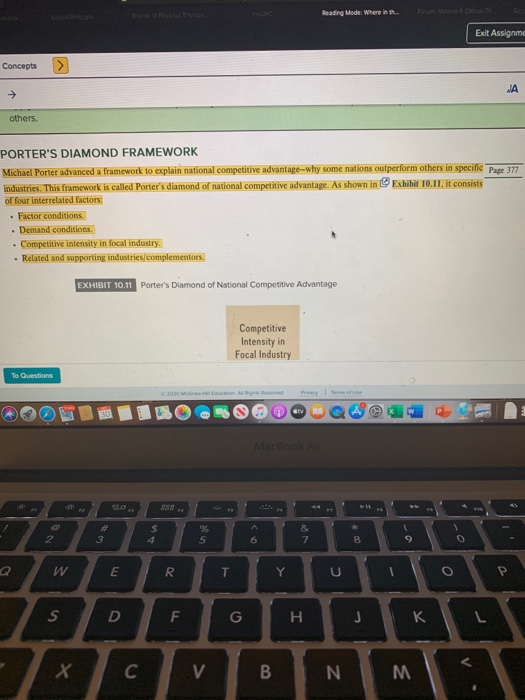

apply porter's diamond framework to explain why certain industries are more competitive in specific nations than others.
(500 words minimum)
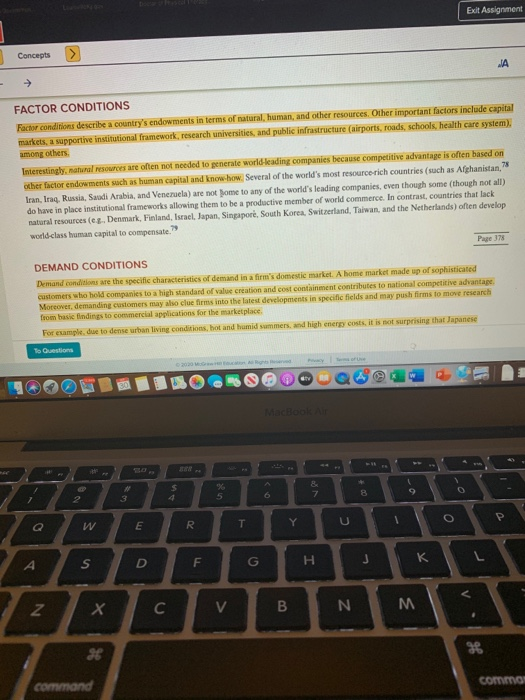
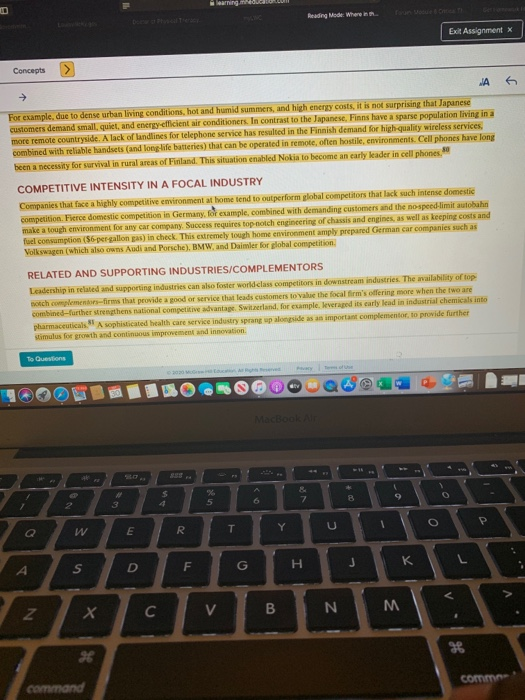
Exit Assignment Concepts > Specific Industries Globalization, the prevalence of the internet with other advances in communications technology, and transportation logistics can lead us to believe that firm location is becoming increasingly less important. Because firms can now, more than ever, source inputs globally, many believe that location must be diminishing in importance as an explanation of firmlevel competitive advantage. This idea is called the death distance hypothesis Despite an increasingly globalized world, however, it turns out that high performing firms in certain industries are concentrated in Page 376 specific countries. For example, the leading biotechnology, software, and internet companies are headquartered in the United States. Some of the world's best computer manufacturers are in China and Thiwan. Many of the leading consumer electronics companies are in South Korea and Japan. The top mining companies are in Australia. The leading business process outsourcing companies are in India. Some of the best engineering and car companies are in Germany. The world's top fashion designers are in Italy. The best wineries are in France. The list goes on. Although globalization lowers the barriers to trade and investments and increases human capital mobility, one key question remains Why are certain industries more competitive in some countries than in others? This question goes to the heart of the issue of national competitive advantage, a consideration of world leadership in specific industries. That issue, in turn, has a direct effect on firm-level competitive advantage Companies from home countries that are world leaders in specific industries tend to be the strongest competitors globally LO 10-6 To Questions 200. $ 4 2 3 5 & 7 6 8 9 E R T Y C 1 o P A S D F G H J K L N x V C V B N . * command command Opl Reading Mode: Where in Exit Assignme Concepts > others. PORTER'S DIAMOND FRAMEWORK Michael Porter advanced a framework to explain national competitive advantage-why some nations outperform others in specific Page 377 industries. This framework is called Porter's diamond of national competitive advantage. As shown in Exhibit 10.11, it consists of four interrelated factors Factor conditions . Demand conditions . Competitive intensity in focal industry. . Related and supporting industries complementors. EXHIBIT 10.11 Porter's Diamond of National Competitive Advantage Competitive Intensity in Focal Industry To Questions es MacBook Air $ 4 % 5 8 7 3 6 8 9 0 Q W E R T Y 0 S D F G . J K L V B N M Exit Assignment Concepts IA FACTOR CONDITIONS Factor conditions describe a country's endowments in terms of natural, human, and other resources. Other important factors include capital markets, a supportive institutional framework, research universities, and public infrastructure airports, roads, schools, health care system). among others Interestingly, natural resources are often not needed to generate world leading companies because competitive advantage is often based on other factor endowments such as human capital and know-how. Several of the world's most resource rich countries (such as Afghanistan, 78 Iran, Iraq, Russia, Saudi Arabia, and Venezuela) are not ome to any of the world's leading companies, even though some though not all) do have in place institutional frameworks allowing them to be a productive member of world commerce. In contrast, countries that lack natural resources (eg, Denmark, Finland, Israel, Japan, Singapore, South Korea, Switzerland Taiwan, and the Netherlands) often develop world-class human capital to compensate. Page 378 DEMAND CONDITIONS Demand conditions are the specific characteristics of demand in a firm's domestic market. A home market made up of sophisticated customers who hold companies to a high standard of value creation and cost containment contributes to national competitive advantage Moreover, demanding customers may also clue firms into the latest developments in specific fields and may push firms to move research from basic findings to commercial applications for the marketplace For example, due to dense urban living conditions, hot and humid summers, and high energy costs, it is not surprising that Japanese To Questions - $ 4 & 7 8 7 6 2 3 5 C C I Q w E Y T R G S F K A . D N C V B N 3 V. 42 common command learning med Reading Mode: Where Exit Assignment x Concepts 6 For example, due to dense urban living conditions, hot and humid summers, and high energy costs, it is not surprising that Japanese customers demand small, quiet, and energy efficient air conditioners. In contrast to the Japanese, Finns have a sparse population living in a more remote countryside. A lack of landlines for telephone service has resulted in the Finnish demand for high quality wireless services, combined with reliable handsets and long-life batteries) that can be operated in remote, often hostile, environments. Cell phones have long been a necessity for survival in rural areas of Finland. This situation enabled Nokia to become an early leader in cell phones 80 COMPETITIVE INTENSITY IN A FOCAL INDUSTRY Companies that face a highly competitive environment at home tend to outperform global competitors that lack such intense domestic competition. Fierce domestic competition in Germany, for example, combined with demanding customers and the no-speed limit autobahn make a tough environment for any car company. Success requires top notch engineering of chassis and engines, as well as keeping costs and fuel consumption (56 per gallon gas) in check. This extremely tough home environment amply prepared German car companies such as Volkswagen (which also owns Audi and Porsche), BMW, and Daimler for global competition RELATED AND SUPPORTING INDUSTRIES/COMPLEMENTORS Leadership in related and supporting industries can also foster world class competitors in downstream industries. The availability of top notch complementos firms that provide a good or service that leads customers to value the focal firm's offering more when the two are combined-further strengthens national competitive advantage Switzerland, for example, leveraged its carly lead in industrial chemicals into pharmaceuticals. A sophisticated health care service industry sprang up alongside as an important complementor, to provide further stimulus for growth and continuous improvement and innovation To Questions GY MacBook $ 5 8 7 6 Y O 1 T R C Q E S F D G J H K A Z C V B N M 38 Com command learning Reading Mode where in the Exit Assignment Concepts JA 6 Leadership in related and supporting industries can ako foster world class competitors in downstream industries. The availability of top notch complementors-firms that provide a good or service that leads customers to value the focal firm's offering more when the two are combined further strengthens national competitive advantage. Switzerland, for example, leveraged its early lead in industrial chemicals into pharmaceuticals. A sophisticated health care service industry sprang up alongside as an important complementor, to provide further stimulus for growth and continuous improvement and innovation The effects of sophisticated customers and highly competitive industries ripple through the industry value chain to create top-notch suppliers and complementors. Toyota's global success in the 1990s and early 2000s was based to a large extent on a network of world class suppliers in Japan." This tightlyknit network allowed for fast two-way knowledge sharing this in turn improved Toyota's quality and lowered its cost, which it leveraged into a successful blue ocean strategy at the business level. It is also interesting to note that by 2010, Toyota's supplier advantage had disappeared. It was unable to solve the trade-off between drastically increasing its volume and maintaining superior quality. Toyota's rapid growth in its quest to become the world's leader in volume required quickly bringing on new suppliers outside Japan. Quality standards, however, could not be maintained. Part of the problem lies in path dependence (discussed in Chapter 4), because Chinese and other suppliers could not be found quickly enough, nor could most foreign suppliers build at the required quality levels fast enough. The cultural distance between Japan and China exacerbated these problems. Combined, these factors explain the quality problems Toyota experienced in recent years, and highlight the importance of related and supporting industries to national competitive advantage To Questions Gtv MacBook $ % 5 7 B o 7 2 3 P 1 R. w C E Y . J F S . K A D V V Z X M V B N * command Step by Step Solution
There are 3 Steps involved in it
1 Expert Approved Answer
Step: 1 Unlock

Question Has Been Solved by an Expert!
Get step-by-step solutions from verified subject matter experts
Step: 2 Unlock
Step: 3 Unlock