







Question: Digital Computer Logic questions. 1. 1. A sequential network has one input X and one output Y. Initially the output is a 0. The output
Digital Computer Logic questions.
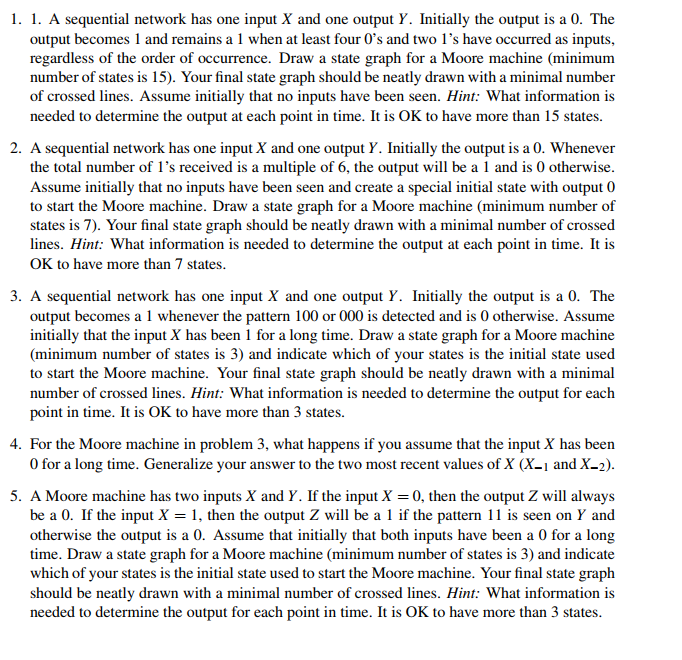
1. 1. A sequential network has one input X and one output Y. Initially the output is a 0. The output becomes 1 and remains a 1 when at least four 0's and two 1's have occurred as inputs, regardless of the order of occurrence. Draw a state graph for a Moore machine (minimum number of states is 15). Your final state graph should be neatly drawn with a minimal number of crossed lines. Assume initially that no inputs have been seen. Hint: What information is needed to determine the output at each point in time. It is OK to have more than 15 states. 2. A sequential network has one input X and one output Y. Initially the output is a 0. Whenever the total number of 1's received is a multiple of 6, the output will be a 1 and is 0 otherwise Assume initially that no inputs have been seen and create a special initial state with output 0 to start the Moore machine. Draw a state graph for a Moore machine (minimum number of states is 7). Your final state graph should be neatly drawn with a minimal number of crossed lines. Hint: What information is needed to determine the output at each point in time. It is OK to have more than 7 states 3. A sequential network has one input X and one output Y. Initially the output is a 0. The output becomes a 1 whenever the pattern 100 or 000 is detected and is 0 otherwise. Assume initially that the input X has been 1 for a long time. Draw a state graph for a Moore machine (minimum number of states is 3) and indicate which of your states is the initial state used to start the Moore machine. Your final state graph should be neatly drawn with a minimal number of crossed lines. Hint: What information is needed to determine the output for each point in time. It is OK to have more than 3 states. 4. For the Moore machine in problem 3, what happens if you assume that the input X has been 0 for a long time. Generalize your answer to the two most recent values of X (X-i and X-2) 5. A Moore machine has two inputs X and Y. If the input X = 0, then the output Z will always be a 0. If the input X = 1, then the output Z will be a 1 if the pattern 1 1 is seen on Y and otherwise the output is a 0. Assume that initially that both inputs have been a 0 for a long time. Draw a state graph for a Moore machine (minimum number of states is 3) and indicate which of your states is the initial state used to start the Moore machine. Your final state graph should be neatly drawn with a minimal number of crossed lines. Hint: What information is needed to determine the output for each point in time. It is OK to have more than 3 states 1. 1. A sequential network has one input X and one output Y. Initially the output is a 0. The output becomes 1 and remains a 1 when at least four 0's and two 1's have occurred as inputs, regardless of the order of occurrence. Draw a state graph for a Moore machine (minimum number of states is 15). Your final state graph should be neatly drawn with a minimal number of crossed lines. Assume initially that no inputs have been seen. Hint: What information is needed to determine the output at each point in time. It is OK to have more than 15 states. 2. A sequential network has one input X and one output Y. Initially the output is a 0. Whenever the total number of 1's received is a multiple of 6, the output will be a 1 and is 0 otherwise Assume initially that no inputs have been seen and create a special initial state with output 0 to start the Moore machine. Draw a state graph for a Moore machine (minimum number of states is 7). Your final state graph should be neatly drawn with a minimal number of crossed lines. Hint: What information is needed to determine the output at each point in time. It is OK to have more than 7 states 3. A sequential network has one input X and one output Y. Initially the output is a 0. The output becomes a 1 whenever the pattern 100 or 000 is detected and is 0 otherwise. Assume initially that the input X has been 1 for a long time. Draw a state graph for a Moore machine (minimum number of states is 3) and indicate which of your states is the initial state used to start the Moore machine. Your final state graph should be neatly drawn with a minimal number of crossed lines. Hint: What information is needed to determine the output for each point in time. It is OK to have more than 3 states. 4. For the Moore machine in problem 3, what happens if you assume that the input X has been 0 for a long time. Generalize your answer to the two most recent values of X (X-i and X-2) 5. A Moore machine has two inputs X and Y. If the input X = 0, then the output Z will always be a 0. If the input X = 1, then the output Z will be a 1 if the pattern 1 1 is seen on Y and otherwise the output is a 0. Assume that initially that both inputs have been a 0 for a long time. Draw a state graph for a Moore machine (minimum number of states is 3) and indicate which of your states is the initial state used to start the Moore machine. Your final state graph should be neatly drawn with a minimal number of crossed lines. Hint: What information is needed to determine the output for each point in time. It is OK to have more than 3 states
Step by Step Solution
There are 3 Steps involved in it

Get step-by-step solutions from verified subject matter experts
 Study Help