







Question: Digital Design I HW # 3 4 . 9 ) An ABCD - to - seven - segment decoder is a combinational circuit that converts
Digital Design I HW #
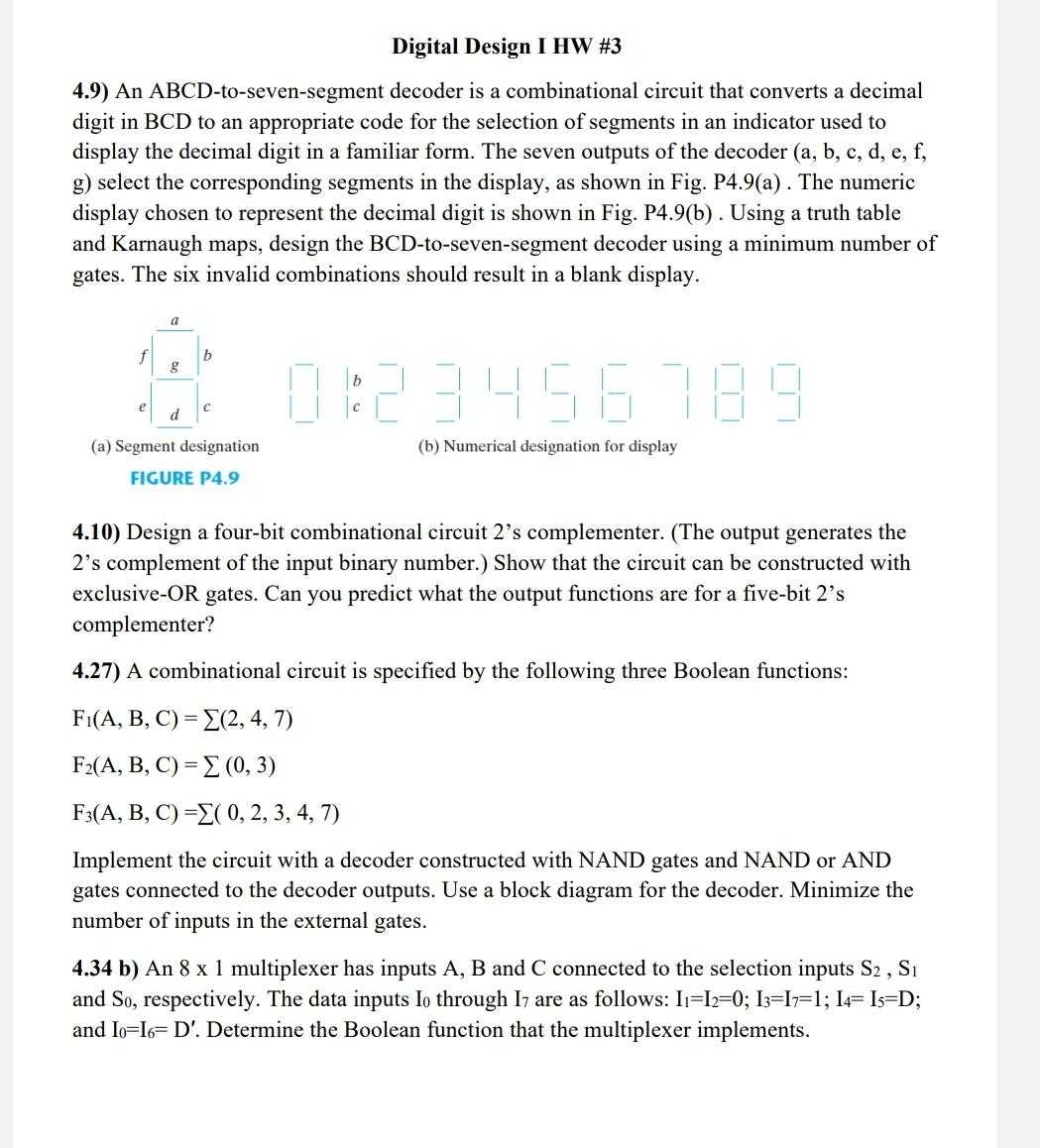
An ABCDtosevensegment decoder is a combinational circuit that converts a decimal digit in to an appropriate code for the selection of segments in an indicator used to display the decimal digit in a familiar form. The seven outputs of the decoder a b c d e f g select the corresponding segments in the display, as shown in Fig. Pa The numeric display chosen to represent the decimal digit is shown in Fig. Pb Using a truth table and Karnaugh maps, design the BCDtosevensegment decoder using a minimum number of gates. The six invalid combinations should result in a blank display.
a Segment designation
b Numerical designation for display
FIGURE P
Design a fourbit combinational circuit s complementer. The output generates the s complement of the input binary number. Show that the circuit can be constructed with exclusiveOR gates. Can you predict what the output functions are for a fivebit s complementer?
A combinational circuit is specified by the following three Boolean functions:
Implement the circuit with a decoder constructed with NAND gates and NAND or AND gates connected to the decoder outputs. Use a block diagram for the decoder. Minimize the number of inputs in the external gates.
b An multiplexer has inputs and connected to the selection inputs and respectively. The data inputs through are as follows: ;;; and Determine the Boolean function that the multiplexer implements.
Step by Step Solution
There are 3 Steps involved in it
1 Expert Approved Answer
Step: 1 Unlock

Question Has Been Solved by an Expert!
Get step-by-step solutions from verified subject matter experts
Step: 2 Unlock
Step: 3 Unlock
 Study Help