







Question: #Digital Image Processing# 3. Consider two images. Imagel is 512 x 512 pixels where the first 256 columns have brightness 0 and the last 256
#Digital Image Processing#
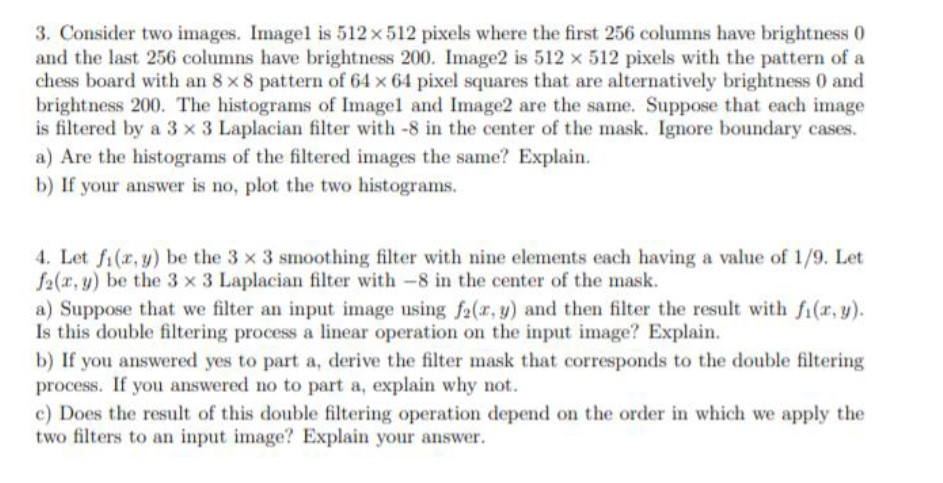
3. Consider two images. Imagel is 512 x 512 pixels where the first 256 columns have brightness 0 and the last 256 columns have brightness 200. Image2 is 512 x 512 pixels with the pattern of a chess board with an 8 x 8 pattern of 64 x 64 pixel squares that are alternatively brightness 0 and brightness 200. The histograms of Imagel and Image2 are the same. Suppose that each image is filtered by a 3 x 3 Laplacian filter with -8 in the center of the mask. Ignore boundary cases. a) Are the histograms of the filtered images the same? Explain. b) If your answer is no, plot the two histograms, 4. Let fic, y) be the 3 x 3 smoothing filter with nine elements each having a value of 1/9. Let 12(x,y) be the 3 x 3 Laplacian filter with -8 in the center of the mask. a) Suppose that we filter an input image using f2(x, y) and then filter the result with f(x,y). Is this double filtering process a linear operation on the input image? Explain. b) If you answered yes to part a, derive the filter mask that corresponds to the double filtering process. If you answered no to part a, explain why not. c) Does the result of this double filtering operation depend on the order in which we apply the two filters to an input image? Explain your answer. 3. Consider two images. Imagel is 512 x 512 pixels where the first 256 columns have brightness 0 and the last 256 columns have brightness 200. Image2 is 512 x 512 pixels with the pattern of a chess board with an 8 x 8 pattern of 64 x 64 pixel squares that are alternatively brightness 0 and brightness 200. The histograms of Imagel and Image2 are the same. Suppose that each image is filtered by a 3 x 3 Laplacian filter with -8 in the center of the mask. Ignore boundary cases. a) Are the histograms of the filtered images the same? Explain. b) If your answer is no, plot the two histograms, 4. Let fic, y) be the 3 x 3 smoothing filter with nine elements each having a value of 1/9. Let 12(x,y) be the 3 x 3 Laplacian filter with -8 in the center of the mask. a) Suppose that we filter an input image using f2(x, y) and then filter the result with f(x,y). Is this double filtering process a linear operation on the input image? Explain. b) If you answered yes to part a, derive the filter mask that corresponds to the double filtering process. If you answered no to part a, explain why not. c) Does the result of this double filtering operation depend on the order in which we apply the two filters to an input image? Explain your
Step by Step Solution
There are 3 Steps involved in it

Get step-by-step solutions from verified subject matter experts
 Study Help