







Question: Dimensionality Reduction Using PCA Bookmark this page Project due Jul 1 0 , 2 0 2 4 1 7 : 2 9 IST PCA finds
Dimensionality Reduction Using PCA
Bookmark this page
Project due Jul : IST
PCA finds orthogonal directions of maximal variation in the data. In this problem we're going to project our
data onto the principal components and explore the effects on performance.
You will be working in the files partmain py and partfeatures py in this problem
Project onto Principal Components
points graded
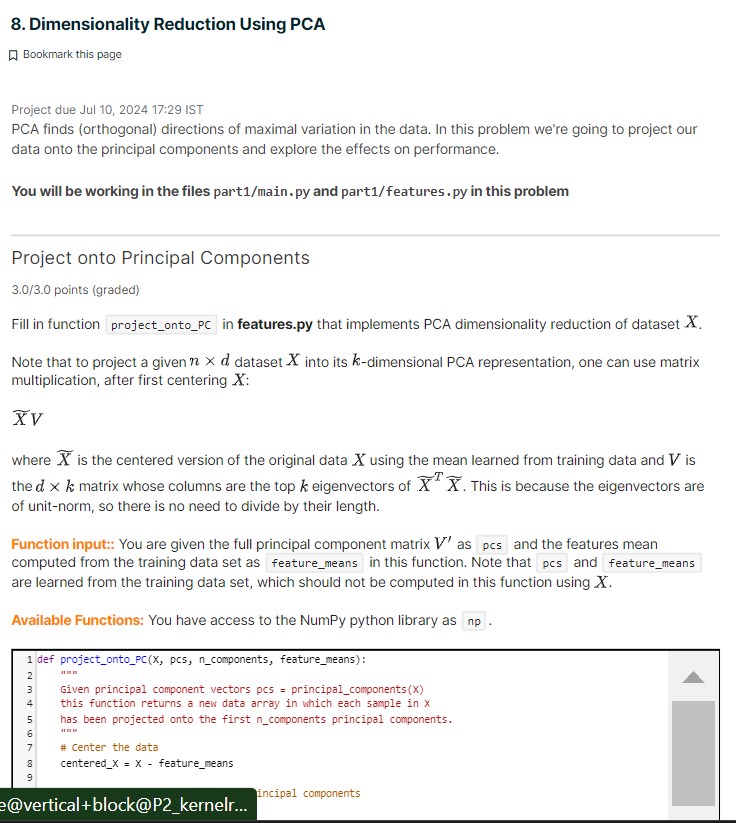
Fill in function
in
features.py that implements PCA dimensionality reduction of dataset
Note that to project a given dataset into its dimensional PCA representation, one can use matrix
multiplication, after first centering :
widetilde
where widetilde is the centered version of the original data using the mean learned from training data and is
the matrix whose columns are the top eigenvectors of widetildewidetilde This is because the eigenvectors are
of unitnorm, so there is no need to divide by their length.
Function input:: You are given the full principal component matrix as pcs and the features mean
computed from the training data set as featuremeans in this function. Note that pcs and featuremeans
are learned from the training data set, which should not be computed in this function using
Available Functions: You have access to the NumPy python library as npnnthis function returns a new data array in which each sample in nmncenteredXxmathrm featuremeans
Step by Step Solution
There are 3 Steps involved in it
1 Expert Approved Answer
Step: 1 Unlock

Question Has Been Solved by an Expert!
Get step-by-step solutions from verified subject matter experts
Step: 2 Unlock
Step: 3 Unlock
 Study Help