







Question: Discrete Mathematics. Determine whether a quantified logical statement is true. (a) x (M(x) D(x)) (b) x M(x) x D(x) (c) x M(x) D(x) (d) x
Discrete Mathematics. Determine whether a quantified logical statement is true.
(a)
x (M(x) D(x))
(b)
x M(x) x D(x)
(c)
x M(x) D(x)
(d)
x (A(x) M(x))
(e)
x (M(x) A(x))
(f)
x ((M(x) A(x)) D(x))
(g)
x (D(x) A(x) M(x))
(h)
x (D(x) (A(x) M(x)))
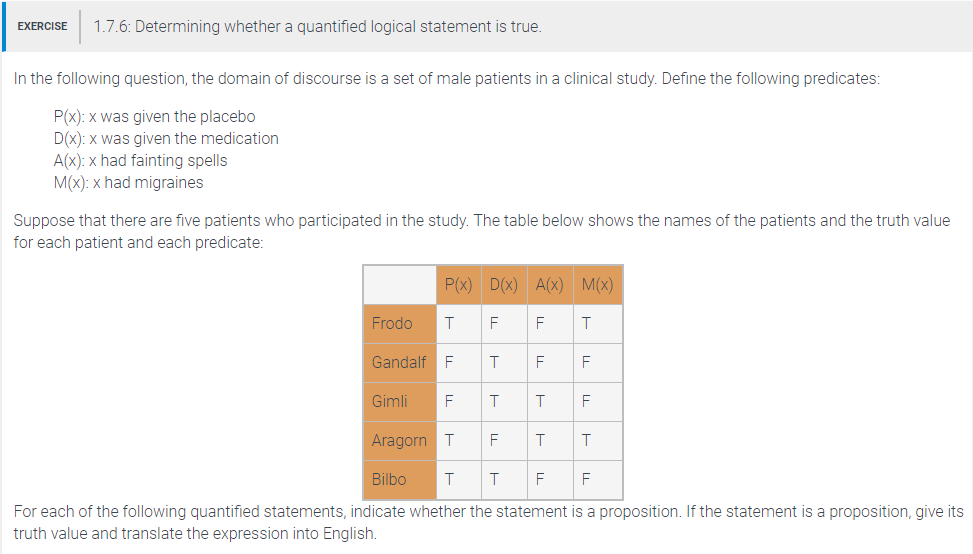
EXERCISE 1.7.6: Determining whether a quantified logical statement is true In the following question, the domain of discourse is a set of male patients in a clinical study. Define the following predicates: P(x):x was given the placebo D(x): x was given the medication A(x): x had fainting spells M(x): x had migraines Suppose that there are five patients who participated in the study. The table below shows the names of the patients and the truth value for each patient and each predicate P(x)D(x) A() MO) Frodo TF F T Gandalf F T F F GimliF T T F Aragorn T F T T BilboT T F F For each of the following quantified statements, indicate whether the statement is a proposition. If the statement is a proposition, give its truth value and translate the expression into English
Step by Step Solution
There are 3 Steps involved in it

Get step-by-step solutions from verified subject matter experts
 Study Help