Question: discussion questions and critical thinking Case Study 8.2: To Tip or Not to Tip The federal minimum wage has not changed from $7.25 per hour
discussion questions and critical thinking
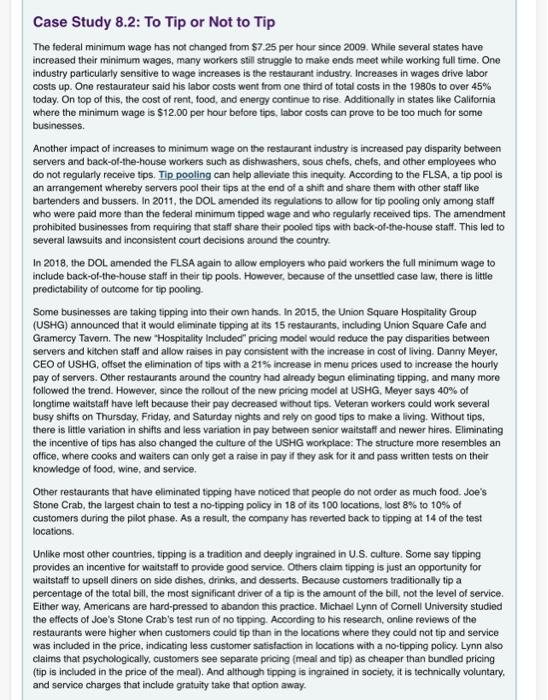
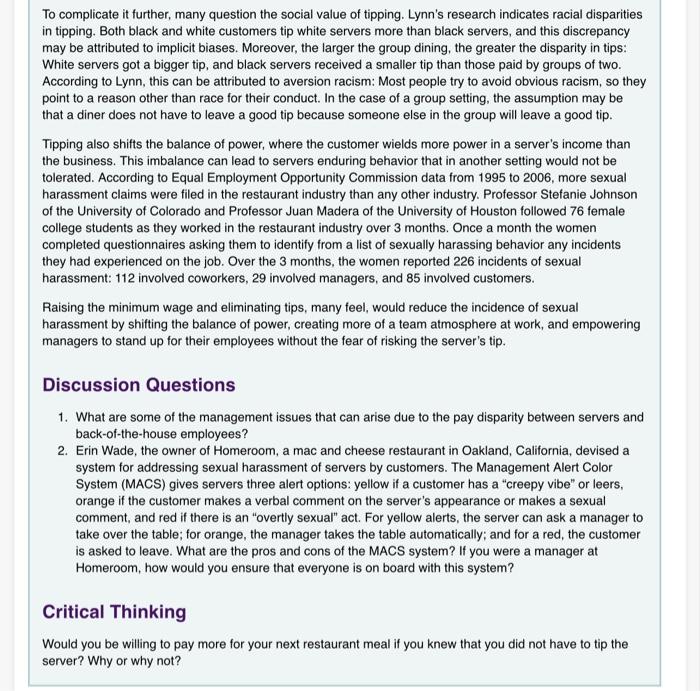
Case Study 8.2: To Tip or Not to Tip The federal minimum wage has not changed from $7.25 per hour since 2009 . While several states have increased their minimum wages, many workers still struggle to make ends meet while working full time. One industry particularly sensitive to wage increases is the restaurant industry. Increases in wages drive labor costs up. One restaurateur said his labor costs went from one third of total costs in the 1980 s to over 45% today. On top of this, the cost of rent, food, and energy continue to rise. Additionally in states like California where the minimum wage is $12.00 per hour betore tips, labor costs can prove to be too much for some businesses. Another impact of increases to minimum wage on the restaurant industry is increased pay disparity between servers and back-of-the-house workers such as dishwashers, sous chefs, chefs, and other employees who do not regularly receive tips. Tip pooling can help alleviate this inequity. According to the FLSA, a tip pool is an arrangement whereby servers pool their tips at the end of a shift and share them with other staff like bartenders and bussers. In 2011, the DOL amended its regulations to allow for tip pooling only among staff who were paid more than the federal minimum tipped wage and who regularly received tips. The amendment prohibited businesses from requiring that staff share their pooled tips with back-of-the-house staff. This led to several lawsuits and inconsistent court decisions around the country. In 2018, the DOL amended the FLSA again to allow employers who paid workers the full minimum wage to include back-of-the-house staff in their tip pools. However, because of the unsettled case law, there is little predictability of outcome for tip pooling- Some businesses are taking tipping into their own hands. In 2015, the Union Square Hospitality Group (USHG) announced that it would eliminate tipping at its 15 restaurants, including Union Square Cafe and Gramercy Tavem. The new "Hospitality Included" pricing model would reduce the pay disparities between servers and kitchen staft and allow raises in pay consistent with the increase in cost of living. Danny Meyer, CEO of USHG, offset the elimination of tips with a 21% increase in menu prices used to increase the hourly pay of servers. Other restaurants around the country had already begun eliminating tipping, and many more followed the trend. However, since the rollout of the new pricing model at USHG, Meyer says 40% of Iongtime waitstaff have left because their pay decreased without tips. Veteran workers could work several busy shifts on Thursday. Friday, and Saturday nights and rely on good tips to make a living. Without tips, there is little variation in shifts and less variation in pay between senior waitstaff and newer hires. Eliminating the incentive of tips has also changed the culture of the USHG workplace: The structure more resembles an office, where cooks and waiters can only get a raise in pay if they ask for it and pass written tests on their knowledge of food, wine, and service. Other restaurants that have eliminated tipping have noticed that people do not order as much food. Joe's Stone Crab, the largest chain to test a no-tipping policy in 18 of its 100 locations, lost 8% to 10% of customers during the pilot phase. As a result, the company has reverted back to tipping at 14 of the test locations. Unlike most other countries, tipping is a tradition and deeply ingrained in U.S, culture. Some say tipping provides an incentive for waitstaff to provide good service. Others claim tipping is just an opportunity for waitstatf to upsell diners on side clishes, drinks, and desserts. Because customers traditionally tip a percentage of the total bill, the most significant driver of a tip is the amount of the bill, not the level of service. Either way. Americans are hard-pressed to abandon this practice. Michael Lynn of Cornell University studied the effects of Joe's Stone Crab's test run of no tipping. According to his research, online reviews of the restaurants were higher when customers could tip than in the locations where they could not tip and service was included in the price, indicating less customer satisfaction in locations with a no-tipping policy. Lynn also claims that psychologically, customers see separate pricing (meal and tip) as cheaper than bundled pricing (tip is included in the price of the meal). And although tipping is ingrained in society, it is technically voluntary. and service charges that include gratuity take that option away. To complicate it further, many question the social value of tipping. Lynn's research indicates racial disparities in tipping. Both black and white customers tip white servers more than black servers, and this discrepancy may be attributed to implicit biases. Moreover, the larger the group dining, the greater the disparity in tips: White servers got a bigger tip, and black servers received a smaller tip than those paid by groups of two. According to Lynn, this can be attributed to aversion racism: Most people try to avoid obvious racism, so they point to a reason other than race for their conduct. In the case of a group setting, the assumption may be that a diner does not have to leave a good tip because someone else in the group will leave a good tip. Tipping also shifts the balance of power, where the customer wields more power in a server's income than the business. This imbalance can lead to servers enduring behavior that in another setting would not be tolerated. According to Equal Employment Opportunity Commission data from 1995 to 2006, more sexual harassment claims were filed in the restaurant industry than any other industry. Professor Stefanie Johnson of the University of Colorado and Professor Juan Madera of the University of Houston followed 76 female college students as they worked in the restaurant industry over 3 months. Once a month the women completed questionnaires asking them to identify from a list of sexually harassing behavior any incidents they had experienced on the job. Over the 3 months, the women reported 226 incidents of sexual harassment: 112 involved coworkers, 29 involved managers, and 85 involved customers. Raising the minimum wage and eliminating tips, many feel, would reduce the incidence of sexual harassment by shifting the balance of power, creating more of a team atmosphere at work, and empowering managers to stand up for their employees without the fear of risking the server's tip. Discussion Questions 1. What are some of the management issues that can arise due to the pay disparity between servers and back-of-the-house employees? 2. Erin Wade, the owner of Homeroom, a mac and cheese restaurant in Oakland, California, devised a system for addressing sexual harassment of servers by customers. The Management Alert Color System (MACS) gives servers three alert options: yellow if a customer has a "creepy vibe" or leers, orange if the customer makes a verbal comment on the server's appearance or makes a sexual comment, and red if there is an "overtly sexual" act. For yellow alerts, the server can ask a manager to take over the table; for orange, the manager takes the table automatically; and for a red, the customer is asked to leave. What are the pros and cons of the MACS system? If you were a manager at Homeroom, how would you ensure that everyone is on board with this system? Critical Thinking Would you be willing to pay more for your next restaurant meal if you knew that you did not have to tip the server? Why or why not