Question: do exercise 6:9 i added everything you might need to do it. like crossbar, aristotle, prop4.5, exercise 4. etc. let the real expert do it

"do exercise 6:9 i added everything you might need to do it. like crossbar, aristotle, prop4.5, exercise 4. etc. let the real expert do it"

"do exercise 6:9 i added everything you might"do exercise 6:9 i added everything you might"do exercise 6:9 i added everything you might"do exercise 6:9 i added everything you might"do exercise 6:9 i added everything you might
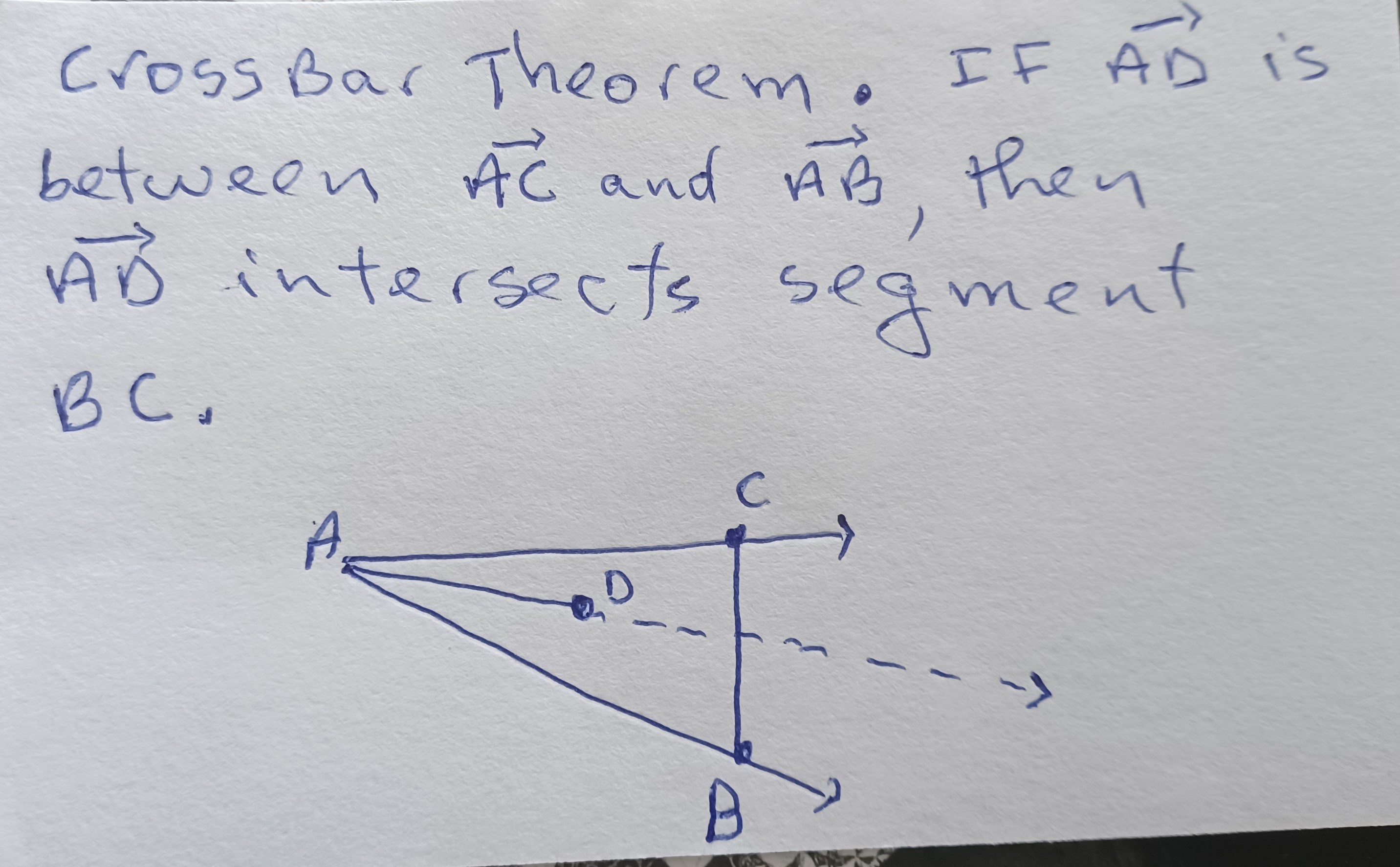
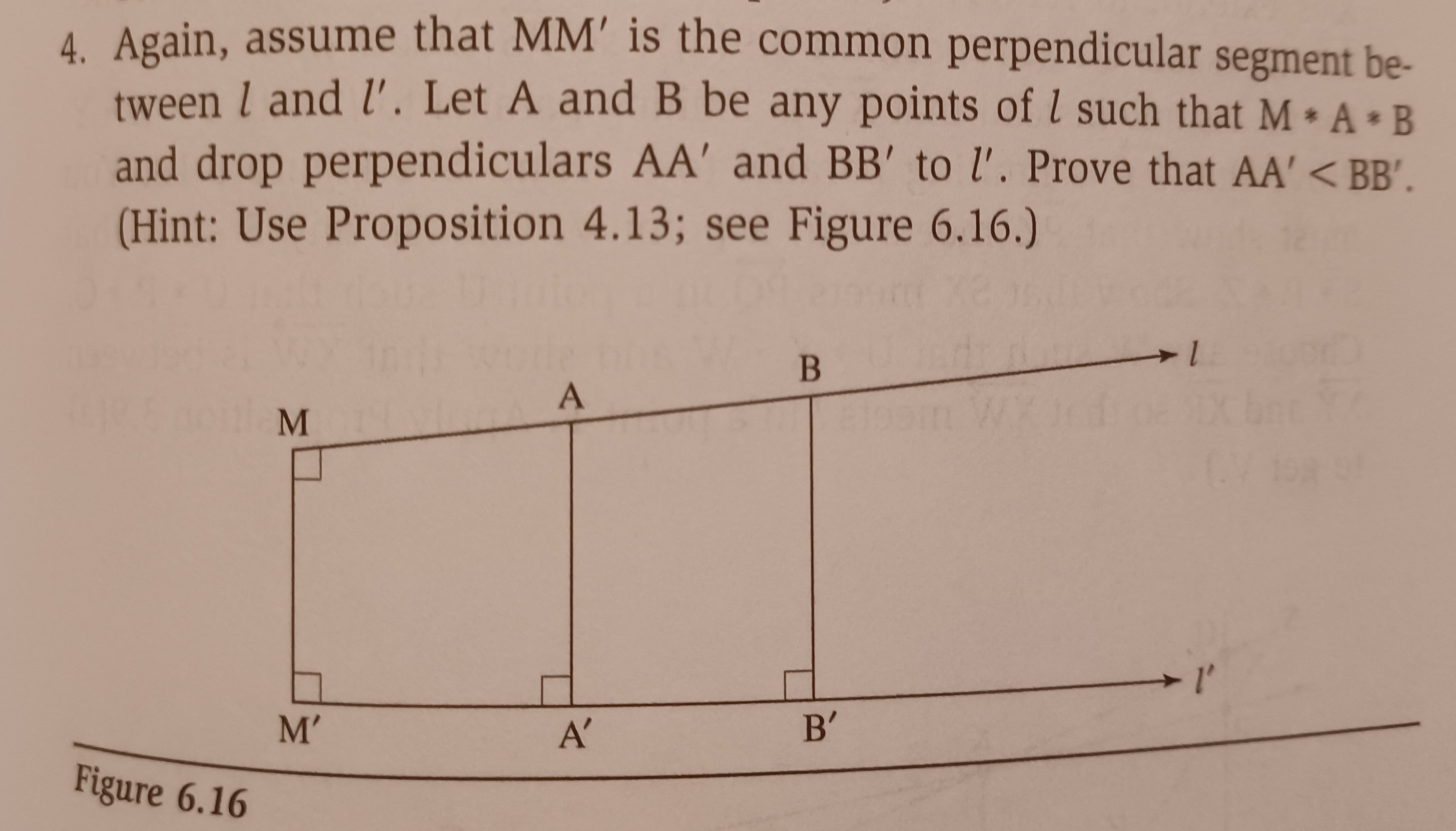
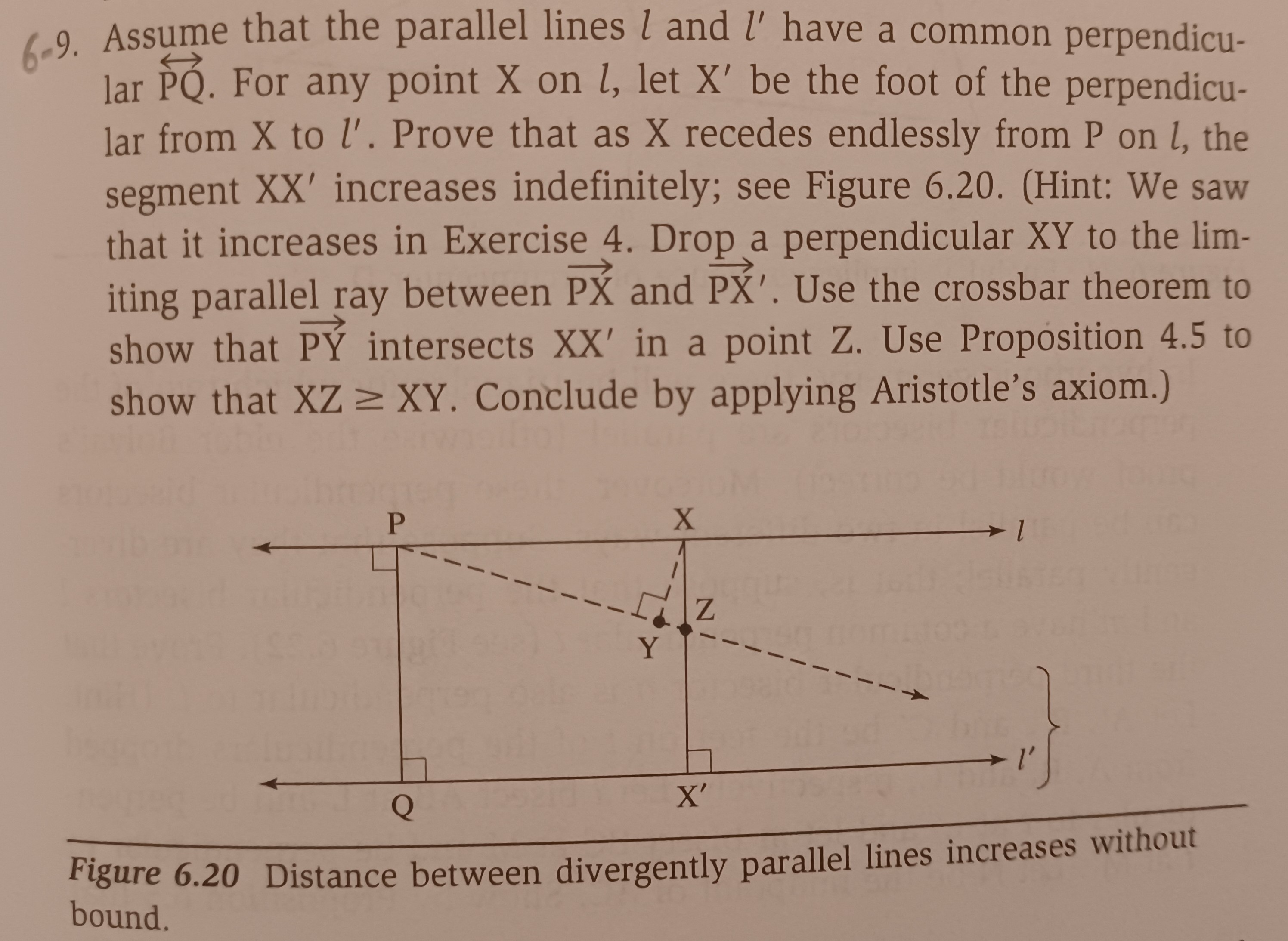
6-9. Assume that the parallel lines ( and I' have a common perpendicu lar PQ. For any point X on l, let X' be the foot of the perpendicu lar from X to l'. Prove that as X recedes endlessly from P on l, the segment XX' increases indefinitely; see Figure 6.20. (Hint: We saw that it increases in Exercise 4. Drop a perpendicular XY to the lim- iting parallel ray between PX and PX'. Use the crossbar theorem to show that PY intersects XX' in a point Z. Use Proposition 4.5 to show that XZ > XY. Conclude by applying Aristotle's axiom.) P X Z Y Q X' Figure 6.20 Distance between divergently parallel lines increases without bound.ARISTOTLE'S AXIOM. Given any side of an acute angle and any seg- ment AB, there exists a point Y on the given side of the angle such that if X is the foot of the perpendicular from Y to the other side of the angle, then XY > AB.Cross Bar Theorem . IF AD is between AC and AB then AD intersects segment BC . C D4. Again, assume that MM' is the common perpendicular segment be- tween I and l'. Let A and B be any points of l such that M * A * B and drop perpendiculars AA' and BB' to l'. Prove that AA' BC if and only if C > KA

Step by Step Solution

There are 3 Steps involved in it

1 Expert Approved Answer
Step: 1 Unlock blur-text-image

Question Has Been Solved by an Expert!

Get step-by-step solutions from verified subject matter experts

Step: 2 Unlock
Step: 3 Unlock

Students Have Also Explored These Related Mathematics Questions!