



Question: Done Done 183 Integration Questions 0. (a) For the relationship in question 19, what is the proportion of variance ac- counted for? (b) What is
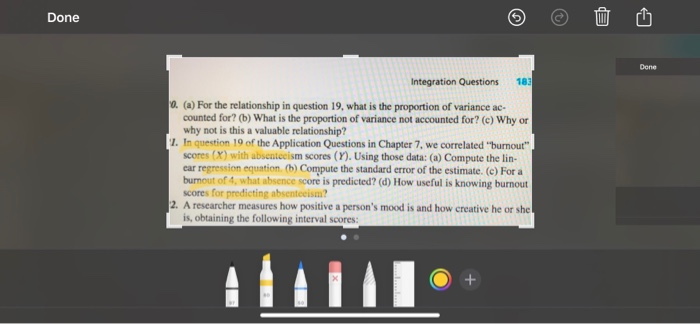
Done Done 183 Integration Questions 0. (a) For the relationship in question 19, what is the proportion of variance ac- counted for? (b) What is the proportion of variance not accounted for? (c) Why or why not is this a valuable relationship? 1. In question 19 of the Application Questions in Chapter 7, we correlated "burmout" scores (X) with absenteeism scores (Y). Using those data: (a) Compute the lin- ear regression equation. (b) Compute the standard error of the estimate. (c) For a burnout of 4, what absence score is predicted? (d) How useful is knowing burnout scores for predicting absenteeism? 2. A researcher measures how positive a person's mood is and how creative he or she l is, obtaining the following interval scores: Done Done 183 Integration Questions 0. (a) For the relationship in question 19, what is the proportion of variance ac- counted for? (b) What is the proportion of variance not accounted for? (c) Why or why not is this a valuable relationship? 1. In question 19 of the Application Questions in Chapter 7, we correlated "burmout" scores (X) with absenteeism scores (Y). Using those data: (a) Compute the lin- ear regression equation. (b) Compute the standard error of the estimate. (c) For a burnout of 4, what absence score is predicted? (d) How useful is knowing burnout scores for predicting absenteeism? 2. A researcher measures how positive a person's mood is and how creative he or she l is, obtaining the following interval scores: Done Done 183 Integration Questions 0. (a) For the relationship in question 19, what is the proportion of variance ac- counted for? (b) What is the proportion of variance not accounted for? (c) Why or why not is this a valuable relationship? 1. In question 19 of the Application Questions in Chapter 7, we correlated "burmout" scores (X) with absenteeism scores (Y). Using those data: (a) Compute the lin- ear regression equation. (b) Compute the standard error of the estimate. (c) For a burnout of 4, what absence score is predicted? (d) How useful is knowing burnout scores for predicting absenteeism? 2. A researcher measures how positive a person's mood is and how creative he or she l is, obtaining the following interval scores: Done Done 183 Integration Questions 0. (a) For the relationship in question 19, what is the proportion of variance ac- counted for? (b) What is the proportion of variance not accounted for? (c) Why or why not is this a valuable relationship? 1. In question 19 of the Application Questions in Chapter 7, we correlated "burmout" scores (X) with absenteeism scores (Y). Using those data: (a) Compute the lin- ear regression equation. (b) Compute the standard error of the estimate. (c) For a burnout of 4, what absence score is predicted? (d) How useful is knowing burnout scores for predicting absenteeism? 2. A researcher measures how positive a person's mood is and how creative he or she l is, obtaining the following interval scores
Step by Step Solution
There are 3 Steps involved in it

Get step-by-step solutions from verified subject matter experts