







Question: Don't answer the question in the book answer these 5 questions. Thank you. Q1-) Give real life example for each 8 project! Q2-) Can you
Don't answer the question in the book answer these 5 questions. Thank you.
Q1-) Give real life example for each 8 project!
Q2-) Can you simply evaluate the projects based on simple cash flows? Why , why not?
Q3-) Calculate NPV, IRR, EAA, Pay Back Period Cash and Profitability Index based on your discount rate assumption. Clearly mention why you choose that discount rate.
Q4-) Assume the projects are replicable and discount rate is 10%! Choose ONLY ONE method to rank the projects. Clearly mention why you choose that method and which assumptions you made to choose that method. Remember there are mutually exclusive projects!
Q5-) Is your method sensitive to discount rate? (use 12% discount rate)
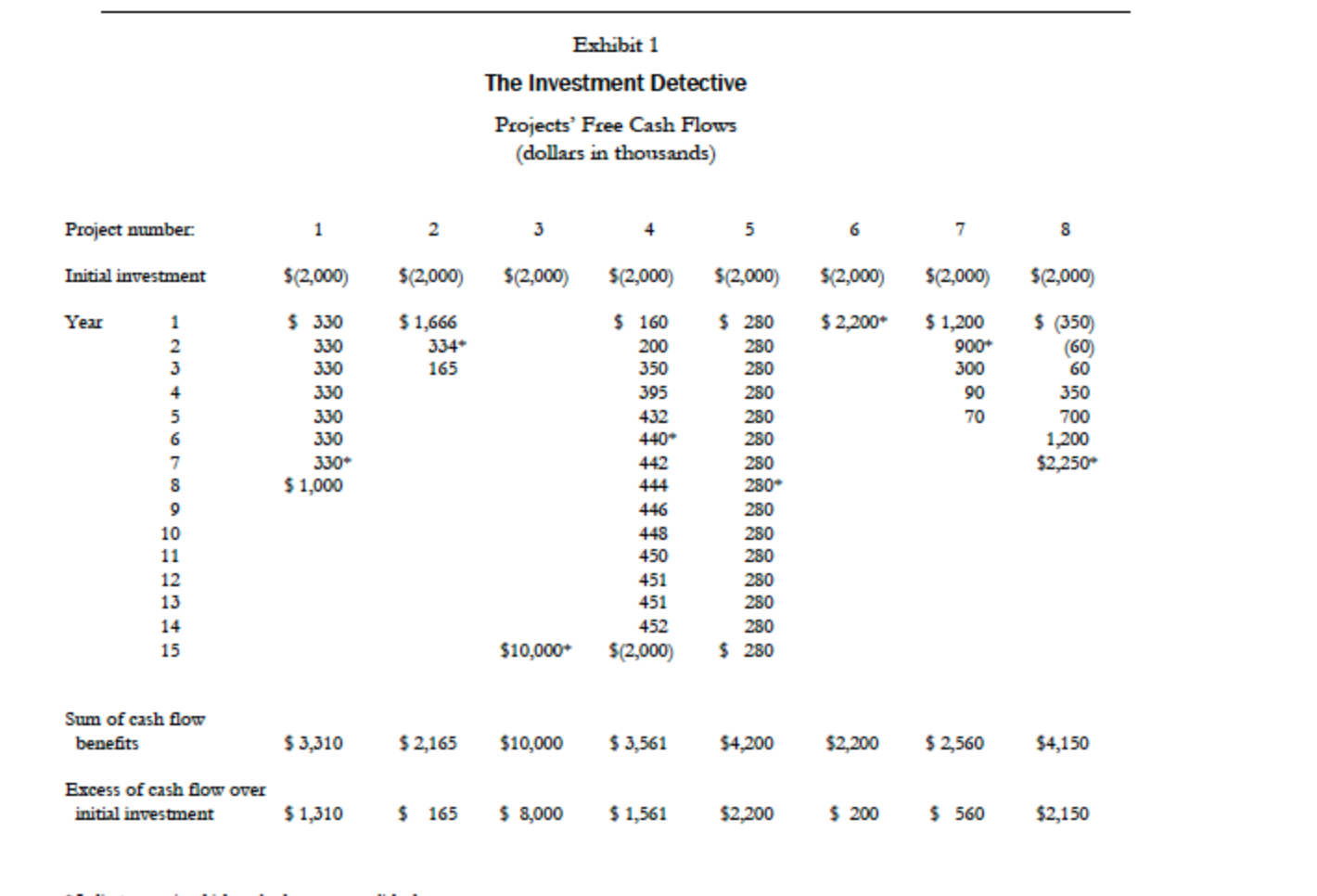
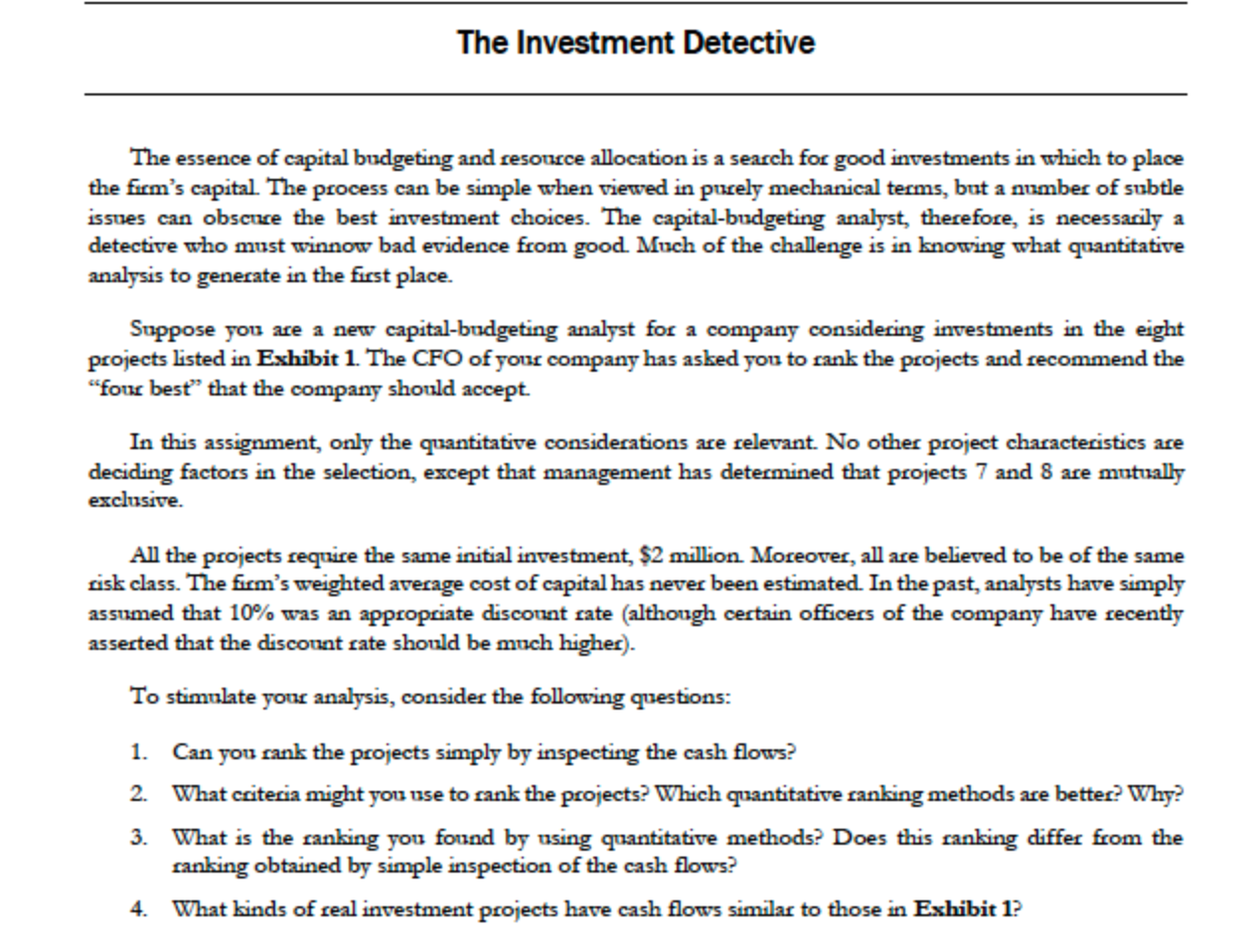
Exhibit 1 The Investment Detective Projects' Free Cash Flows (dollars in thousands) 1 2 4 5 6 7 8 Project number Initial investment $(2,000) $(2,000) $(2,000) $(2,000) $(2,000) $(2,000) $(2,000) $(2,000) Year $2,200 $ 330 330 330 330 $1,666 334 165 $ 1,200 900* 300 90 70 $ (350) (60) 60 350 700 1,200 $2,250 330 330 1 2 3 4 5 6 7 8 9 10 11 12 13 14 15 $1,000 $ 160 200 350 395 432 440 442 444 446 448 450 451 451 452 $(2,000) $ 280 280 280 280 280 280 280 280 280 280 280 280 280 280 $ 280 $10,000+ Sum of cash flow benefits $ 3,310 $ 2,165 $10,000 $3,561 $4,200 $2,200 $ 2,560 $4,150 Excess of cash flow over initial investment $1,310 $ 165 $ 8,000 $1,561 $2,200 $ 200 $ 560 $2,150 The Investment Detective The essence of capital budgeting and resource allocation is a search for good investments in which to place the firm's capital. The process can be simple when viewed in purely mechanical terms, but a number of subtle issues can obscure the best investment choices. The capital-budgeting analyst, therefore, is necessarily a detective who must winnow bad evidence from good Much of the challenge is in knowing what quantitative analysis to generate in the first place. Suppose you are a new capital-budgeting analyst for a company considering investments in the eight projects listed in Exhibit 1. The CFO of your company has asked you to rank the projects and recommend the four best that the company should accept In this assignment, only the quantitative considerations are relevant. No other project characteristics are deciding factors in the selection, except that management has determined that projects 7 and 8 are mutually exclusive. All the projects require the same initial investment, $2 million Moreover, all are believed to be of the same risk class. The firm's weighted average cost of capital has never been estimated. In the past, analysts have simply assumed that 10% was an appropriate discount cate (although certain officers of the company have recently asserted that the discount cate should be much higher). To stimulate your analysis, consider the following questions: 1. Can you rank the projects simply by inspecting the cash flows? 2. What criteria might you use to rank the projects? Which quantitative ranking methods are better? Why? 3. What is the ranking you found by using quantitative methods? Does this ranking differ from the canking obtained by simple inspection of the cash flows? What kinds of real investment projects have cash flows similar to those in Exhibit 12 4. Exhibit 1 The Investment Detective Projects' Free Cash Flows (dollars in thousands) 1 2 4 5 6 7 8 Project number Initial investment $(2,000) $(2,000) $(2,000) $(2,000) $(2,000) $(2,000) $(2,000) $(2,000) Year $2,200 $ 330 330 330 330 $1,666 334 165 $ 1,200 900* 300 90 70 $ (350) (60) 60 350 700 1,200 $2,250 330 330 1 2 3 4 5 6 7 8 9 10 11 12 13 14 15 $1,000 $ 160 200 350 395 432 440 442 444 446 448 450 451 451 452 $(2,000) $ 280 280 280 280 280 280 280 280 280 280 280 280 280 280 $ 280 $10,000+ Sum of cash flow benefits $ 3,310 $ 2,165 $10,000 $3,561 $4,200 $2,200 $ 2,560 $4,150 Excess of cash flow over initial investment $1,310 $ 165 $ 8,000 $1,561 $2,200 $ 200 $ 560 $2,150 The Investment Detective The essence of capital budgeting and resource allocation is a search for good investments in which to place the firm's capital. The process can be simple when viewed in purely mechanical terms, but a number of subtle issues can obscure the best investment choices. The capital-budgeting analyst, therefore, is necessarily a detective who must winnow bad evidence from good Much of the challenge is in knowing what quantitative analysis to generate in the first place. Suppose you are a new capital-budgeting analyst for a company considering investments in the eight projects listed in Exhibit 1. The CFO of your company has asked you to rank the projects and recommend the four best that the company should accept In this assignment, only the quantitative considerations are relevant. No other project characteristics are deciding factors in the selection, except that management has determined that projects 7 and 8 are mutually exclusive. All the projects require the same initial investment, $2 million Moreover, all are believed to be of the same risk class. The firm's weighted average cost of capital has never been estimated. In the past, analysts have simply assumed that 10% was an appropriate discount cate (although certain officers of the company have recently asserted that the discount cate should be much higher). To stimulate your analysis, consider the following questions: 1. Can you rank the projects simply by inspecting the cash flows? 2. What criteria might you use to rank the projects? Which quantitative ranking methods are better? Why? 3. What is the ranking you found by using quantitative methods? Does this ranking differ from the canking obtained by simple inspection of the cash flows? What kinds of real investment projects have cash flows similar to those in Exhibit 12 4
Step by Step Solution
There are 3 Steps involved in it

Get step-by-step solutions from verified subject matter experts
 Study Help