Question: Dont use or copy existing Solution.. i have subscription, do yourself Activity Mapping c. Are Walgreen's distinctive competencies VRIN? Why? - Slide 2 Activity mapping
 Dont use or copy existing Solution.. i have subscription, do yourself
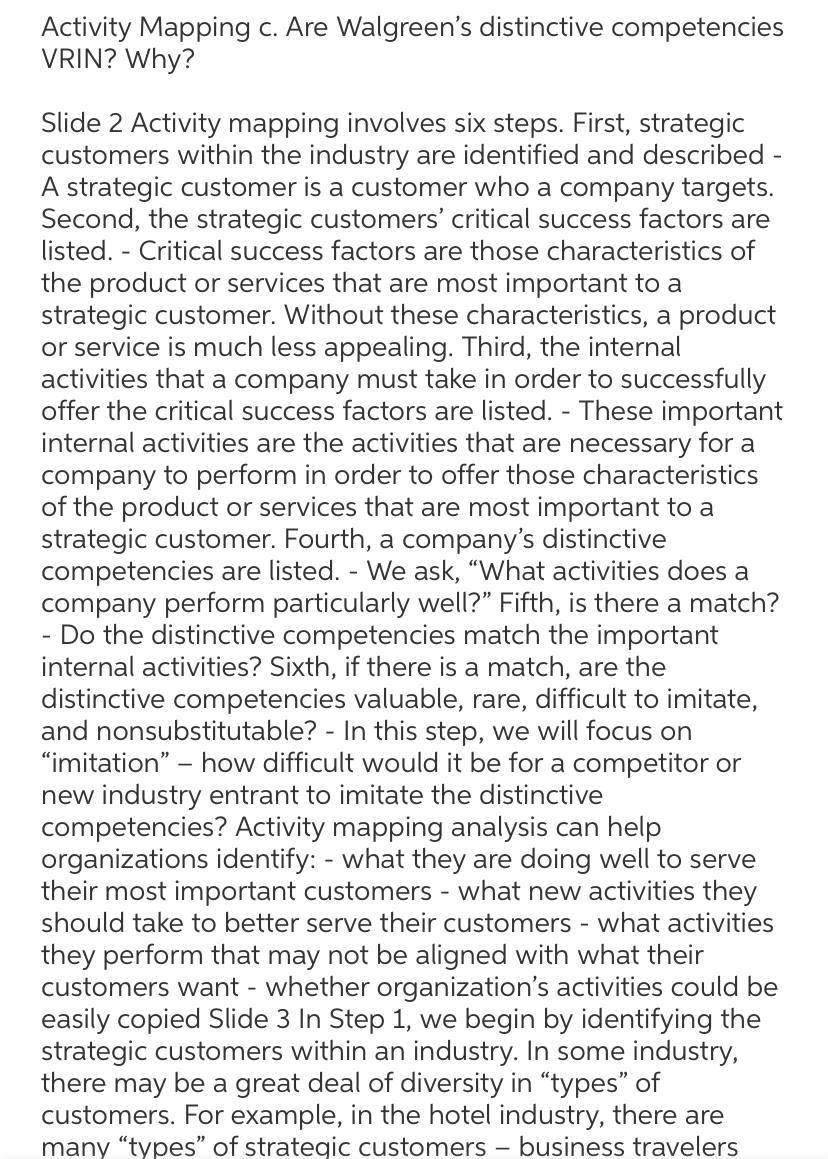
Activity Mapping c. Are Walgreen's distinctive competencies VRIN? Why? - Slide 2 Activity mapping involves six steps. First, strategic customers within the industry are identified and described - A strategic customer is a customer who a company targets. Second, the strategic customers' critical success factors are listed. - Critical success factors are those characteristics of the product or services that are most important to a strategic customer. Without these characteristics, a product or service is much less appealing. Third, the internal activities that a company must take in order to successfully offer the critical success factors are listed. - These important internal activities are the activities that are necessary for a company to perform in order to offer those characteristics of the product or services that are most important to a strategic customer. Fourth, a company's distinctive competencies are listed. - We ask, What activities does a company perform particularly well?" Fifth, is there a match? Do the distinctive competencies match the important internal activities? Sixth, if there is a match, are the distinctive competencies valuable, rare, difficult to imitate, and nonsubstitutable? - In this step, we will focus on "imitation how difficult would it be for a competitor or new industry entrant to imitate the distinctive competencies? Activity mapping analysis can help organizations identify: - what they are doing well to serve their most important customers - what new activities they should take to better serve their customers - what activities they perform that may not be aligned with what their customers want - whether organization's activities could be easily copied Slide 3 In Step 1, we begin by identifying the strategic customers within an industry. In some industry, there may be a great deal of diversity in "types" of customers. For example, in the hotel industry, there are many "types" of strategic customers business travelers Activity Mapping c. Are Walgreen's distinctive competencies VRIN? Why? - Slide 2 Activity mapping involves six steps. First, strategic customers within the industry are identified and described - A strategic customer is a customer who a company targets. Second, the strategic customers' critical success factors are listed. - Critical success factors are those characteristics of the product or services that are most important to a strategic customer. Without these characteristics, a product or service is much less appealing. Third, the internal activities that a company must take in order to successfully offer the critical success factors are listed. - These important internal activities are the activities that are necessary for a company to perform in order to offer those characteristics of the product or services that are most important to a strategic customer. Fourth, a company's distinctive competencies are listed. - We ask, What activities does a company perform particularly well?" Fifth, is there a match? Do the distinctive competencies match the important internal activities? Sixth, if there is a match, are the distinctive competencies valuable, rare, difficult to imitate, and nonsubstitutable? - In this step, we will focus on "imitation how difficult would it be for a competitor or new industry entrant to imitate the distinctive competencies? Activity mapping analysis can help organizations identify: - what they are doing well to serve their most important customers - what new activities they should take to better serve their customers - what activities they perform that may not be aligned with what their customers want - whether organization's activities could be easily copied Slide 3 In Step 1, we begin by identifying the strategic customers within an industry. In some industry, there may be a great deal of diversity in "types" of customers. For example, in the hotel industry, there are many "types" of strategic customers business travelers









 Study Help