







Question: During a regular cleaning cycle for a cylindrical drinking water storage tank ( diameter = 7 0 feet; depth = 1 2 feet ) ,
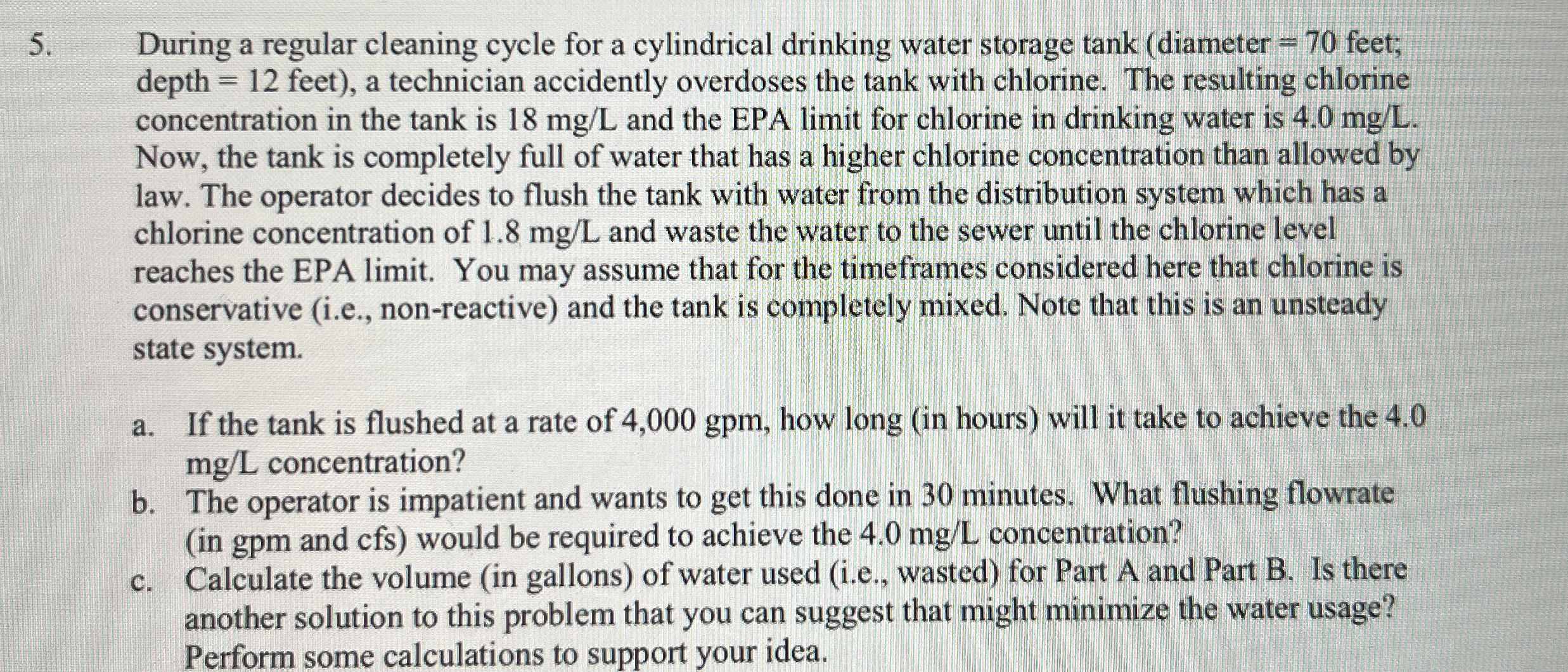
During a regular cleaning cycle for a cylindrical drinking water storage tank diameter feet; depth feet a technician accidently overdoses the tank with chlorine. The resulting chlorine concentration in the tank is and the EPA limit for chlorine in drinking water is Now, the tank is completely full of water that has a higher chlorine concentration than allowed by law. The operator decides to flush the tank with water from the distribution system which has a chlorine concentration of and waste the water to the sewer until the chlorine level reaches the EPA limit You may assume that for the timeframes considered here that chlorine is conservative ie nonreactive and the tank is completely mixed. Note that this is an unsteady state system.
a If the tank is flushed at a rate of gpm how long in hours will it take to achieve the concentration?
b The operator is impatient and wants to get this done in minutes. What flushing flowrate in gpm and cfs would be required to achieve the concentration?
c Calculate the volume in gallons of water used ie wasted for Part A and Part B Is there another solution to this problem that you can suggest that might minimize the water usage? Perform some calculations to support your idea.
Step by Step Solution
There are 3 Steps involved in it
1 Expert Approved Answer
Step: 1 Unlock

Question Has Been Solved by an Expert!
Get step-by-step solutions from verified subject matter experts
Step: 2 Unlock
Step: 3 Unlock
 Study Help