







Question: Dynamic Lot Sizing The dynamic lot-size model in inventory theory, is a generalisation of the Economic Order Quantity (EOQ) model that takes into account that
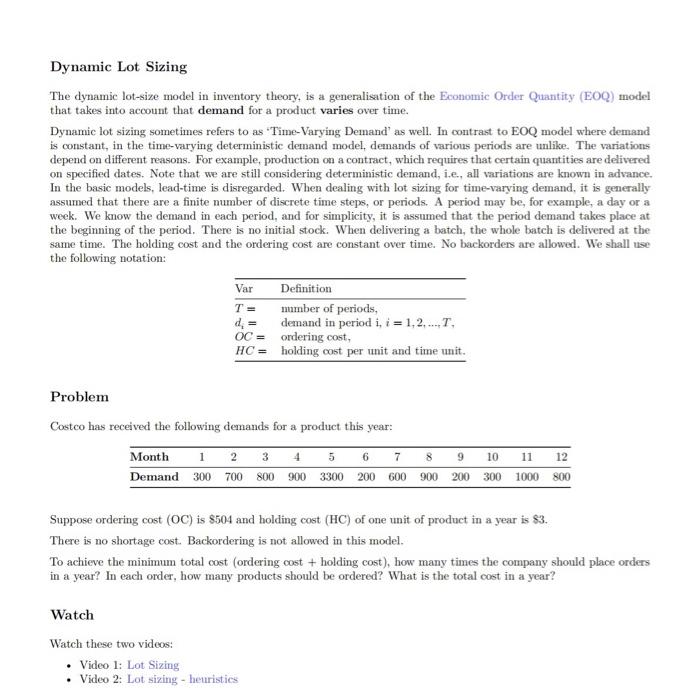
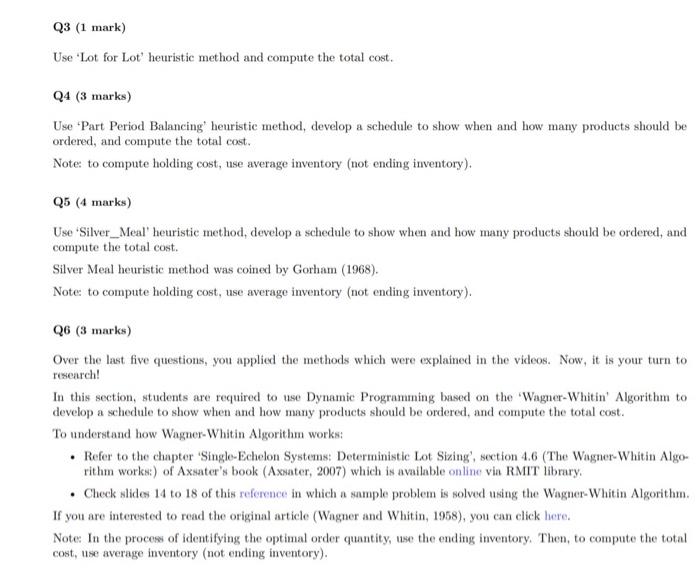
Dynamic Lot Sizing The dynamic lot-size model in inventory theory, is a generalisation of the Economic Order Quantity (EOQ) model that takes into account that demand for a product varies over time. Dynamic lot sizing sometimes refers to as 'Time-Varying Demand' as well. In contrast to EOQ model where demand is constant, in the time-varying deterministic demand model, demands of various periods are unlike. The variations depend on different reasons. For example, production on a contract, which requires that certain quantities are delivered on specified dates. Note that we are still considering deterministic demand, i.e, all variations are known in advance. In the basic models, lead-time is disregarded. When dealing with lot sizing for time-varying demand, it is generally assumed that there are a finite number of discrete time steps, or periods. A period may be, for example, a day or a week. We know the demand in each period, and for simplicity, it is assumed that the period demand takes place at the beginning of the period. There is no initial stock. When delivering a batch, the whole batch is delivered at the same time. The holding cost and the ordering cost are constant over time. No backorders are allowed. We shall use the following notation: Problem Costco has received the following demands for a product this year: Suppose ordering cost (OC) is $504 and holding cost (HC) of one unit of product in a year is 83 . There is no shortage cost. Backordering is not allowed in this model. To achieve the minimum total cost (ordering cost + holding cost), how many times the company should place orders in a year? In each order, how many products should be ordered? What is the total cost in a year? Watch Watch these two videos: - Video 1: Lot Sizing - Video 2: Lot sizing - heuristics Q3 (1 mark) Use 'Lot for Lot' heuristic method and compute the total cost. Q4 (3 marks) Use 'Part Period Balancing' heuristic method, develop a schedule to show when and how many products should be ordered, and compute the total cost. Note: to compute holding cost, use average inventory (not ending inventory). Q5 (4 marks) Use 'Silver_Meal' heuristic method, develop a schedule to show when and how many products should be ordered, and compute the total cost. Silver Meal heuristic method was coined by Gorham (1968). Note: to compute holding cost, use average inventory (not ending inventory). Q6 (3 marks) Over the last five questions, you applied the methods which were explained in the videos. Now, it is your turn to rasearch! In this section, students are required to use Dynamic Programming based on the 'Wagner-Whitin' Algorithm to develop a schedule to show when and how many products should be ordered, and compute the total cost. To understand how Wagner-Whitin Algorithm works: - Refer to the chapter 'Single-Echelon Systems: Deterministic Lot Sizing', section 4.6 (The Wagner-Whitin Algorithm works:) of Axsater's book (Axsater, 2007) which is available online via RMIT library. - Check slides 14 to 18 of this reference in which a sample problem is solved using the Wagner-Whitin Algorithm. If you are interested to read the original article (Wagner and Whitin, 1958), you can elick here. Note: In the proces of identifying the optimal order quantity, use the ending inventory. Then, to compute the total cost, use average inventory (not ending inventory)
Step by Step Solution
There are 3 Steps involved in it

Get step-by-step solutions from verified subject matter experts
 Study Help