







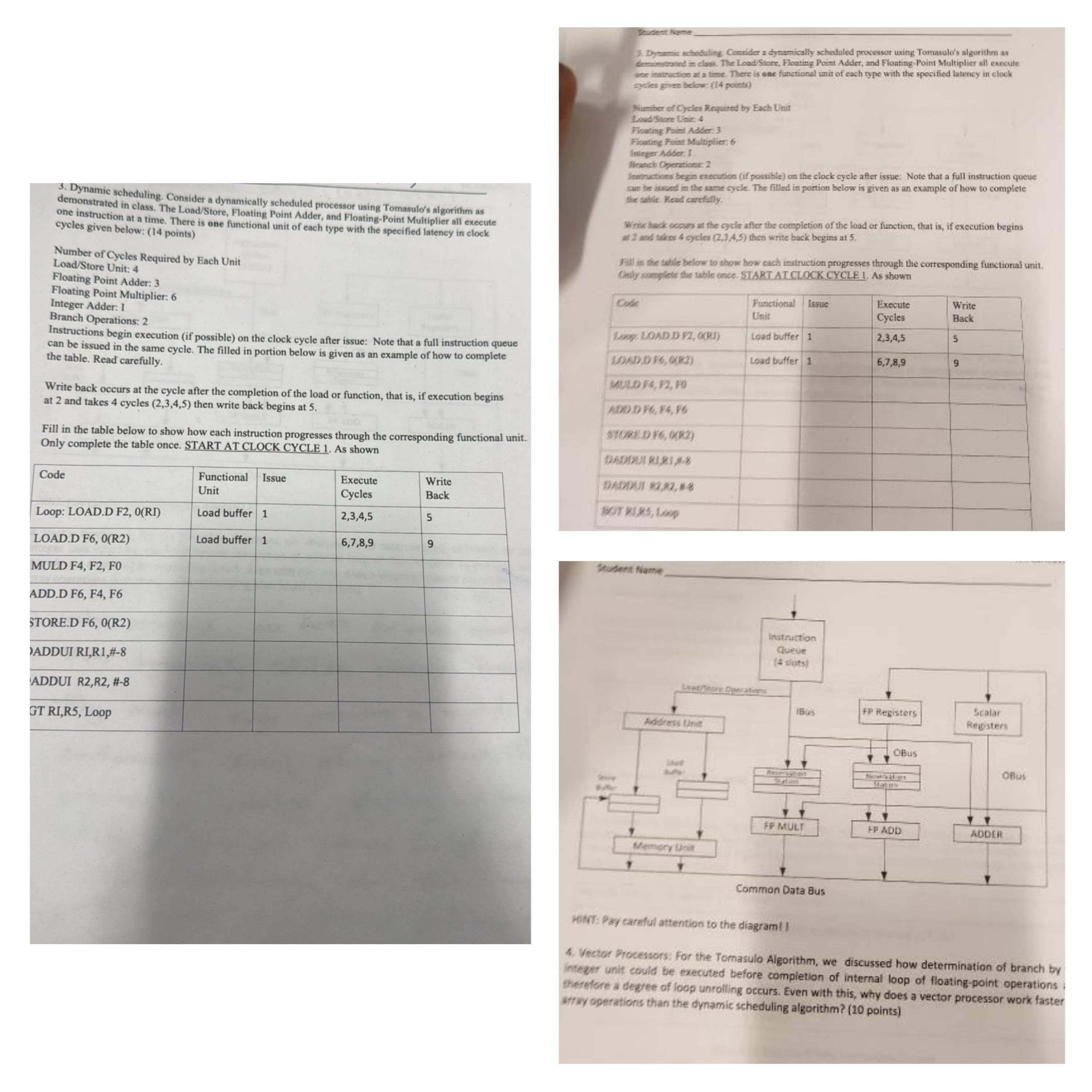
Question: Dynamic scheduling. Consider a dynamically scheduled processor using Tomasulo's algorithm as demonstrated in class. The Load / Store , Floating Point Adder, and Floating -
Dynamic scheduling. Consider a dynamically scheduled processor using Tomasulo's algorithm as
demonstrated in class. The LoadStore Floating Point Adder, and FloatingPoint Multiplier all execute
one instruction at a time There is one functional unit of each type with the specified latency in clock
cycles given below: points
Number of Cycles Required by Each Unit
LoadStore Unit:
Floating Point Adder:
Floating Point Multiplier:
Integer Adder: I
Branch Operations:
Instructions begin execution if possible on the clock cycle after issue: Note that a fullinstruction gueue
can be issued in the same cycle. The filled in portion below is given as an example of how to complete
the table Read carefully.
Write back occurs at the cycle after the completion of the load or function, that is if execution begins
at and takes cycles then write back begins at
Fill in the table below to show how each instruction progresses through the corresponding functional unit.
Only complete the table once. START AT CLOCK CYCLE As shown
Code
Loop: LOAD.D F ORI
LOAD.D FR
MULD F F FO
ADD.D F F F
STORE.D FR
pADDUI RIR#
ADDUI RR #
GT RIR Loop
Functional
Unit
Load buffer
Load buffer
Issue
Execute
Cycles
Write
Back
Please use these start values.
Step by Step Solution
There are 3 Steps involved in it
1 Expert Approved Answer
Step: 1 Unlock

Question Has Been Solved by an Expert!
Get step-by-step solutions from verified subject matter experts
Step: 2 Unlock
Step: 3 Unlock
 Study Help