



Question: e) 1.26 x 10 ) 8. Specific heat capacity is a) the quantity of heat needed to change the temperature of 1.00 g of a
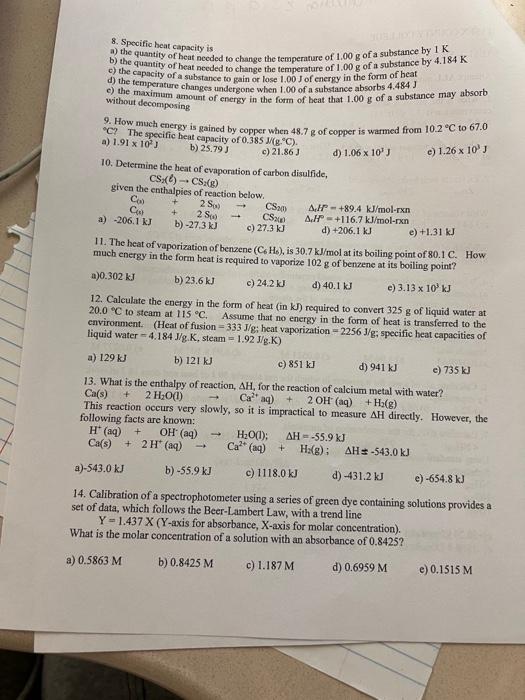
e) 1.26 x 10 ) 8. Specific heat capacity is a) the quantity of heat needed to change the temperature of 1.00 g of a substance by IK e) the capacity of a substance to gain or lose 1.00 J of energy in the form of heat b) the quantity of heat needed to change the temperature of 1.00 g of a substance by 4.184 K d) the temperature changes undergone when 1.00 of a substance absorbs 4.484 ) without decomposing e) the maximum amount of energy in the form of heat that 1.00 g of a substance may absorb 9. How much cergy is gained by copper when 48.7 g of copper is warmed from 10.2 C to 67.0 "C? The specific heat capacity of 0.385 Mg."C). a) 1.91 x 10) b) 25.79 c)21.86 ) d) 1.06 x 10' 10. Determine the heat of evaporation of carbon disulfide, CS () --CS () given the enthalpies of reaction below. Co 2 S. CS AH- +89.4 kJ/mol-rxn CA 2 S CS A.H+116.7 kJ/mol-rxn a) -206.1 kJ b) -27.3 kJ c) 27.3 kJ d) +206.1 kJ e) +1.31 kJ 11. The heat of vaporization of benzene (CH), is 30.7 kJ/mol at its boiling point of 80.1 C. How much energy in the form heat is required to vaporize 102 g of benzene at its boiling point? a)0.302 kJ b) 23.6 kJ c) 24.2 kJ d) 40.1 J e) 3.13 x 10 W 12. Calculate the energy in the form of heat (in kJ) required to convert 325 g of liquid water at 20.0C to steam at 115 C. Assume that no energy in the form of heat is transferred to the environment. (Heat of fusion = 333 J/g: heat vaporization - 2256 Jig: specific heat capacities of liquid water-4.184 J/g. K, steam - 1.92 J/g.K) Cadaq + a) 129 b) 121 kJ c) 851 kJ d) 941 kJ e) 735 kJ 13. What is the enthalpy of reaction, AH, for the reaction of calcium metal with water? Ca(s) + 2 H2O(1) 2OH(aq) + Ha(8) This reaction occurs very slowly, so it is impractical to measure AH directly. However, the following facts are known: H+ (aq) + OH(aq) H2O(l): AH --55.9 kJ Ca(s) + 2 H(aq) Ca** (aq) + H.(g): AH-543.0 kJ a)-543.0 kJ b)-55.9 kJ c) 1118.0 kJ d) -431.2 kJ e) -654.8 kJ 14. Calibration of a spectrophotometer using a series of green dye containing solutions provides a set of data, which follows the Beer-Lambert Law, with a trend line Y-1.437 X (Y-axis for absorbance, X-axis for molar concentration). What is the molar concentration of a solution with an absorbance of 0.8425? a) 0.5863 M b) 0.8425 M c) 1.187 M d) 0.6959 M e) 0.1515 M
Step by Step Solution
There are 3 Steps involved in it

Get step-by-step solutions from verified subject matter experts