







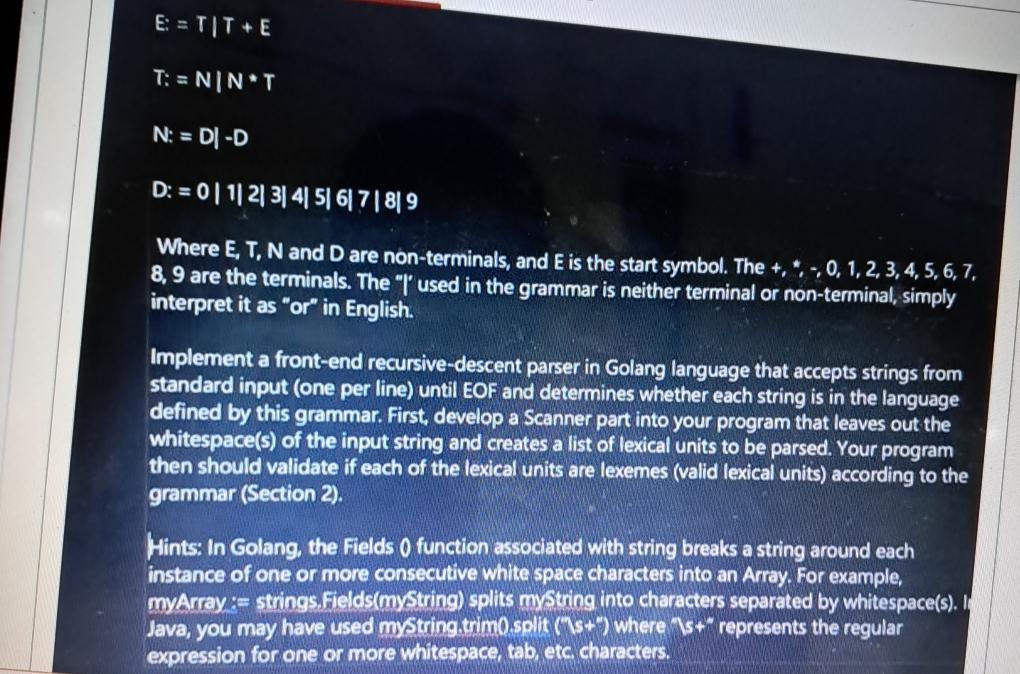
Question: E i = T | T + E | T : = N | N * * T | N : = D | -
:
:
:
Where and are nonterminals, and is the start symbol. The are the terminals. The used in the grammar is neither terminal or nonterminal, simply interpret it as or in English.
Implement a frontend recursivedescent parser in Golang language that accepts strings from standard input one per line until EOF and determines whether each string is in the language defined by this grammar. First, develop a Scanner part into your program that leaves out the whitespaces of the input string and creates a list of lexical units to be parsed. Your program then should validate if each of the lexical units are lexemes valid lexical units according to the grammar Section
Hints: In Golang, the Fields function associated with string breaks a string around each instance of one or more consecutive white space characters into an Array. For example, myArray: strings: FieldsmyEtring splits mystring into characters separated by whitespaces Java, you may have used mystring.trimo solit s where represents the regular expression for one or more whitespace, tab, etc characters.
Step by Step Solution
There are 3 Steps involved in it
1 Expert Approved Answer
Step: 1 Unlock

Question Has Been Solved by an Expert!
Get step-by-step solutions from verified subject matter experts
Step: 2 Unlock
Step: 3 Unlock
 Study Help