







Question: Eample PROBLEM b. What is the minimum-cost schedule? c. What is the critical path for the minimum-cost schedule? The Advanced Tech Company has a project
Eample
PROBLEM
b. What is the minimum-cost schedule?
c. What is the critical path for the minimum-cost schedule?
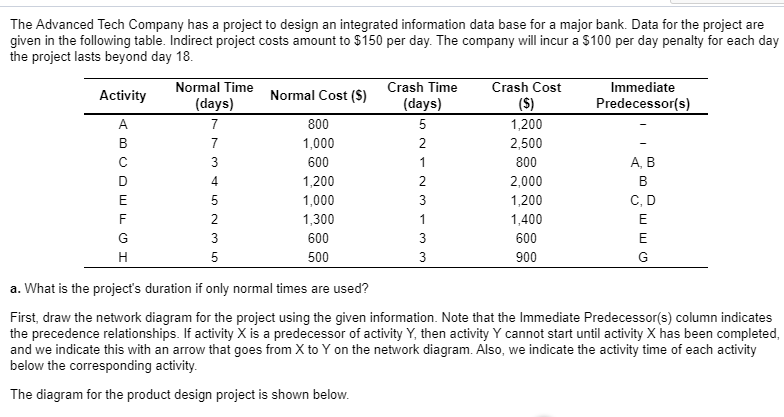
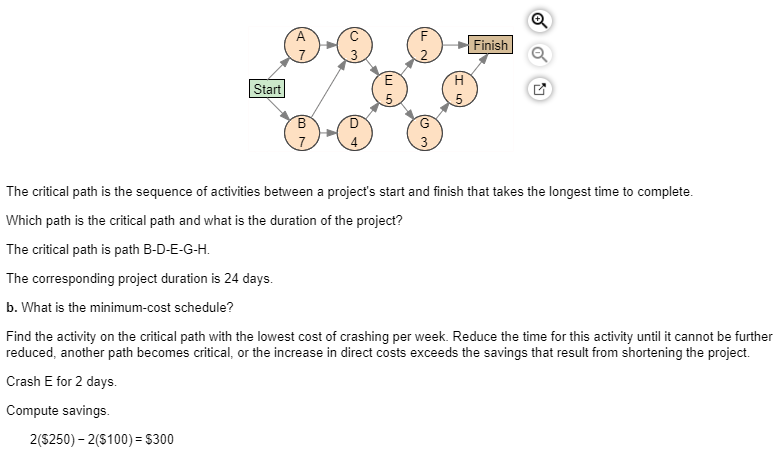
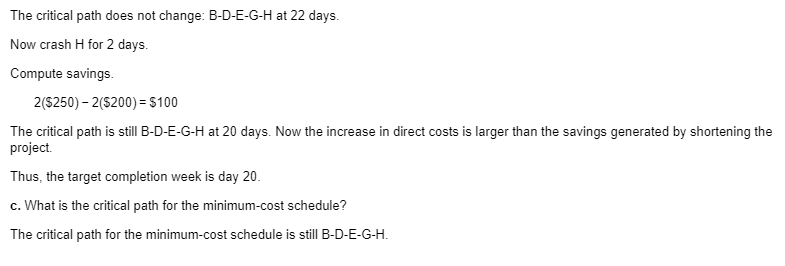
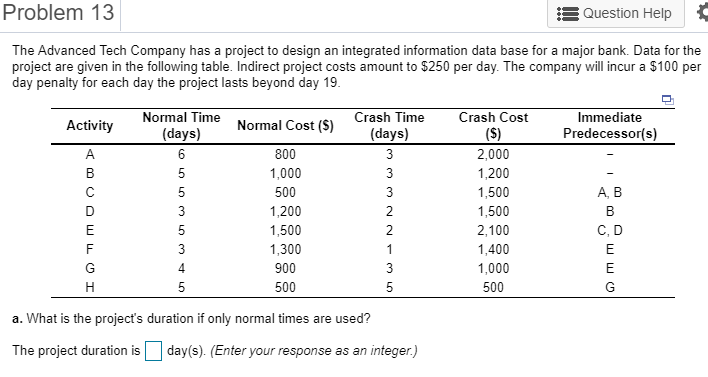
The Advanced Tech Company has a project to design an integrated information data base for a major bank. Data for the project are given in the following table. Indirect project costs amount to $150 per day. The company will incur a $100 per day penalty for each day the project lasts beyond day 18. Activity Crash Time (days) Immediate Predecessor(s) IOT MOOD Normal Time Normal Cost is Normal Cost ($) (days) 800 1,000 600 1,200 1,000 1,300 600 500 U W NAW wwwNNU Crash Cost ($) 1,200 2,500 800 2,000 1,200 1,400 600 900 c mww a. What is the project's duration if only normal times are used? First, draw the network diagram for the project using the given information. Note that the Immediate Predecessor(s) column indicates the precedence relationships. If activity X is a predecessor of activity Y, then activity Y cannot start until activity X has been completed, and we indicate this with an arrow that goes from X to Y on the network diagram. Also, we indicate the activity time of each activity below the corresponding activity. The diagram for the product design project is shown below. The critical path is the sequence of activities between a project's start and finish that takes the longest time to complete. Which path is the critical path and what is the duration of the project? The critical path is path B-D-E-G-H. The corresponding project duration is 24 days. b. What is the minimum-cost schedule? Find the activity on the critical path with the lowest cost of crashing per week. Reduce the time for this activity until it cannot be further reduced, another path becomes critical, or the increase in direct costs exceeds the savings that result from shortening the project. Crash E for 2 days Compute savings. 2($250) - 2(5100) = $300 The critical path does not change: B-D-E-G-H at 22 days. Now crash H for 2 days Compute savings. 2($250) -2($200) = $100 The critical path is still B-D-E-G-H at 20 days. Now the increase in direct costs is larger than the savings generated by shortening the project. Thus, the target completion week is day 20. c. What is the critical path for the minimum-cost schedule? The critical path for the minimum-cost schedule is still B-D-E-G-H. Problem 13 Question Help The Advanced Tech Company has a project to design an integrated information data base for a major bank. Data for the project are given in the following table. Indirect project costs amount to $250 per day. The company will incur a $100 per day penalty for each day the project lasts beyond day 19. Activity Crash Time (days) Immediate Predecessor(s) Normal Time Normal Cost (S) (days) 800 1,000 500 1,200 1,500 1,300 IOTMOOO Crash Cost ($) 2,000 1,200 1,500 1,500 2,100 1,400 1,000 500 uw NN www CD 900 500 a. What is the project's duration if only normal times are used? The project duration is day(s). (Enter your response as an integer.)
Step by Step Solution
There are 3 Steps involved in it
1 Expert Approved Answer
Step: 1 Unlock

Question Has Been Solved by an Expert!
Get step-by-step solutions from verified subject matter experts
Step: 2 Unlock
Step: 3 Unlock
 Study Help