







Question: EBIT-EPS and capital structure Data-Check is considering two capital structures. The key information is shown in the following table. Assume a 40% tax rate. Structure
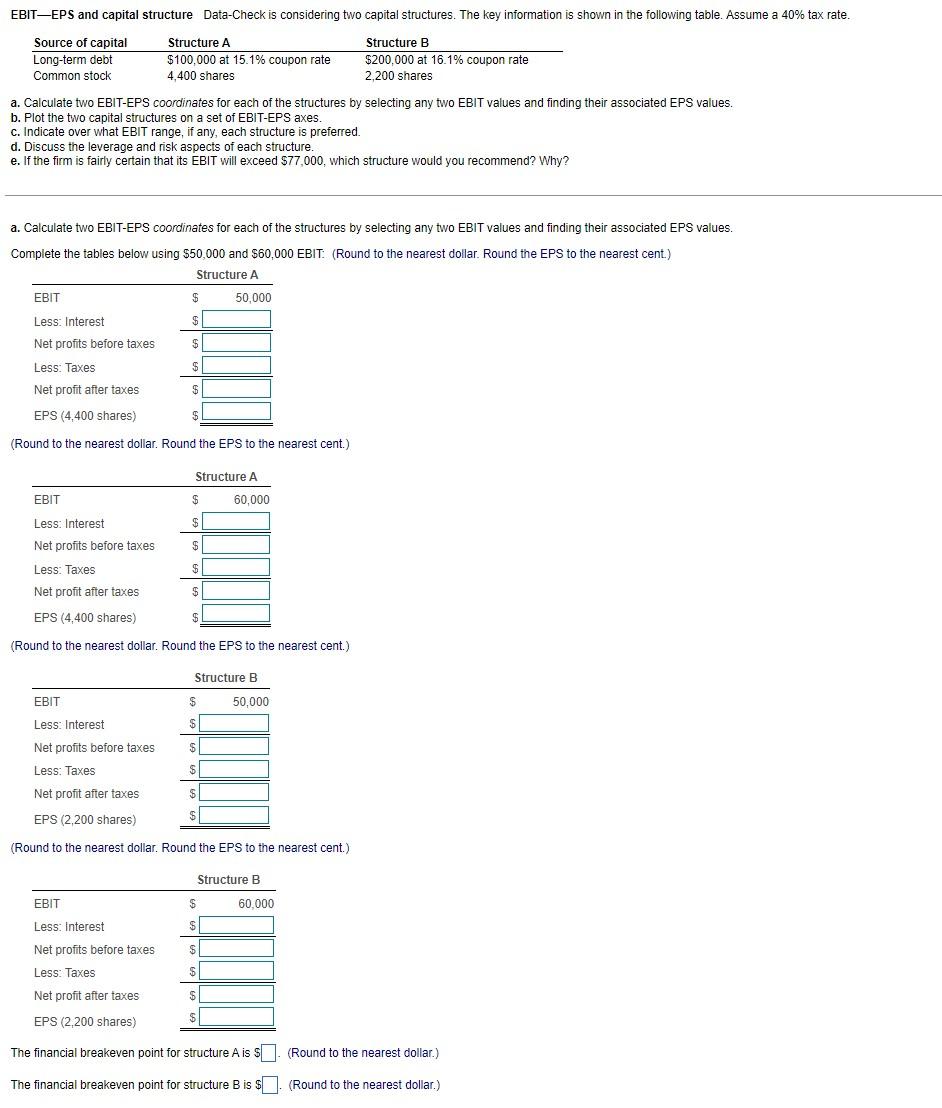
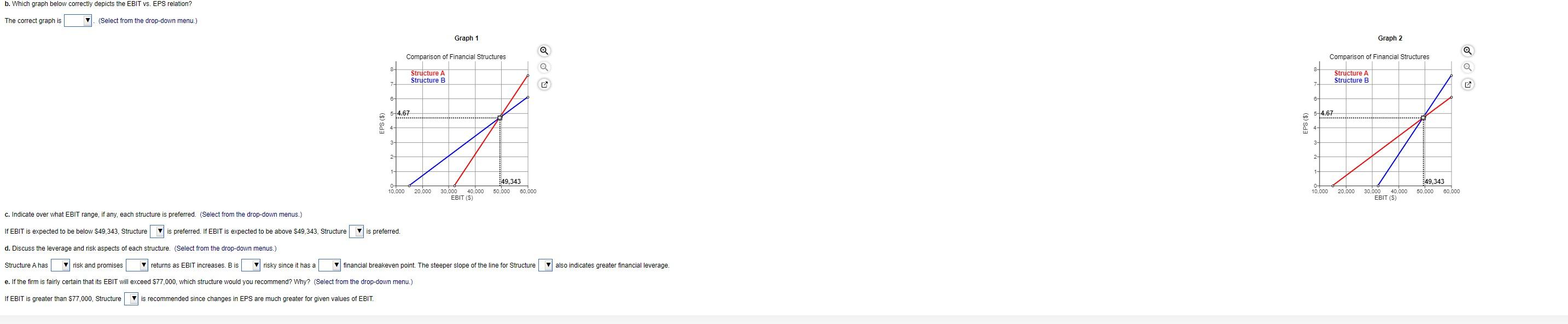
EBIT-EPS and capital structure Data-Check is considering two capital structures. The key information is shown in the following table. Assume a 40% tax rate. Structure A Structure B Source of capital Long-term debt $100,000 at 15.1% coupon rate 4,400 shares $200,000 at 16.1% coupon rate 2,200 shares Common stock a. Calculate two EBIT-EPS coordinates for each of the structures by selecting any two EBIT values and finding their associated EPS values. b. Plot the two capital structures on a set of EBIT-EPS axes. c. Indicate over what EBIT range, if any, each structure is preferred. d. Discuss the leverage and risk aspects of each structure. e. If the firm is fairly certain that its EBIT will exceed $77,000, which structure would you recommend? Why? a. Calculate two EBIT-EPS coordinates for each of the structures by selecting any two EBIT values and finding their associated EPS values. Complete the tables below using $50,000 and $60,000 EBIT: (Round to the nearest dollar. Round the EPS to the nearest cent.) Structure A EBIT $ 50,000 Less: Interest $ Net profits before taxes $ Less: Taxes $ Net profit after taxes $ EPS (4,400 shares) $ (Round to the nearest dollar. Round the EPS to the nearest cent.) Structure A EBIT $ 60,000 Less: Interest $ Net profits before taxes $ Less: Taxes $ Net profit after taxes $ EPS (4,400 shares) (Round to the nearest dollar. Round the EPS to the nearest cent.) Structure B EBIT $ 50,000 Less: Interest $ Net profits before taxes $ Less: Taxes $ Net profit after taxes $ EPS (2,200 shares) (Round to the nearest dollar. Round the EPS to the nearest cent.) Structure B EBIT $ 60,000 Less: Interest $ Net profits before taxes Less: Taxes $ Net profit after taxes $ EPS (2,200 shares) The financial breakeven point for structure A is S. (Round to the nearest dollar.) The financial breakeven point for structure B is $. (Round to the nearest dollar.) b. Which graph below correctly depicts the EBIT vs. EPS relation? The correct graph is (Select from the drop-down menu.) c. Indicate over what EBIT range, if any, each structure is preferred. (Select from the drop-down menus.) If EBIT is expected to be below $49,343, Structure is preferred. If EBIT is expected to be above $49,343, Structure d. Discuss the leverage and risk aspects of each structure. (Select from the drop-down menus.) Structure A has risk and promises returns as EBIT increases. B is risky since it has a e. If the firm is fairly certain that its EBIT will exceed $77,000, which structure would you recommend? Why? (Select from the drop-down menu.) is recommended since changes in EPS are much greater for given values of EBIT. If EBIT is greater than $77,000, Structure Graph 1 Comparison of Financial Structures Structure A Structure B 5-4.67 2- 49.343 10,000 20,000 30,000 40,000 50,000 60,000 EBIT (S) is preferred. financial breakeven point. The steeper slope of the line for Structure EPS ($) Q 2 also indicates greater financial leverage. EPS ($) Graph 2 Comparison of Financial Structures Structure A Structure B 5-4.67 2- 1- 10,000 20,000 30,000 40,000 EBIT (S) 49,343 50,000 60,000 D
Step by Step Solution
There are 3 Steps involved in it

Get step-by-step solutions from verified subject matter experts
 Study Help