



Question: eBook Video Calculator Print Item Cornerstone Exercise 6-21 (Algorithmic) Inventory Costing: Weighted Average Cost Filimonov Inc. has the following information related to purchases and sales
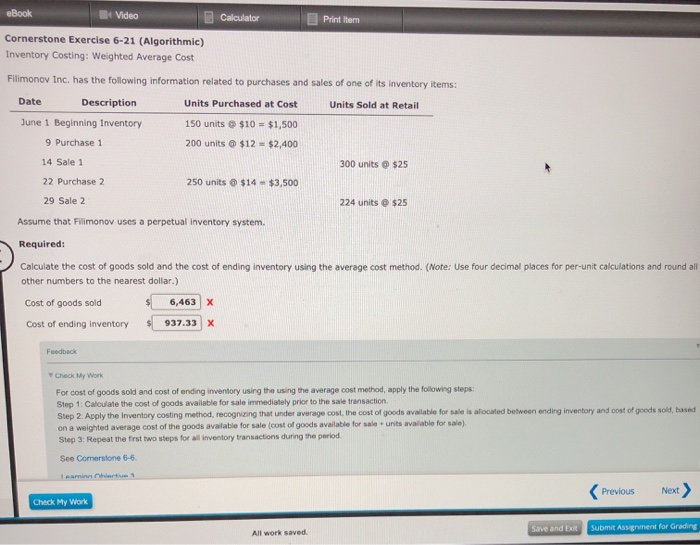
eBook Video Calculator Print Item Cornerstone Exercise 6-21 (Algorithmic) Inventory Costing: Weighted Average Cost Filimonov Inc. has the following information related to purchases and sales of one of its inventory items: Date Description Units Purchased at Cost Units Sold at Retail June 1 Beginning Inventory 150 units @ $10 = $1,500 9 Purchase 1 200 units $12 = $2,400 14 Sale 1 300 units @ $25 22 Purchase 2 250 units @ $14 - $3,500 29 Sale 2 224 units @ $25 Assume that Filimonov uses a perpetual Inventory system. Required: Calculate the cost of goods sold and the cost of ending inventory using the average cost method. (Note: Use four decimal places for per-unit calculations and round all other numbers to the nearest dollar.) Cost of goods sold $ 6,463 x Cost of ending inventory $ 937.33 X Feedback Check My Work For cost of goods sold and cost of ending inventory using the using the average cost method, apply the following steps: Step 1: Calculate the cost of goods available for sale immediately prior to the sale transaction Step 2. Apply the Inventory costing method, recognizing that under average cost, the cost of goods available for sale is allocated between ending inventory and cost of goods sold based on a weighted average cost of the goods available for sale (cost of goods available for sale units available for sale). Step 3: Repeat the first two steps for all inventory transactions during the period. See Comorstone 6-6. Previous Next > Check My Work Submit Assement for Grading All work saved Save and Exit
Step by Step Solution
There are 3 Steps involved in it

Get step-by-step solutions from verified subject matter experts