







Question: ee Dimensions and its probability de probability density? y to the n = 0 (c) This state is often referred to as the 2p. Why?
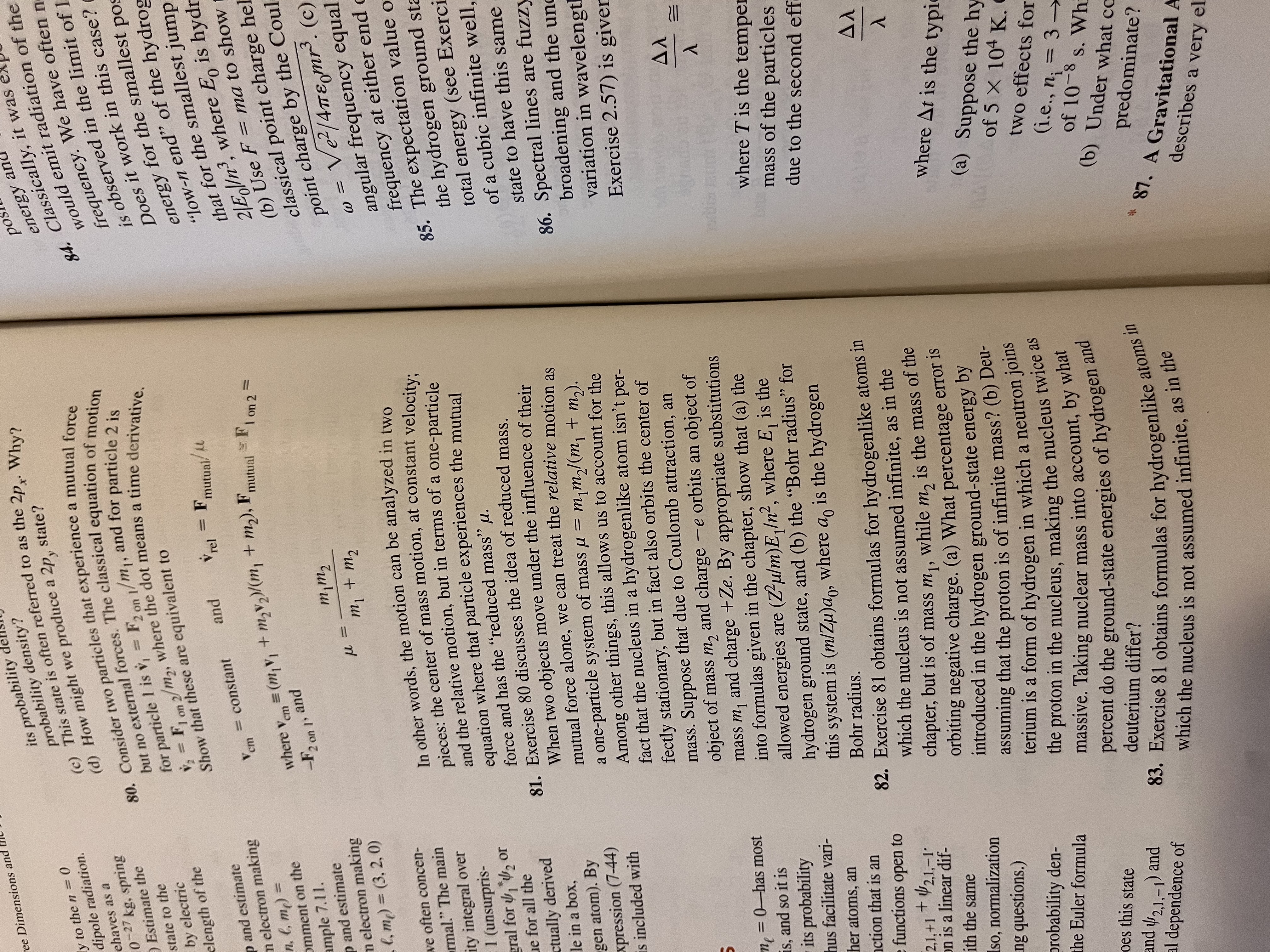
ee Dimensions and its probability de probability density? y to the n = 0 (c) This state is often referred to as the 2p. Why? post dipole radiation. (d) How might we produce a 2p, state? energy and chaves as a 84. Classically, it was ex 0-27 kg, spring 80. Consider two particles that experience a mutual force would emit radiation of the Estimate the but no external forces. The classical equation of motion frequency. We have often n state to the for particle 1 is v, = F2 on 1/my, and for particle 2 is is observed in the limit of by electric elength of the V2 = F1 on 2/m2, where the dot means a time derivative. Does it work in this case ? Show that these are equivalent to energy for the smallest po p and estimate and Vrel = Fmutual/ re "low-n end" of the hydro n electron making Vem = constant that for the smallest jump n, (, me) = mment on the where Von =(m, V, + m2 2)/(m, + m2), Fmutual FI on 2= 2/E W3, where Eo is hyd mple 7.11. -F2 on 1, and (b) Use F = ma to show and estimate mm2 classical point charge he n electron making (, my) = (3, 2, 0) M = point charge by the Coul w = Ve2/4 TEOmr. (c ve often concen- rmal." The main In other words, the motion can be analyzed in two angular frequency equa frequency at either end ity integral over pieces: the center of mass motion, at constant velocity; 1 (unsurpris- and the relative motion, but in terms of a one-particle 85. The expectation value o gral for us 2 or equation where that particle experiences the mutual the hydrogen ground st e for all the force and has the "reduced mass" u. total energy (see Exerci ctually derived 81. Exercise 80 discusses the idea of reduced mass. of a cubic infinite well, e in a box, When two objects move under the influence of their gen atom). By mutual force alone, we can treat the relative motion as state to have this same pression (7-44) a one-particle system of mass u = mim2 (m, + m2). 86. Spectral lines are fuzz s included with Among other things, this allows us to account for the broadening and the un fact that the nucleus in a hydrogenlike atom isn't per- variation in wavelengt fectly stationary, but in fact also orbits the center of Exercise 2.57) is giver mass. Suppose that due to Coulomb attraction, an object of mass m, and charge -e orbits an object of ne = 0-has most mass m, and charge + Ze. By appropriate substitutions is, and so it is into formulas given in the chapter, show that (a) the its probability allowed energies are (Zzulm) E In, where E, is the hus facilitate vari- hydrogen ground state, and (b) the "Bohr radius" for where T is the temper her atoms, an this system is (m/Zu)do, where do is the hydrogen mass of the particles ction that is an Bohr radius. due to the second eff functions open to 82. Exercise 81 obtains formulas for hydrogenlike atoms in 2,1, + 1 + 1/2,1, - 1. which the nucleus is not assumed infinite, as in the n is a linear dif- ith the same chapter, but is of mass m], while m, is the mass of the so, normalization orbiting negative charge. (a) What percentage error is ng questions.) introduced in the hydrogen ground-state energy by where At is the typi assuming that the proton is of infinite mass? (b) Deu- probability den- terium is a form of hydrogen in which a neutron joins (a) Suppose the hy he Euler formula the proton in the nucleus, making the nucleus twice as of 5 X 10⁴ K. two effects for es this state massive. Taking nuclear mass into account, by what percent do the ground-state energies of hydrogen and (i.e., n; = 3 - and 42,1,-1) and deuterium differ? of 10-8 s. Wh al dependence of 83. Exercise 81 obtains formulas for hydrogenlike atoms in (b) Under what co which the nucleus is not assumed infinite, as in the predominate? * 87. A Gravitational describes a very el
Step by Step Solution
There are 3 Steps involved in it

Get step-by-step solutions from verified subject matter experts
 Study Help