Question: . Efficient operations require that managers match supply to demand. As they lack a crystal ball, they must rely on forecasting to help predict future
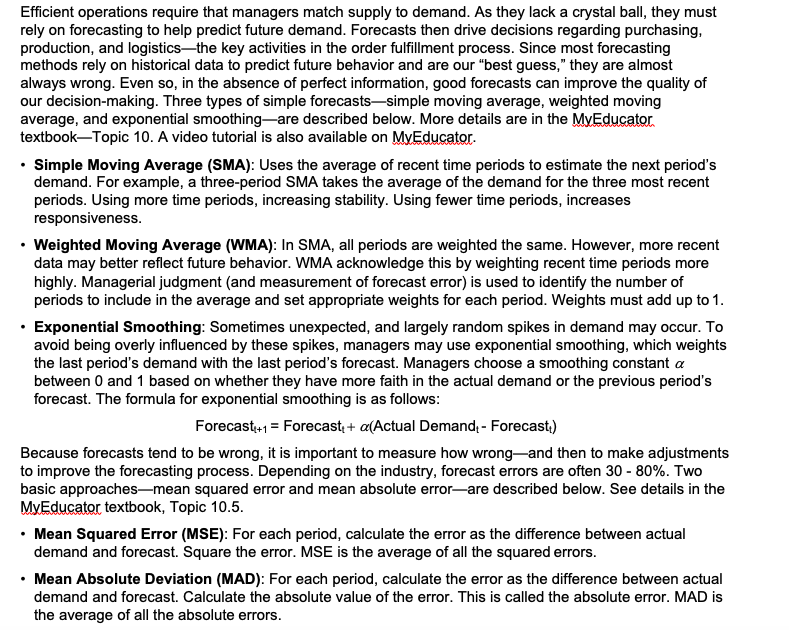
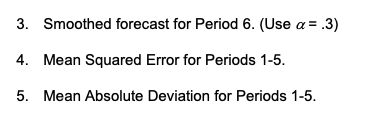
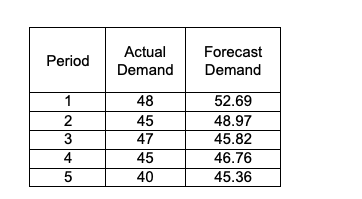
. Efficient operations require that managers match supply to demand. As they lack a crystal ball, they must rely on forecasting to help predict future demand. Forecasts then drive decisions regarding purchasing, production, and logisticsthe key activities in the order fulfillment process. Since most forecasting methods rely on historical data to predict future behavior and are our "best guess," they are almost always wrong. Even so, in the absence of perfect information, good forecasts can improve the quality of our decision-making. Three types of simple forecastssimple moving average, weighted moving average, and exponential smoothing-are described below. More details are in the MyEducator textbook-Topic 10. A video tutorial is also available on MyEducator. Simple Moving Average (SMA): Uses the average of recent time periods to estimate the next period's demand. For example, a three-period SMA takes the average of the demand for the three most recent periods. Using more time periods, increasing stability. Using fewer time periods, increases responsiveness. Weighted Moving Average (WMA): In SMA, all periods are weighted the same. However, more recent data may better reflect future behavior. WMA acknowledge this by weighting recent time periods more highly. Managerial judgment (and measurement of forecast error) is used to identify the number of periods to include in the average and set appropriate weights for each period. Weights must add up to 1. Exponential Smoothing: Sometimes unexpected, and largely random spikes in demand may occur. To avoid being overly influenced by these spikes, managers may use exponential smoothing, which weights the last period's demand with the last period's forecast. Managers choose a smoothing constant a between 0 and 1 based on whether they have more faith in the actual demand or the previous period's forecast. The formula for exponential smoothing is as follows: Forecast +1 = Forecast + a(Actual Demand - Forecast) Because forecasts tend to be wrong, it is important to measure how wrongand then to make adjustments to improve the forecasting process. Depending on the industry, forecast errors are often 30 - 80%. Two basic approachesmean squared error and mean absolute errorare described below. See details in the MyEducator textbook, Topic 10.5. Mean Squared Error (MSE): For each period, calculate the error as the difference between actual demand and forecast. Square the error. MSE is the average of all the squared errors. Mean Absolute Deviation (MAD): For each period, calculate the error as the difference between actual demand and forecast. Calculate the absolute value of the error. This is called the absolute error. MAD is the average of all the absolute errors. 3. Smoothed forecast for Period 6. (Use a=.3) 4. Mean Squared Error for Periods 1-5. 5. Mean Absolute Deviation for Periods 1-5. Period Actual Demand Forecast Demand 1 2 3 4 5 48 45 47 45 40 52.69 48.97 45.82 46.76 45.36









 Study Help