







Question: Ethical decision making model ethics code Ethical Decision Making Models Paramedic Ethics is a model proposed by W. Robert Collins and Keith W. Miller. It
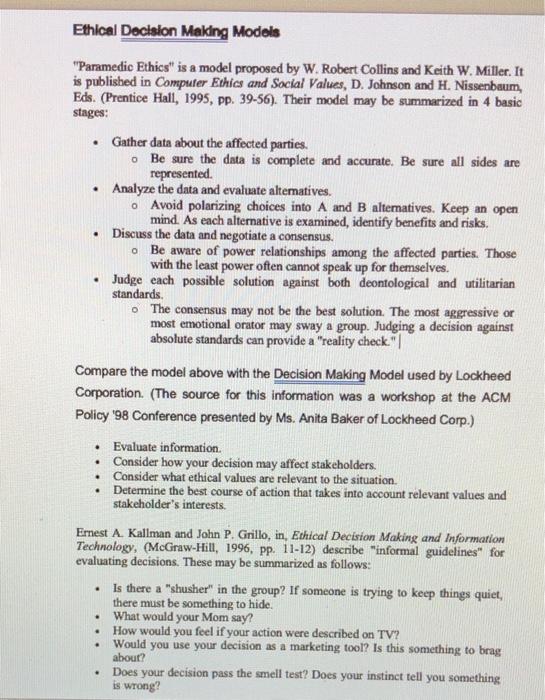
Ethical Decision Making Models "Paramedic Ethics" is a model proposed by W. Robert Collins and Keith W. Miller. It is published in Computer Ethics and Social Values, D. Johnson and H. Nissenbaum, Eds. (Prentice Hall, 1995, pp. 39-56). Their model may be summarized in 4 basic stages: Gather data about the affected parties. o Be sure the data is complete and accurate. Be sure all sides are represented Analyze the data and evaluate alteratives. o Avoid polarizing choices into A and B alternatives. Keep an open mind. As each alternative is examined, identify benefits and risks. Discuss the data and negotiate a consensus. o Be aware of power relationships among the affected parties. Those with the least power often cannot speak up for themselves. Judge each possible solution against both deontological and utilitarian standards The consensus may not be the best solution. The most aggressive or most emotional orator may sway a group. Judging a decision against absolute standards can provide a "reality check." || Compare the model above with the Decision Making Model used by Lockheed Corporation. (The source for this information was a workshop at the ACM Policy '98 Conference presented by Ms. Anita Baker of Lockheed Corp.) Evaluate information Consider how your decision may affect stakeholders. Consider what ethical values are relevant to the situation. Determine the best course of action that takes into account relevant values and stakeholder's interests Ernest A. Kallman and John P. Grillo, in, Ethical Decision Making and Information Technology, (McGraw-Hill, 1996, pp. 11-12) describe "informal guidelines" for evaluating decisions. These may be summarized as follows: Is there a "shusher" in the group? If someone is trying to keep things quiet, there must be something to hide. What would your Mom say? How would you feel if your action were described on TV? Would you use your decision as a marketing tool? Is this something to brag Does your decision pass the smell test? Does your instinct tell you something is wrong? . . . . about? . Ethical Decision Making Models "Paramedic Ethics" is a model proposed by W. Robert Collins and Keith W. Miller. It is published in Computer Ethics and Social Values, D. Johnson and H. Nissenbaum, Eds. (Prentice Hall, 1995, pp. 39-56). Their model may be summarized in 4 basic stages: Gather data about the affected parties. o Be sure the data is complete and accurate. Be sure all sides are represented Analyze the data and evaluate alteratives. o Avoid polarizing choices into A and B alternatives. Keep an open mind. As each alternative is examined, identify benefits and risks. Discuss the data and negotiate a consensus. o Be aware of power relationships among the affected parties. Those with the least power often cannot speak up for themselves. Judge each possible solution against both deontological and utilitarian standards The consensus may not be the best solution. The most aggressive or most emotional orator may sway a group. Judging a decision against absolute standards can provide a "reality check." || Compare the model above with the Decision Making Model used by Lockheed Corporation. (The source for this information was a workshop at the ACM Policy '98 Conference presented by Ms. Anita Baker of Lockheed Corp.) Evaluate information Consider how your decision may affect stakeholders. Consider what ethical values are relevant to the situation. Determine the best course of action that takes into account relevant values and stakeholder's interests Ernest A. Kallman and John P. Grillo, in, Ethical Decision Making and Information Technology, (McGraw-Hill, 1996, pp. 11-12) describe "informal guidelines" for evaluating decisions. These may be summarized as follows: Is there a "shusher" in the group? If someone is trying to keep things quiet, there must be something to hide. What would your Mom say? How would you feel if your action were described on TV? Would you use your decision as a marketing tool? Is this something to brag Does your decision pass the smell test? Does your instinct tell you something is wrong? . . . . about
Step by Step Solution
There are 3 Steps involved in it

Get step-by-step solutions from verified subject matter experts
 Study Help