



Question: Evolutionary theories often emphasize that humans have adapted to their physical environment. One such theory hypothesizes that people should spontaneously follow a 24-hour cycle of
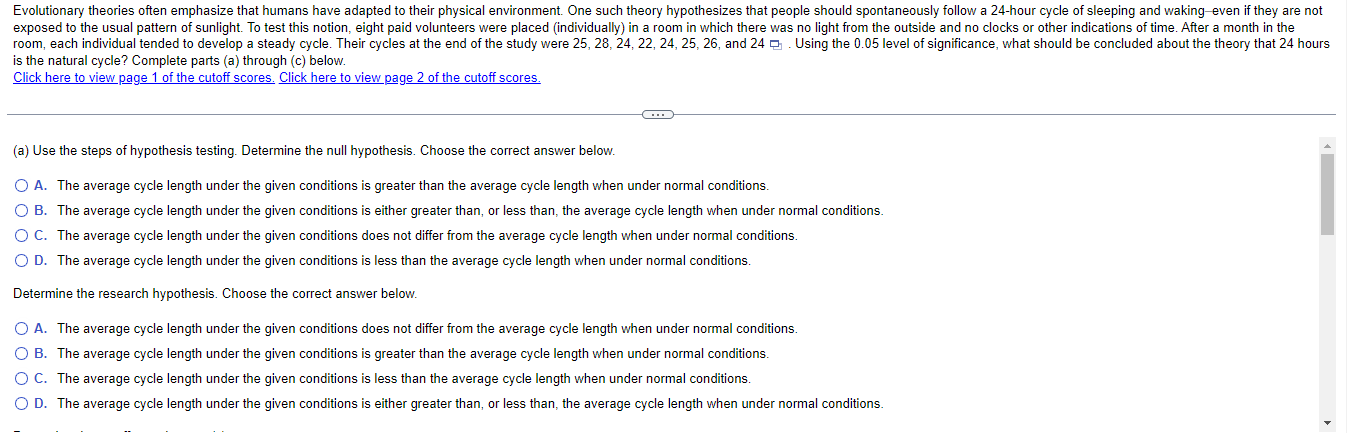
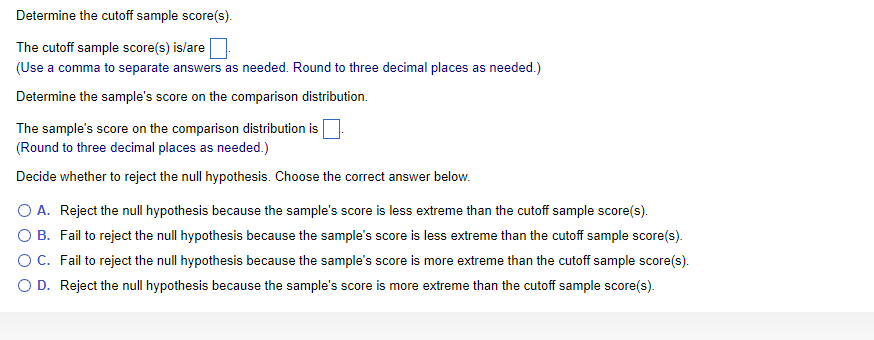

Evolutionary theories often emphasize that humans have adapted to their physical environment. One such theory hypothesizes that people should spontaneously follow a 24-hour cycle of sleeping and waking even if they are not exposed to the usual pattern of sunlight. To test this notion, eight paid volunteers were placed (individually) in a room in which there was no light from the outside and no clocks or other indications of time. After a month in the room, each individual tended to develop a steady cycle. Their cycles at the end of the study were 25, 28, 24, 22, 24, 25, 26, and 24 3 . Using the 0.05 level of significance, what should be concluded about the theory that 24 hours is the natural cycle? Complete parts (a) through (c) below. Click here to view page 1 of the cutoff scores. Click here to view page 2 of the cutoff scores. (a) Use the steps of hypothesis testing. Determine the null hypothesis. Choose the correct answer below. O A. The average cycle length under the given conditions is greater than the average cycle length when under normal conditions. O B. The average cycle length under the given conditions is either greater than, or less than, the average cycle length when under normal conditions. O C. The average cycle length under the given conditions does not differ from the average cycle length when under normal conditions. O D. The average cycle length under the given conditions is less than the average cycle length when under normal conditions. Determine the research hypothesis. Choose the correct answer below. O A. The average cycle length under the given conditions does not differ from the average cycle length when under normal conditions. O B. The average cycle length under the given conditions is greater than the average cycle length when under normal conditions. O C. The average cycle length under the given conditions is less than the average cycle length when under normal conditions. O D. The average cycle length under the given conditions is either greater than, or less than, the average cycle length when under normal conditions.Determine the cutoff sample score(s). The cutoff sample score(s) is/are Use a comma to separate answers as needed. Round to three decimal places as needed.) Determine the sample's score on the comparison distribution. The sample's score on the comparison distribution is (Round to three decimal places as needed.) Decide whether to reject the null hypothesis. Choose the correct answer below. O A. Reject the null hypothesis because the sample's score is less extreme than the cutoff sample score(s). O B. Fail to reject the null hypothesis because the sample's score is less extreme than the cutoff sample score(s). O C. Fail to reject the null hypothesis because the sample's score is more extreme than the cutoff sample score(s). O D. Reject the null hypothesis because the sample's score is more extreme than the cutoff sample score(s).(c) Explain the answer to someone who has never taken a course in statistics. Choose the correct answer below. O A. Since the sample's score was more extreme than the cutoff sample score(s), that means the probability of that score occurring, given that the null hypothesis is true, is less than 0.05. With this knowledge, one can fail to reject the null hypothesis. O B. Since the sample's score was more extreme than the cutoff sample score(s), that means the probability of that score occurring, given that the null hypothesis is true, is more than 0.05. With this knowledge, one can reject the null hypothesis. O C. Since the sample's score was less extreme than the cutoff sample score(s), that means the probability of that score occurring, given that the null hypothesis is true, is more than 0.05. With this knowledge, one can fail to reject the null hypothesis
Step by Step Solution
There are 3 Steps involved in it

Get step-by-step solutions from verified subject matter experts