Question: Examine specific language for the following keyword sets and explain your interpretation of the clause that you consider to be most clear and specific to
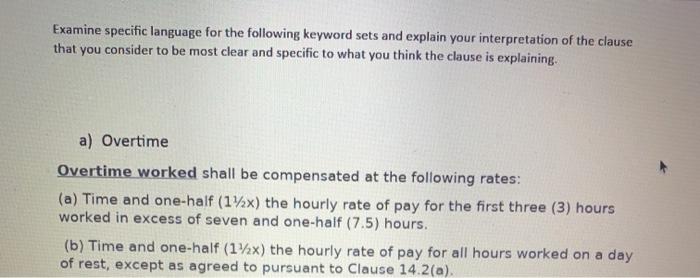
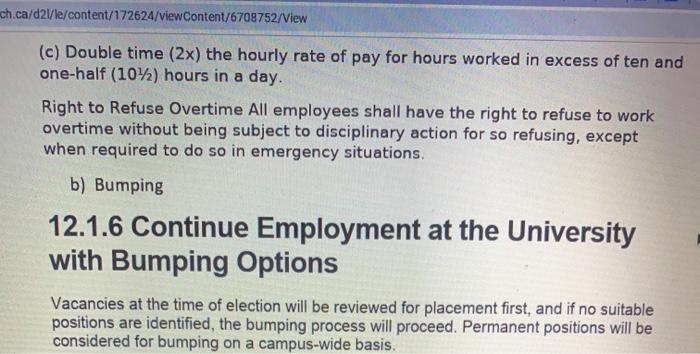
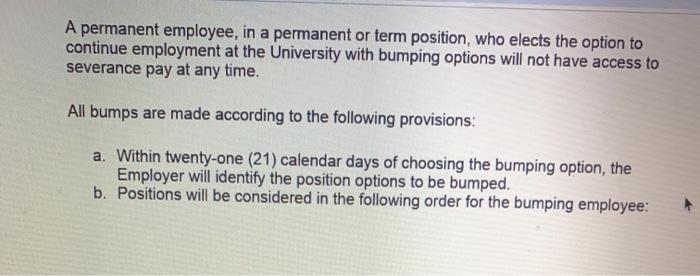
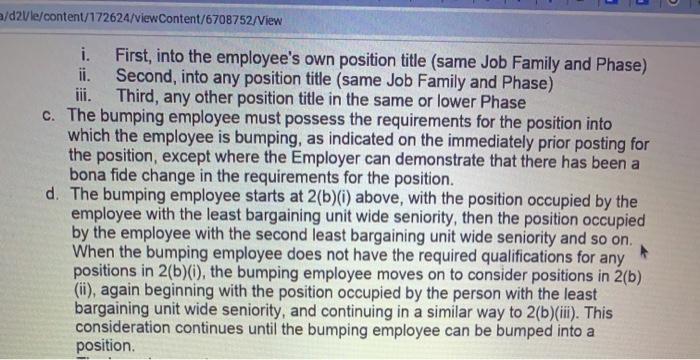
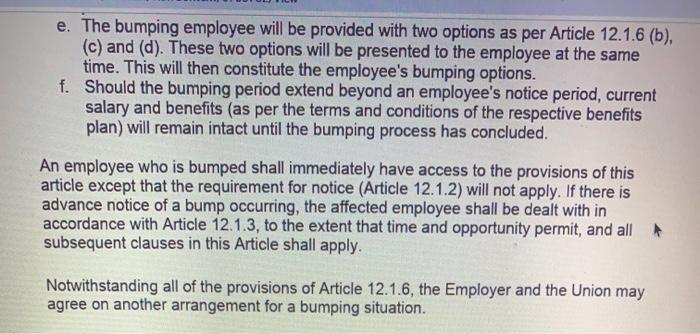
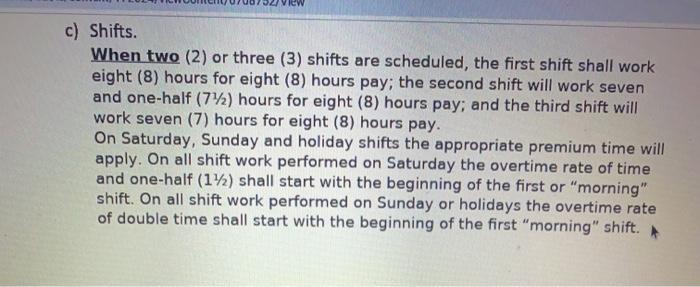
Examine specific language for the following keyword sets and explain your interpretation of the clause that you consider to be most clear and specific to what you think the clause is explaining. a) Overtime Overtime worked shall be compensated at the following rates: (a) Time and one-half (17x) the hourly rate of pay for the first three (3) hours worked in excess of seven and one-half (7.5) hours. (b) Time and one-half (1/2x) the hourly rate of pay for all hours worked on a day of rest, except as agreed to pursuant to Clause 14.2(a). ch.ca/d2\/le/content/172624/viewContent/6708752/View (c) Double time (2x) the hourly rate of pay for hours worked in excess of ten and one-half (1042) hours in a day. Right to Refuse Overtime All employees shall have the right to refuse to work overtime without being subject to disciplinary action for so refusing, except when required to do so in emergency situations. b) Bumping 12.1.6 Continue Employment at the University with Bumping Options Vacancies at the time of election will be reviewed for placement first, and if no suitable positions are identified, the bumping process will proceed. Permanent positions will be considered for bumping on a campus-wide basis. A permanent employee, in a permanent or term position, who elects the option to continue employment at the University with bumping options will not have access to severance pay at any time. All bumps are made according to the following provisions: a. Within twenty-one (21) calendar days of choosing the bumping option, the Employer will identify the position options to be bumped. b. Positions will be considered in the following order for the bumping employee: /d2Vle/content/172624/viewContent/6708752/View i. First, into the employee's own position title (same Job Family and Phase) ii. Second, into any position title (same Job Family and Phase) Third, any other position title in the same or lower Phase c. The bumping employee must possess the requirements for the position into which the employee is bumping, as indicated on the immediately prior posting for the position, except where the Employer can demonstrate that there has been a bona fide change in the requirements for the position. d. The bumping employee starts at 2(b)) above, with the position occupied by the employee with the least bargaining unit wide seniority, then the position occupied by the employee with the second least bargaining unit wide seniority and so on. When the bumping employee does not have the required qualifications for any positions in 2(b)), the bumping employee moves on to consider positions in 2(b) (ii), again beginning with the position occupied by the person with the least bargaining unit wide seniority, and continuing in a similar way to 2(b)(ii). This consideration continues until the bumping employee can be bumped into a position e. The bumping employee will be provided with two options as per Article 12.1.6 (b), (c) and (d). These two options will be presented to the employee at the same time. This will then constitute the employee's bumping options. f. Should the bumping period extend beyond an employee's notice period, current salary and benefits (as per the terms and conditions of the respective benefits plan) will remain intact until the bumping process has concluded. An employee who is bumped shall immediately have access to the provisions of this article except that the requirement for notice (Article 12.1.2) will not apply. If there is advance notice of a bump occurring, the affected employee shall be dealt with in accordance with Article 12.1.3, to the extent that time and opportunity permit, and all subsequent clauses in this Article shall apply. Notwithstanding all of the provisions of Article 12.1.6, the Employer and the Union may agree on another arrangement for a bumping situation. c) Shifts. When two (2) or three (3) shifts are scheduled, the first shift shall work eight (8) hours for eight (8) hours pay; the second shift will work seven and one-half (742) hours for eight (8) hours pay; and the third shift will work seven (7) hours for eight (8) hours pay. On Saturday, Sunday and holiday shifts the appropriate premium time will apply. On all shift work performed on Saturday the overtime rate of time and one-half (1%) shall start with the beginning of the first or "morning" shift. On all shift work performed on Sunday or holidays the overtime rate of double time shall start with the beginning of the first "morning" shift. A Examine specific language for the following keyword sets and explain your interpretation of the clause that you consider to be most clear and specific to what you think the clause is explaining. a) Overtime Overtime worked shall be compensated at the following rates: (a) Time and one-half (17x) the hourly rate of pay for the first three (3) hours worked in excess of seven and one-half (7.5) hours. (b) Time and one-half (1/2x) the hourly rate of pay for all hours worked on a day of rest, except as agreed to pursuant to Clause 14.2(a). ch.ca/d2\/le/content/172624/viewContent/6708752/View (c) Double time (2x) the hourly rate of pay for hours worked in excess of ten and one-half (1042) hours in a day. Right to Refuse Overtime All employees shall have the right to refuse to work overtime without being subject to disciplinary action for so refusing, except when required to do so in emergency situations. b) Bumping 12.1.6 Continue Employment at the University with Bumping Options Vacancies at the time of election will be reviewed for placement first, and if no suitable positions are identified, the bumping process will proceed. Permanent positions will be considered for bumping on a campus-wide basis. A permanent employee, in a permanent or term position, who elects the option to continue employment at the University with bumping options will not have access to severance pay at any time. All bumps are made according to the following provisions: a. Within twenty-one (21) calendar days of choosing the bumping option, the Employer will identify the position options to be bumped. b. Positions will be considered in the following order for the bumping employee: /d2Vle/content/172624/viewContent/6708752/View i. First, into the employee's own position title (same Job Family and Phase) ii. Second, into any position title (same Job Family and Phase) Third, any other position title in the same or lower Phase c. The bumping employee must possess the requirements for the position into which the employee is bumping, as indicated on the immediately prior posting for the position, except where the Employer can demonstrate that there has been a bona fide change in the requirements for the position. d. The bumping employee starts at 2(b)) above, with the position occupied by the employee with the least bargaining unit wide seniority, then the position occupied by the employee with the second least bargaining unit wide seniority and so on. When the bumping employee does not have the required qualifications for any positions in 2(b)), the bumping employee moves on to consider positions in 2(b) (ii), again beginning with the position occupied by the person with the least bargaining unit wide seniority, and continuing in a similar way to 2(b)(ii). This consideration continues until the bumping employee can be bumped into a position e. The bumping employee will be provided with two options as per Article 12.1.6 (b), (c) and (d). These two options will be presented to the employee at the same time. This will then constitute the employee's bumping options. f. Should the bumping period extend beyond an employee's notice period, current salary and benefits (as per the terms and conditions of the respective benefits plan) will remain intact until the bumping process has concluded. An employee who is bumped shall immediately have access to the provisions of this article except that the requirement for notice (Article 12.1.2) will not apply. If there is advance notice of a bump occurring, the affected employee shall be dealt with in accordance with Article 12.1.3, to the extent that time and opportunity permit, and all subsequent clauses in this Article shall apply. Notwithstanding all of the provisions of Article 12.1.6, the Employer and the Union may agree on another arrangement for a bumping situation. c) Shifts. When two (2) or three (3) shifts are scheduled, the first shift shall work eight (8) hours for eight (8) hours pay; the second shift will work seven and one-half (742) hours for eight (8) hours pay; and the third shift will work seven (7) hours for eight (8) hours pay. On Saturday, Sunday and holiday shifts the appropriate premium time will apply. On all shift work performed on Saturday the overtime rate of time and one-half (1%) shall start with the beginning of the first or "morning" shift. On all shift work performed on Sunday or holidays the overtime rate of double time shall start with the beginning of the first "morning" shift. A









 Study Help