





Question: Examine Table 8.3 below and describe ways it would also be relevant for 're-onboarding' TABLE 8.3 Design Elements Common to Effective Orientation. 1. Well-run orientation

Examine Table 8.3 below and describe ways it would also be relevant for 're-onboarding'
Examine Table 8.3 below and describe ways it

Examine Table 8.3 below and describe ways it

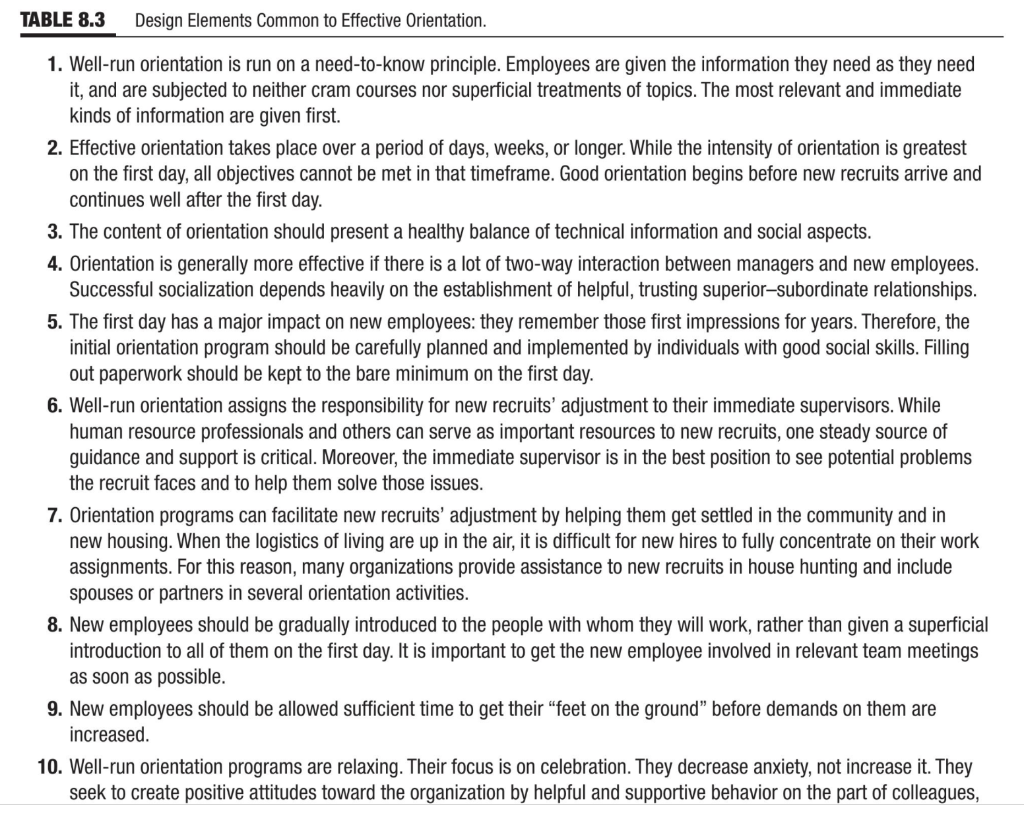
TABLE 8.3 Design Elements Common to Effective Orientation. 1. Well-run orientation is run on a need-to-know principle. Employees are given the information they need as they need it, and are subjected to neither cram courses nor superficial treatments of topics. The most relevant and immediate kinds of information are given first. 2. Effective orientation takes place over a period of days, weeks, or longer. While the intensity of orientation is greatest on the first day, all objectives cannot be met in that timeframe. Good orientation begins before new recruits arrive and continues well after the first day. 3. The content of orientation should present a healthy balance of technical information and social aspects. 4. Orientation is generally more effective if there is a lot of two-way interaction between managers and new employees. Successful socialization depends heavily on the establishment of helpful, trusting superior-subordinate relationships. 5. The first day has a major impact on new employees: they remember those first impressions for years. Therefore, the initial orientation program should be carefully planned and implemented by individuals with good social skills. Filling out paperwork should be kept to the bare minimum on the first day. 6. Well-run orientation assigns the responsibility for new recruits' adjustment to their immediate supervisors. While human resource professionals and others can serve as important resources to new recruits, one steady source of guidance and support is critical. Moreover, the immediate supervisor is in the best position to see potential problems the recruit faces and to help them solve those issues. 7. Orientation programs can facilitate new recruits' adjustment by helping them get settled in the community and in new housing. When the logistics of living are up in the air, it is difficult for new hires to fully concentrate on their work assignments. For this reason, many organizations provide assistance to new recruits in house hunting and include spouses or partners in several orientation activities. 8. New employees should be gradually introduced to the people with whom they will work, rather than given a superficial introduction to all of them on the first day. It is important to get the new employee involved in relevant team meetings as soon as possible. 9. New employees should be allowed sufficient time to get their "feet on the ground" before demands on them are increased. 10. Well-run orientation programs are relaxing. Their focus is on celebration. They decrease anxiety, not increase it. They seek to create positive attitudes toward the organization by helpful and supportive behavior on the part of colleagues, 11. Organizations should systematically diagnose the needs of new recruits and evaluate the effectiveness of their orientation programs. New topics and issues can be added to orientation when needed, and peripheral parts of the orientation can be pruned

Step by Step Solution

There are 3 Steps involved in it

1 Expert Approved Answer
Step: 1 Unlock blur-text-image

Question Has Been Solved by an Expert!

Get step-by-step solutions from verified subject matter experts

Step: 2 Unlock
Step: 3 Unlock

Students Have Also Explored These Related General Management Questions!
