







Question: EXAMPLE 7.1 (Calculation of bubble point, dew point and equilibrium data for an ideal binary mixture) Cyclo-pentane( A) and benzene (B) form nearly ideal solutions.
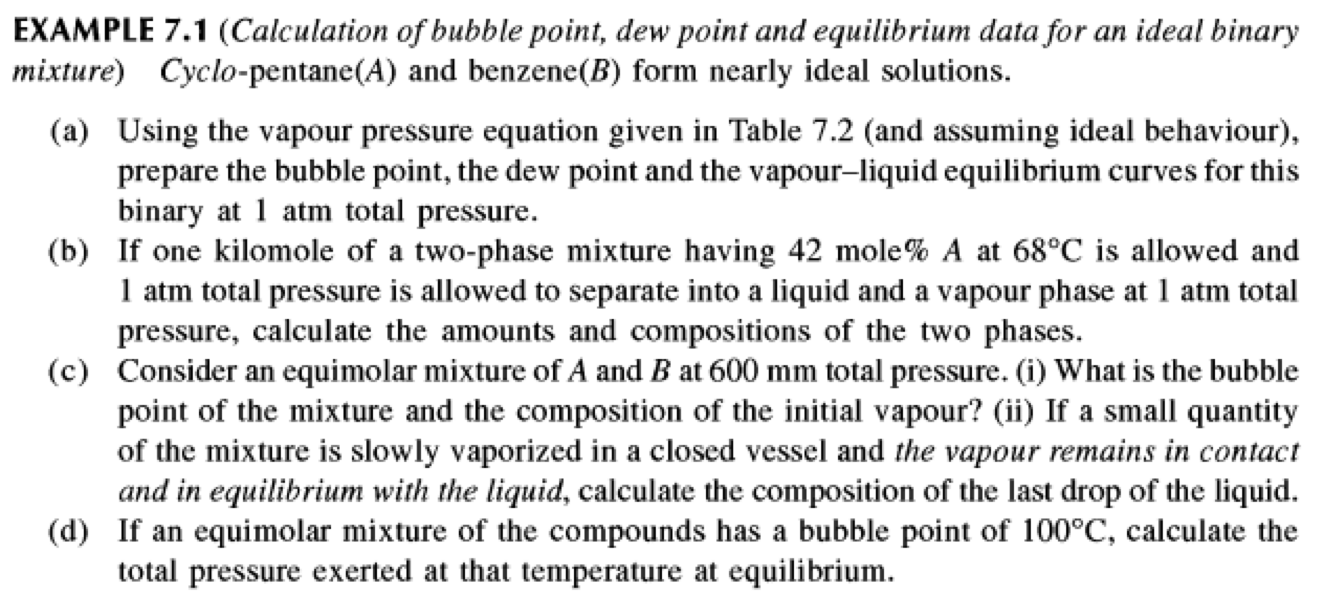
EXAMPLE 7.1 (Calculation of bubble point, dew point and equilibrium data for an ideal binary mixture) Cyclo-pentane( A) and benzene (B) form nearly ideal solutions. (a) Using the vapour pressure equation given in Table 7.2 (and assuming ideal behaviour), prepare the bubble point, the dew point and the vapour-liquid equilibrium curves for this binary at 1atm total pressure. (b) If one kilomole of a two-phase mixture having 42mole%A at 68C is allowed and 1atm total pressure is allowed to separate into a liquid and a vapour phase at 1atm total pressure, calculate the amounts and compositions of the two phases. (c) Consider an equimolar mixture of A and B at 600mm total pressure. (i) What is the bubble point of the mixture and the composition of the initial vapour? (ii) If a small quantity of the mixture is slowly vaporized in a closed vessel and the vapour remains in contact and in equilibrium with the liquid, calculate the composition of the last drop of the liquid. (d) If an equimolar mixture of the compounds has a bubble point of 100C, calculate the total pressure exerted at that temperature at equilibrium. EXAMPLE 7.1 (Calculation of bubble point, dew point and equilibrium data for an ideal binary mixture) Cyclo-pentane( A) and benzene (B) form nearly ideal solutions. (a) Using the vapour pressure equation given in Table 7.2 (and assuming ideal behaviour), prepare the bubble point, the dew point and the vapour-liquid equilibrium curves for this binary at 1atm total pressure. (b) If one kilomole of a two-phase mixture having 42mole%A at 68C is allowed and 1atm total pressure is allowed to separate into a liquid and a vapour phase at 1atm total pressure, calculate the amounts and compositions of the two phases. (c) Consider an equimolar mixture of A and B at 600mm total pressure. (i) What is the bubble point of the mixture and the composition of the initial vapour? (ii) If a small quantity of the mixture is slowly vaporized in a closed vessel and the vapour remains in contact and in equilibrium with the liquid, calculate the composition of the last drop of the liquid. (d) If an equimolar mixture of the compounds has a bubble point of 100C, calculate the total pressure exerted at that temperature at equilibrium
Step by Step Solution
There are 3 Steps involved in it

Get step-by-step solutions from verified subject matter experts
 Study Help