







Question: Exercise 1. As shown in Fig. 1, the server and the peers are connected to the Internet with access links based on the client-server (CS)
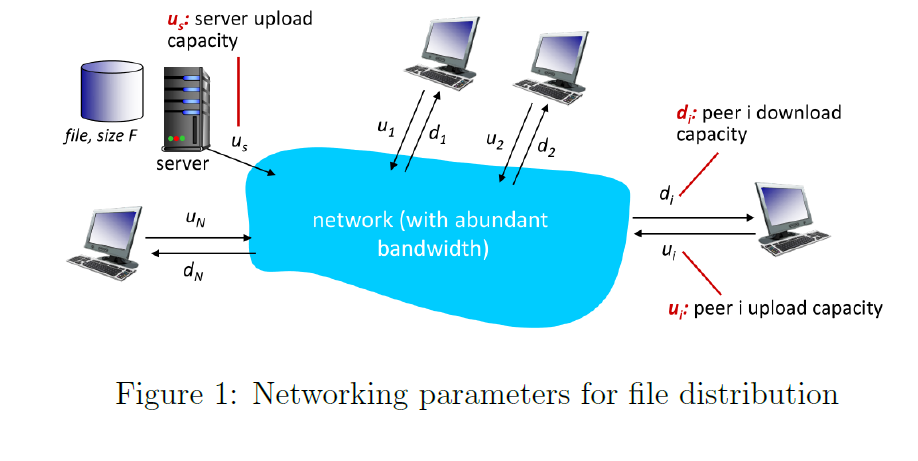
Exercise 1. As shown in Fig. 1, the server and the peers are connected to the Internet with access links based on the client-server (CS) or peer-to-peer (P2P) architectures. We define as the distribution time (D), the time it takes to get a copy of the file to all N peers via the Internet core network. For both CS and P2P architectures, we assume that the Internet core has abundant bandwidth. Given the following networking characteristics:
- F = 10 Gbits, file size
- us = 20 Mbps, server's upload capacity
- di = 10 Mbps, peer's download capacity
- ui = 1 Mbps, peer's upload capacity
(a) Calculate the minimum (lower bound) time needed for distributing a file using the CS and P2P architectures; see the formula and examples in the discussion slides.
(b) Calculate and show graphically the minimum times for distributing the le using the CS and P2P architectures as a function of N peers, such that N = 10, 25, 50, 75, 150, 200, 250 and 500. In addition, briefly compare the two architectures based on the resulting graph. Finally, perform the above calculations and create new graphs for ui = 2 Mbps and ui = 5 Mbps.
us: server upload capacity file, size F u1 d;: peer i download capacity (d, us U2 Id2 server d; UN network (with abundant bandwidth) U; dN u; peer i upload capacity Figure 1: Networking parameters for file distribution
Step by Step Solution
There are 3 Steps involved in it

Get step-by-step solutions from verified subject matter experts
 Study Help