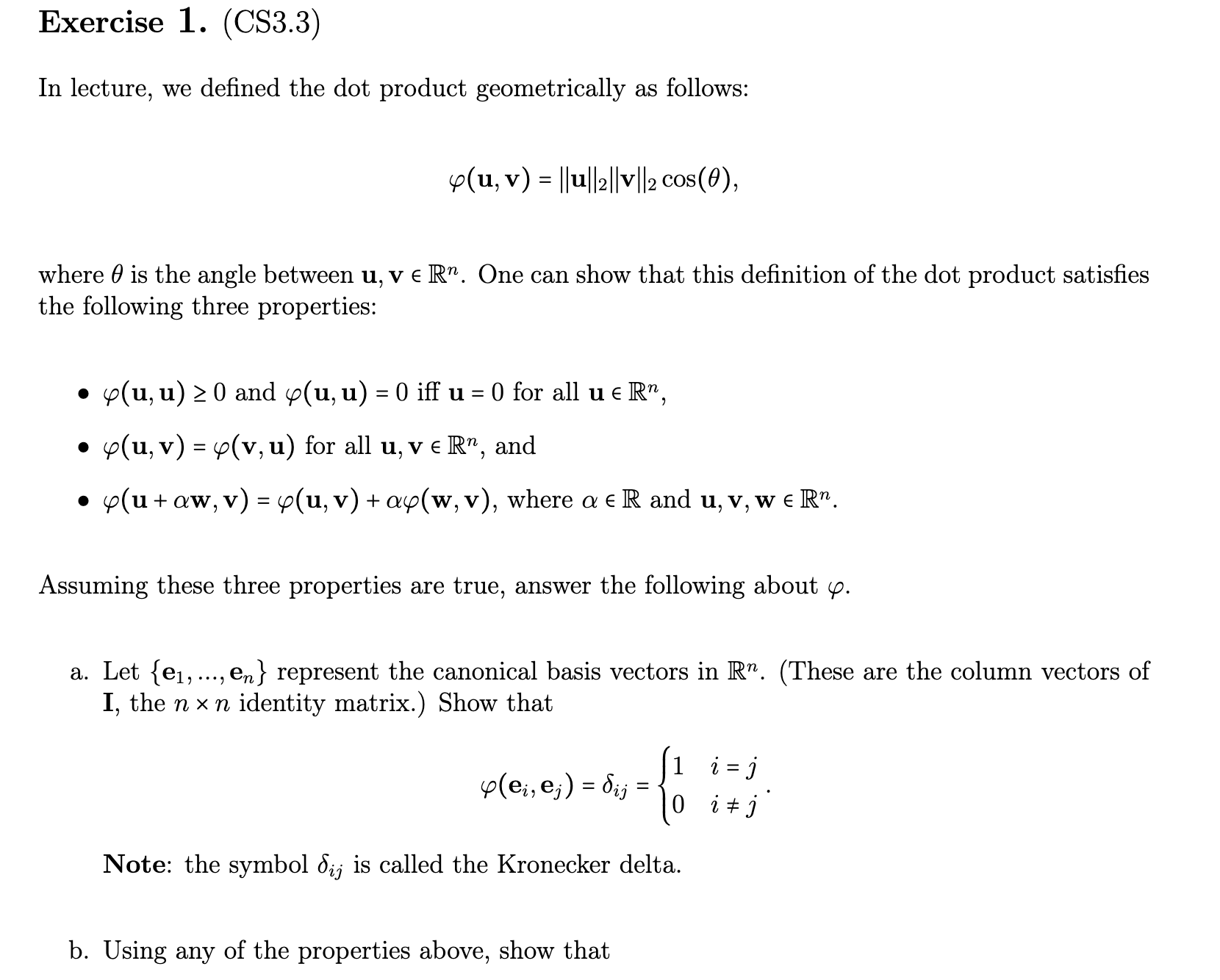
Question: Exercise 1. (CS3.3) In lecture, we defined the dot product geometrically as follows: p(u, v) = |lul|2|/v//2 cos(0), where 0 is the angle between u,
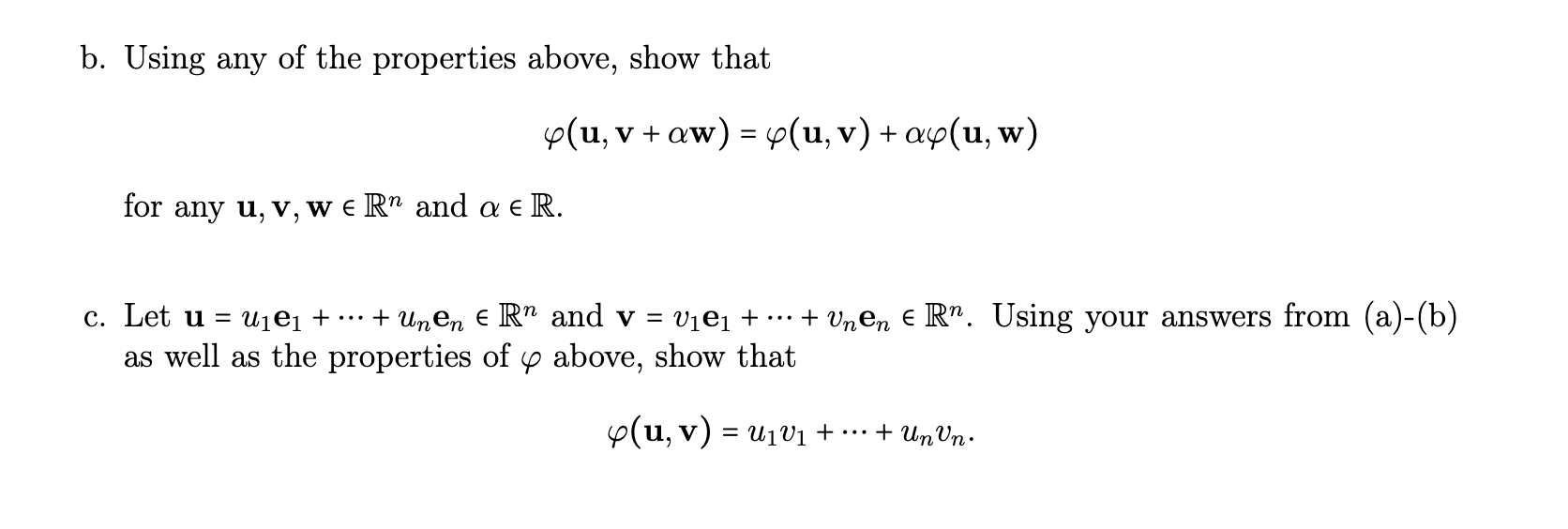
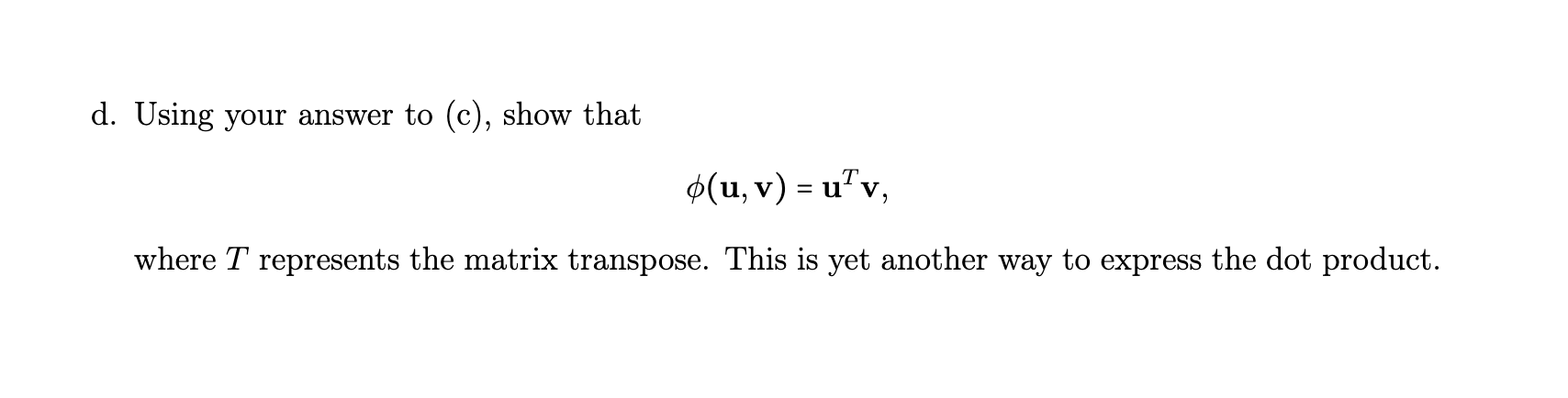
Exercise 1. (CS3.3) In lecture, we defined the dot product geometrically as follows: p(u, v) = |lul|2|/v//2 cos(0), where 0 is the angle between u, ve R". One can show that this definition of the dot product satisfies the following three properties: . (u, u) 2 0 and p(u, u) = 0 iff u = 0 for all u e Rn, . p(u, v) = 4(v, u) for all u, v e Rn, and . p( u t aw, v) = 4(u, v) + ap(w, v), where a E R and u, v, w E Rn. Assuming these three properties are true, answer the following about p. a. Let {el, ..., en} represent the canonical basis vectors in Rn. (These are the column vectors of I, the n x n identity matrix.) Show that 1 i= j p(ei, e;) = bij = o iti Note: the symbol bij is called the Kronecker delta. b. Using any of the properties above, show thatb. Using any of the properties above, show that 90(11, v + 0W) = 90(11, V) + (Mu, W) for any u,v,w e R\" and 0: E R. C. Let u = ulel + + awen E R" and v = U191 + + one\" 6 R\". Using your answers from (a)(b) as well as the properties of gm above, show that 90(11, v) = 11,1111 + + uni)\". (:1. Using your answer to (0), show that 4501: V) = \"TV, where T represents the matrix transpose. This is yet another way to express the dot product
Step by Step Solution
There are 3 Steps involved in it
1 Expert Approved Answer
Step: 1 Unlock
Question Has Been Solved by an Expert!
Get step-by-step solutions from verified subject matter experts
Step: 2 Unlock
Step: 3 Unlock
Students Have Also Explored These Related Mathematics Questions!









 Study Help