







Question: Exercise 1: Horizontal Differentiation Consider a two firm differentiated product erwirorunent where firms choose their price but not their product type. The product is differentiated
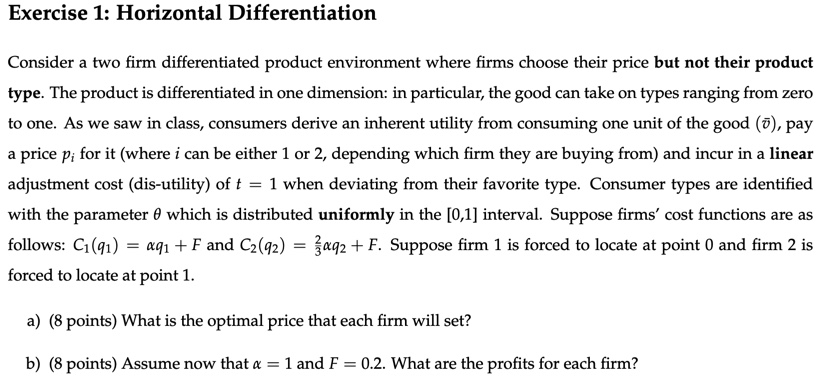
Exercise 1: Horizontal Differentiation Consider a two firm differentiated product erwirorunent where firms choose their price but not their product type. The product is differentiated in one dimension: in particular, the good can take on types ranging from zero to one. As we saw in class, consumers derive an inherent utility from consuming one unit of the good {1'1}, pa}r a price p,- for it (where i can be either 1 or 2, depending which rm the").r are buying from) and incur in a linear adjustment cost {dis-utility) of t = 1 when deviating from their favorite type. Consumer types are identied with the parameter 5' which is distributed uniformly in the [[1,1] interval. Suppose firms' cost functions are as follows: lel} = non + .F and Cqg] = gag; + 1-". Suppose rm 1 is forced to locate at point [I and firm 2 is forced to 10cate at point 1. a) [3 points} What is the optimal price that each firm will set? b) [8 points} Assume now that at = 1 and F = 0.2. What are the prots for each firm
Step by Step Solution
There are 3 Steps involved in it

Get step-by-step solutions from verified subject matter experts
 Study Help