







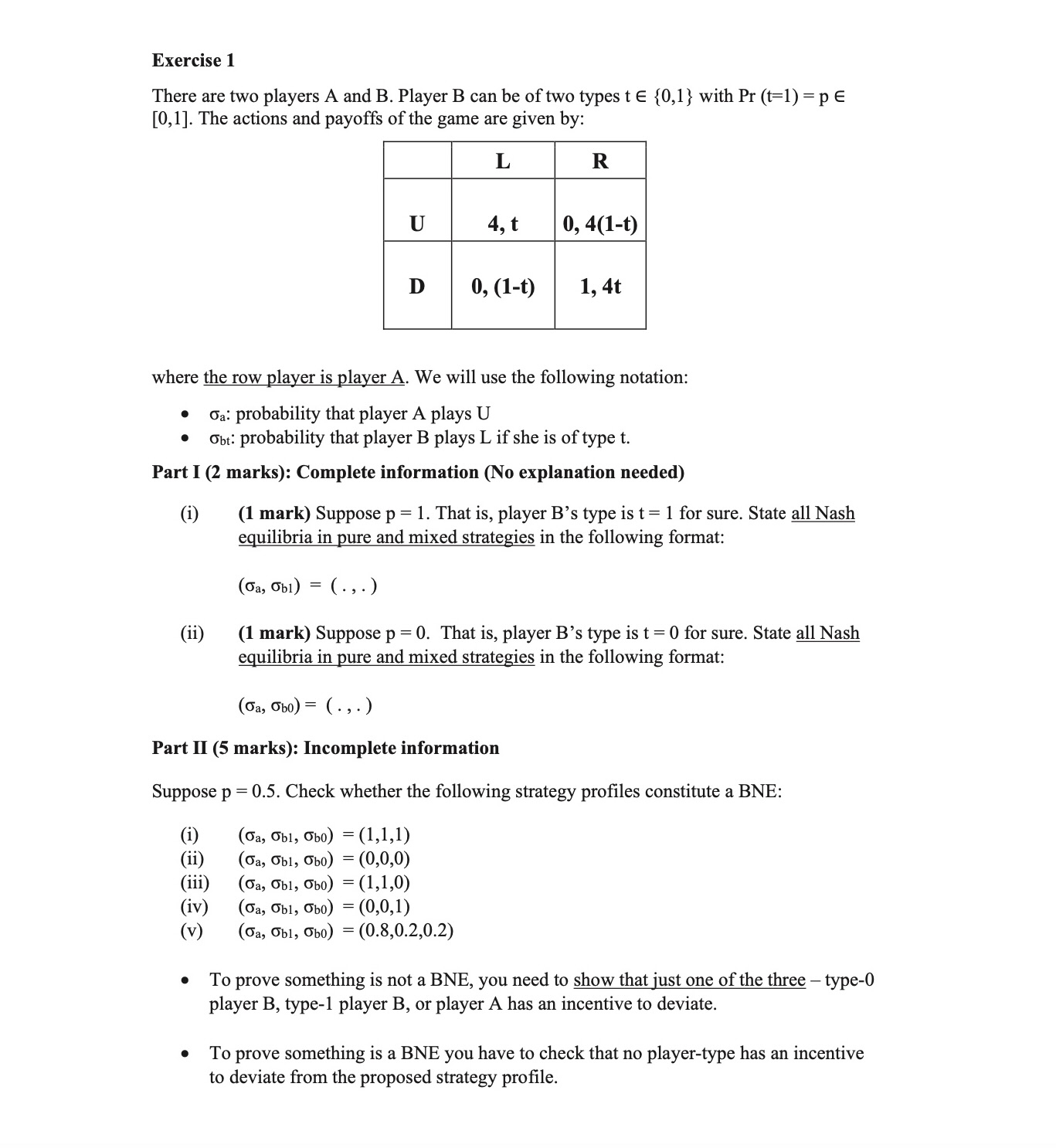
Question: Exercise 1 There are two players A and B. Player B can be of two types t {0,1} with Pr (t=1)=p [0,1]. The actions and
![can be of two types t {0,1} with Pr (t=1)=p [0,1]. The](https://s3.amazonaws.com/si.experts.images/answers/2024/06/6674e095e784a_7016674e095c111f.jpg)
Exercise 1 There are two players A and B. Player B can be of two types t {0,1} with Pr (t=1)=p [0,1]. The actions and payoffs of the game are given by: L R n 0, 401-0) where the row plaver is player A. We will use the following notation: e o, probability that player A plays U e o probability that player B plays L if she is of type t. Part I (2 marks): Complete information (No explanation needed) (6] (1 mark) Suppose p = 1. That is, player B's type is t = 1 for sure. State all Nash equilibria in pure and mixed strategies in the following format: (0'3,0]31) B (') (ii) (1 mark) Suppose p =0. That is, player B's type is t = 0 for sure. State all Nash equilibria in pure and mixed strategies in the following format: (0-3'0170): (a) Part IT (5 marks): Incomplete information Suppose p = 0.5. Check whether the following strategy profiles constitute a BNE: @i (o4, ob1, 000) = (1,1,1) (ii) (o, b1, 6b0) = (0,0,0) (iii) (oa, Ob1, Gb0) = (1,1,0) (iv) (a, o1, ob0) = (0,0,1) (v) (0a, o1, Gb0) =(0.8,0.2,0.2) To prove something is not a BNE, you need to show that just one of the three type-0 player B, type-1 player B, or player A has an incentive to deviate. e To prove something is a BNE you have to check that no player-type has an incentive to deviate from the proposed strategy profile
Step by Step Solution
There are 3 Steps involved in it

Get step-by-step solutions from verified subject matter experts
 Study Help